Factorio

1554 readers
4 users here now

A Lemmy community for the game Factorio made by Wube Software.

Rules

founded 2 years ago
MODERATORS
1
2


After MANY hours of single-player playthroughs, I decided to join one of the public multiplayer games. It was a bit crowded and overwhelming (but very cool – so much creative engineering in there 🙂), and I had no idea how to jump in and contribute.

I almost never play any multiplayer games, so this might be a dumb question, but... How does this usually go?

3


...and tanked a hit from the first cargo wagon.

4


The story of Factorio is wild. Two Czech programmers quit their jobs, pooled their savings for one year of living expenses, and bet everything on a factory b...

5
6
7
32
submitted 1 month ago* (last edited 1 month ago) by artiman@piefed.social to c/factorio@lemmy.world
8


I had one previous space-age run that stopped a bit into Gelba. If im honest I really didn't care for the spoilage mechanics. Finally getting to the point in current run that planet explorations on the horizon. Want to try something different. Please recommend me a good planet to try next without spoilers (or spoilage).

9
10
11
12
13


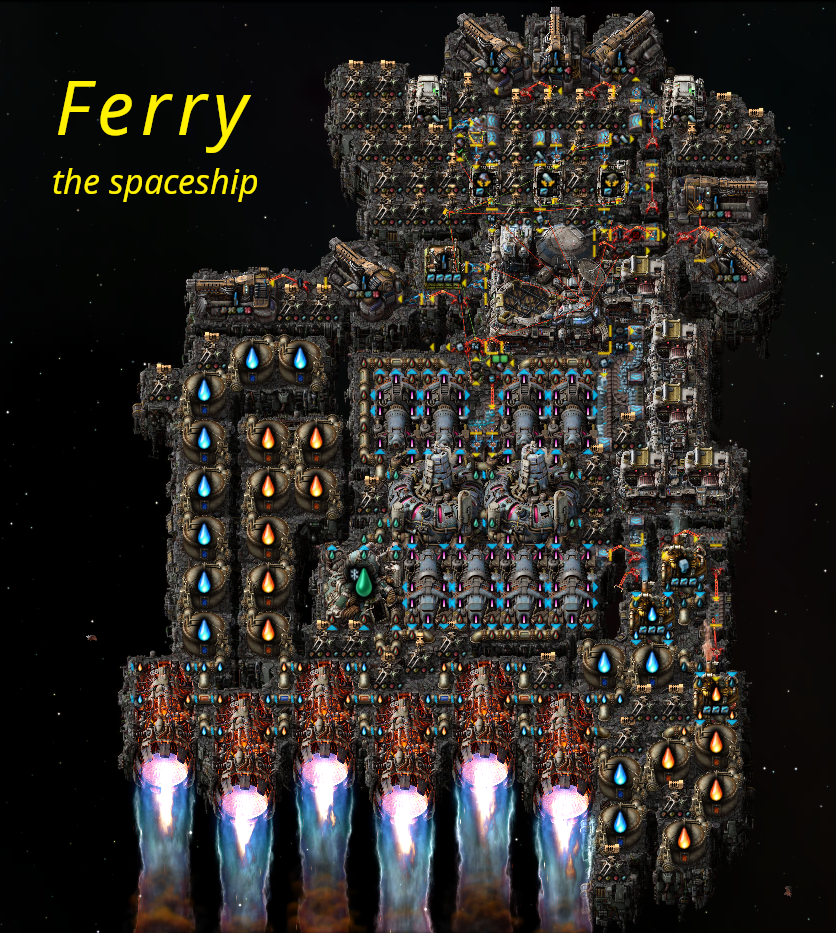
Meet Ferry the Spaceship.

When you need a quick one-off delivery, Ferry is your chauffeur. We hired him because there is no traffic or possibility of collisions in space. This makes him excellently suited for the job: fast, reliable, and no driver's license required.

When this boat floors it, the first 100 km/s out of a planetary orbit are reached in less than a second. My trusty qalculater tells me that

> 100km/s /1s to gees
 (100 kilometers/second) / (1 second) ≈ 10197.2 gees

Being used to tens or perhaps hundreds of gs at most, I thought my calculation had gone wrong, but no: with one earth g at ~9.8m/s², these 100km/s² aren't a mere ten of those, there is an extra kilo of them.

Ten thousand earth gravities. Fancy that pulling on your buttocks! Ferry's leap into interplanetary space is, however, no unparalleled feat. Desiring to put this number into context, my deep dive research (i.e., opening Wikipedia) landed me at this comparison table. Coming in at 10'400 g, a Mantis Shrimp's claw during predatory strike accelerates as fast as Ferry's six rocket engines.

The next entry of the table is also of Factorial relevance: the electronics in military artillery shells is rated up to 15'500 g. I am glad I haven't pushed a little harder! Poor Ferry, his electronics broken, völlig losgelöst

I hope this fun fact made your day just a little better :)

14


I had to turn on peaceful mode from the console because it felt exhausting and not fun anymore. Didn't finish just yet, I'm trying to build my first moveable spaceship

Edit: I for some reason had the impression it can be done in a week or two, but months seems reasonable to me haha (especially if you've got to work irl)

15
84
submitted 2 months ago* (last edited 2 months ago) by remotelove@lemmy.ca to c/factorio@lemmy.world


I stumbled on this stupid-simple build that will kick out extra U-235 with splitter priorities instead of using chests and circuit counters.

It takes a bit for it to "settle in" and may kick out some U-238 during startup. Probably not an ideal build for early game as it takes quite a bit of uranium to get belt "back pressure" correct.

16


(Though it becomes increasingly disconcerting, from a paramedic’s point of view.)

17


This is a noob question, hope you don't mind.

Should construction bots from roboport buildings use items in my inventory to build? They're not, but maybe I am doing something wrong?

I'm wearing a powered personal roboport and am standing inside the orange area of the roboport building, yet only my 10 personal bots are working. As soon as I put some of my inventory into a yellow chest, the "outside" bots start using items from the chest to help.

Constructing big blueprints kind of takes ages this way, having to switch my inventory over fixes it but is annoying. I thought all bots should consider me part of the network, so they should use my inventory.

18


Every vanilla playthrough of mine follows a rough progression: get to blue science with spaghetti, organize a bit, and then get bots all with my initial ore deposits (maybe a few trains to the closest other ones if needed). After that, I build a larger, more organized base with a comprehensive train network from scratch in another location and then work to finish the game.

I assumed this was the norm---or close to it---but I've seen people just progressively expand their initial base at spawn until they beat the game. I feel like I could do it differently just because I have less experience and hence less foresight into what I'll need as I go, but I'm not sure.

What do you guys do? How come?

19
20


...and am I a pussy for maxing out richness and turning off bugs?

21
22
23


The Factoriopedia lists one "/m" rate for each asteroid type at a given position on a space route, but you clearly have to kill more asteroids as you go faster so it cannot be "per minute" (Factorio uses /m to mean per minute elsewhere in the game). However, it cannot mean metre either because you travel at many kilometres per second: you'd get thousands of asteroids per second per type! Searching through the forums, Lemmy, and reddit, I didn't find an answer to this conundrum of space versus time

I've now gotten around to figuring out how the spawn rate varies :)

Method

  1. Let the ship fly at the indicated speed (V) for 10 minutes (plus margin, because the asteroids need a bit of time to move from spawn to the ship) between Solar System Edge and Shattered Planet
  2. Open the production stats window, set to 10 minutes, select the kills tab, and take a screenshot so that we can work with nonmoving values
  3. Calculate the ship's average position, namely: position at time of screenshot minus (5 minutes × V km/s)
  4. Look up the expected spawn rate at that position by linearly interpolating between the nearest values in the Factoriopedia (they are precise to 40 km, so we know the value at 0km, ..., 960km, 1000km, 1040km, etc.)
  5. Calculate the ratio between how many huge asteroids were killed per minute (per the kills graph) and how many huge asteroids should have spawned
  6. Plot that value on the graph as a percentage

Results

There seem to be two or three formulas in use: one for 10km/s and below (it appears as though this is in effect when your ship touches 10.xx km/s every few seconds, but that seems strange), one for a rapid but smooth transition (or maybe they blend the two other formulas together?), and then one for speeds above 15 km/s. The middle formula may also just be a blend of the other two, perhaps they average the result between 10 and 15 km/s (or apply a sigmoid or whatnot)

  • The formula for slow speeds seems to spawn 1.1x (or 10%) more asteroids as the speed doubles from 5 to 10 km/s (not many data points in this range; value is very approximate)

  • The formula for high speeds spawns about 1.5–1.7x more asteroids when you go 2x faster

The Factoriopedia value isn't distance-based (one could think "/m" is a shorthand for "/10km" or so), because then it would have been 1:1 linear: when you cover twice as much distance per unit of time, the number of kills would double. It also isn't time-based, because then the graph should have shown a flat line at 100%. It appears to be a derivative of your ship's speed (and perhaps other factors, such as its width)

Sorry for the sparse data above 50 km/s btw. I had spent a bunch of time and already pretty much gotten the answer when I realised that I could go back to an earlier save and do the same thing for an easier section of the route where the ship can safely fly faster. I collected just these two data points and, when that also looked close enough to linear, called it "good enough" =)

Discussion/limitations

  1. I wonder if the Factorio developers made Promethium much more common if you fly slow, to make it easier to collect for players that didn't build a great ship

  2. Not all asteroids that spawn get killed, so the graph must be wrong in absolute terms, i.e., the actual spawn rate is higher than what I calculate using the "killed" statistic. My railguns' range about covers as far as the huge asteroids spawn out and I see that only a few on the edges (faded out, only visible when hovering over them) make it down the length of the ship, so the absolute number is probably not super far off. In any case, my personal goal was to figure out the relative number, not the absolute one

  3. Yes, I know these speeds are rookie numbers compared to some of the things I see online. But it's all my own work :). I purposefully don't look at other designs in detail because the satisfaction of figuring it out is the point of the game for me. The "not invented here" syndrome is a problem for my workplace, not my gaming experience :D

Future work

A. I'm also curious how platform width affects the rates, but did not have time to design another ship for trying that out

B. Check that the results are identical on other routes

C. Check how it behaves at and below zero speed

Supplementary material

The Factoriopedia does not show the total spawn rate and so it's hard to see what the difficulty is of each segment towards Shattered Planet. I've added a few data points to what I needed for the above calculation anyway and now we have the answer to that as well:

Basically a copy of the Factoriopedia graph, but with two lines added: the sum of the four values (sharp increase until 674 at 1.6Mm, then roughly flat (if you plot it on a log scale with a fat marker) until 3Mm, and finally it increases until 795 at 3.96Mm), and the sum of the three base asteroid types, that is, excluding Promethium (peaks at 1.6Mm, just shy of 400)

Spreadsheet with raw data for your enjoyment: https://lucgommans.nl/p/factorio/space-age-asteroid-spawn-rate-factoriov2.0.48.ods

Feel free to share the graphs or infos around, consider it CC-BY-SA or a similar flavor if you like ^^

24
23
Version 2.0.63 (forums.factorio.com)
submitted 4 months ago by notes@piefed.social to c/factorio@lemmy.world
25
view more: next ›