We have a realistic minimum wage, but not everything that needs doing generates enough income to pay it. Taking care of your elderly mother as the simplest example but also firefighting apparently. It regularly blows my mind how much is done by volunteers. We could do so much more if you knew life's basics were going to be covered regardless of how you help society
lucg
joined 9 months ago
no
I would vote for it, because it seems nice and I don't see myself sitting still regardless, just that I'd choose more fulfilling / societally beneficial work if there weren't this idea of needing to provide and work with market forces. But then it came up with my cousin and she said she'd do fuck all, travel, spend time horse riding or whatnot, anything but work because why bother. Less anecdotal studies show cautiously positive results (or exceedingly positive in misleading headlines until you open the study and find two sides to the coin), but afaik have so far been very limited in both scale and duration. So idk but it seems at least worth a real try. Do we always need to have strong opinions?
Well that escalated quickly
Wie de fuck is tnl?
- shelf-stable spinach
- quiet and splash-free porous asphalt
- as well as non-car infrastructure
- not needing to book a train 4 months ahead to get a fair price. I didn't even know it was abnormal that I could show up to any station, tap my card, and board any train that goes to my destination
Besides the ones already mentioned: Threema
The laptop was plugged in right? As in, not induced currents
My partner and I often collaborate on Lexica (basically Boggle but you can choose some game modes) while waiting for food in a restaurant. Sometimes also Lichess of late
Simon Tatham's puzzle game collection is already mentioned in the thread. I can only recommend it again
"Slay" is a paid little puzzle game that's a lot of fun (iirc like 5€ one time up front via Google Play). Very intuitive but I've not seen the concept before. The author made a bunch of small fun Windows games and ported this particular one to Android (maybe also available on the dark side, who knows). With a honorable mention of Antiyoy (expanding upon the concept) that you can also find there, the open source implementation is called Feudal Tactics
Missing the latest addition to the OSI model: AI!
Layer 8 (sender): turning a few keywords into a well-formed text
Layer 8 (receiver): summarising text back into its short form
Saying this gift is awesome sounds like a straight-up lie, given what OP wrote about their true feeling
Weasel wording around it, like acknowledging their thoughtfulness (as you say with "appreciate that you noticed how much I use it" without mentioning the gift's downsides) seems like a really good option and I'd leave it at that, leaving options open to later discuss what to do with the instance of this object that has sentimental value attached. Hearing that question/thought (later, when not in the middle of a gift-giving ritual), the partner presumably realises the error without needing to be told and can warm up to the idea that this new one might not be what OP would prefer to keep
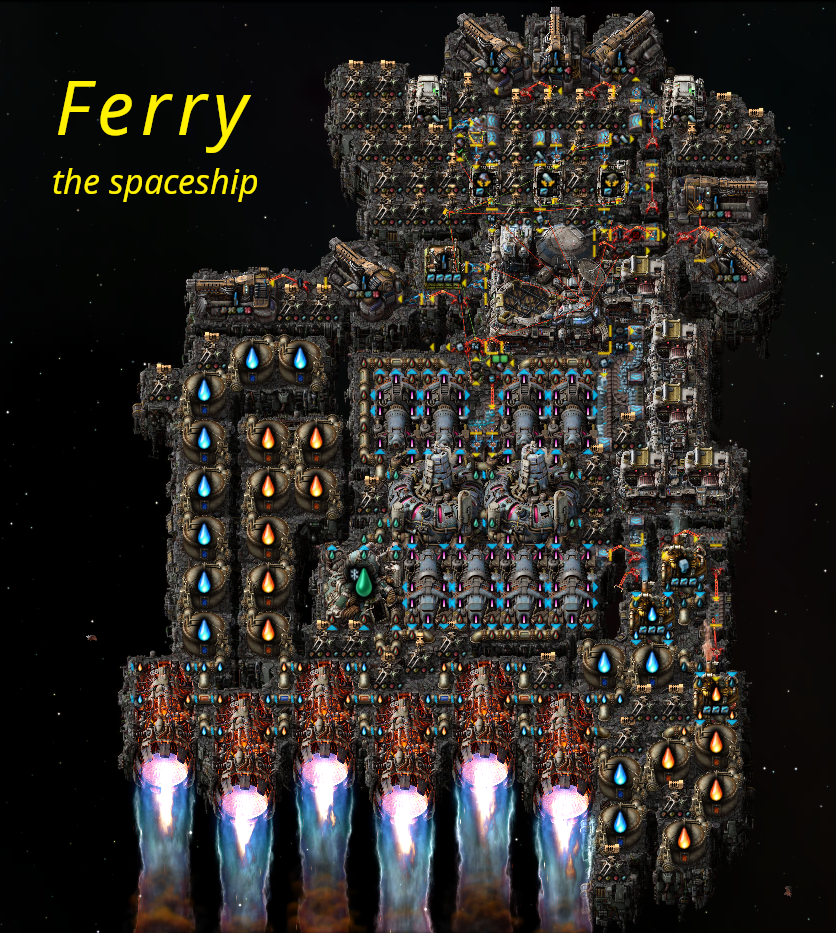

The Factoriopedia lists one "/m" rate for each asteroid type at a given position on a space route, but you clearly have to kill more asteroids as you go faster so it cannot be "per minute" (Factorio uses /m to mean per minute elsewhere in the game). However, it cannot mean metre either because you travel at many kilometres per second: you'd get thousands of asteroids per second per type! Searching through the forums, Lemmy, and reddit, I didn't find an answer to this conundrum of space versus time
I've now gotten around to figuring out how the spawn rate varies :)
Method
- Let the ship fly at the indicated speed (V) for 10 minutes (plus margin, because the asteroids need a bit of time to move from spawn to the ship) between Solar System Edge and Shattered Planet
- Open the production stats window, set to 10 minutes, select the kills tab, and take a screenshot so that we can work with nonmoving values
- Calculate the ship's average position, namely: position at time of screenshot minus (5 minutes × V km/s)
- Look up the expected spawn rate at that position by linearly interpolating between the nearest values in the Factoriopedia (they are precise to 40 km, so we know the value at 0km, ..., 960km, 1000km, 1040km, etc.)
- Calculate the ratio between how many huge asteroids were killed per minute (per the kills graph) and how many huge asteroids should have spawned
- Plot that value on the graph as a percentage
Results
There seem to be two or three formulas in use: one for 10km/s and below (it appears as though this is in effect when your ship touches 10.xx km/s every few seconds, but that seems strange), one for a rapid but smooth transition (or maybe they blend the two other formulas together?), and then one for speeds above 15 km/s. The middle formula may also just be a blend of the other two, perhaps they average the result between 10 and 15 km/s (or apply a sigmoid or whatnot)
-
The formula for slow speeds seems to spawn 1.1x (or 10%) more asteroids as the speed doubles from 5 to 10 km/s (not many data points in this range; value is very approximate)
-
The formula for high speeds spawns about 1.5–1.7x more asteroids when you go 2x faster
The Factoriopedia value isn't distance-based (one could think "/m" is a shorthand for "/10km" or so), because then it would have been 1:1 linear: when you cover twice as much distance per unit of time, the number of kills would double. It also isn't time-based, because then the graph should have shown a flat line at 100%. It appears to be a derivative of your ship's speed (and perhaps other factors, such as its width)
Sorry for the sparse data above 50 km/s btw. I had spent a bunch of time and already pretty much gotten the answer when I realised that I could go back to an earlier save and do the same thing for an easier section of the route where the ship can safely fly faster. I collected just these two data points and, when that also looked close enough to linear, called it "good enough" =)
Discussion/limitations
-
I wonder if the Factorio developers made Promethium much more common if you fly slow, to make it easier to collect for players that didn't build a great ship
-
Not all asteroids that spawn get killed, so the graph must be wrong in absolute terms, i.e., the actual spawn rate is higher than what I calculate using the "killed" statistic. My railguns' range about covers as far as the huge asteroids spawn out and I see that only a few on the edges (faded out, only visible when hovering over them) make it down the length of the ship, so the absolute number is probably not super far off. In any case, my personal goal was to figure out the relative number, not the absolute one
-
Yes, I know these speeds are rookie numbers compared to some of the things I see online. But it's all my own work :). I purposefully don't look at other designs in detail because the satisfaction of figuring it out is the point of the game for me. The "not invented here" syndrome is a problem for my workplace, not my gaming experience :D
Future work
A. I'm also curious how platform width affects the rates, but did not have time to design another ship for trying that out
B. Check that the results are identical on other routes
C. Check how it behaves at and below zero speed
Supplementary material
The Factoriopedia does not show the total spawn rate and so it's hard to see what the difficulty is of each segment towards Shattered Planet. I've added a few data points to what I needed for the above calculation anyway and now we have the answer to that as well:

Spreadsheet with raw data for your enjoyment: https://lucgommans.nl/p/factorio/space-age-asteroid-spawn-rate-factoriov2.0.48.ods
Feel free to share the graphs or infos around, consider it CC-BY-SA or a similar flavor if you like ^^
view more: next ›
I coincidentally heard something about that today. Sadly in German but according to https://www.youtube.com/watch?v=CGE8jzGZ7To
80% of people said they would continue working
80% of people thought others would not
We seem to expect worse of others than of ourselves. Even if it turns out to be that 40% ends up stopping to do anything remotely useful, it's at least worth trying and finding out what works and what doesn't imo. Having the right to choose how to live your life freely seems like an enormous benefit that a minority needn't ruin