26
27
Anas Zayed Fteiha, a Palestinian photojournalist in the Gaza Strip, filed a legal claim seeking an injunction against global publishing giant Axel Springer, which he accuses of violating his constitutional rights by falsely portraying him as a Hamas propagandist in Germany’s largest tabloid, BILD.
The filing against a European news organization is a first-of-its-kind legal strategy for a journalist working in Palestine. “I want to prove the truth cannot be erased by false allegations,” Fteiha told The Intercept.
Fteiha’s legal claim, submitted in the Frankfurt am Main Regional Court, stems from a BILD article published on August 5 under the headline “This Gaza photographer stages Hamas propaganda.”
The BILD piece singled out Fteiha, alleging he fabricated images of starving Palestinians to push a Hamas narrative. To underscore this charge, BILD published a picture showing Fteiha kneeling to photograph people in Gaza holding empty pots in front of a metal barrier. BILD framed the scene as an attempt to exaggerate the levels of hunger in Gaza. Later in August, a United Nations-backed body declared a famine in Gaza.
The article claims Fteiha staged the photo and describes him as a “journalist” three times, always in quotation marks.
“In fact it was a genuine moment of human suffering,” Fteiha told The Intercept.
“I could be targeted simply because false reports about me were published.”
Fteiha was at the food distribution site as a freelancer for the Turkish news agency Anadolu and published a range of photographs online from that day. To Fteiha, BILD’s reporting is part of a campaign to discredit Palestinian journalists, he told The Intercept.
“Falsely accusing me of staging propaganda exposes me to threats and undermines the supposed protections afforded to journalists,” he said. “It means I could be targeted simply because false reports about me were published.”
Fteiha is seeking an injunction proceeding, an emergency procedure aimed at reaching a quicker resolution than a typical lawsuit. If granted by the court, the injunction would require Axel Springer to correct the statements in the article that he alleges are false and would oblige the publisher to cover the costs of the legal proceedings brought by Fteiha.
Axel Springer has not responded to questions from The Intercept. A BILD group communications spokesperson said that the company has not yet received Fteiha’s filing and therefore cannot comment on it.
Fteiha’s legal action could test whether German courts are willing to hold one of the country’s most powerful media outlets accountable for defamatory coverage that critics say has fueled the dehumanization of Palestinians. Just days after Fteiha was singled out in the August article, BILD ran the image of Al Jazeera correspondent Anas al-Sharif — who was killed by an Israeli strike hours earlier — with the headline: “Terrorist disguised as journalist killed in Gaza.” The phrasing was later revised to “Killed journalist allegedly was a terrorist.”
That article, too, is mentioned in the filing: “It seems that [Axel Springer] is promoting a narrative portraying journalists in Gaza as accomplices of Hamas.”
Fteiha’s claim, filed by German press lawyer Ingrid Yeboah with support from the European Legal Support Center, rejects BILD’s assertions that Fteiha staged or manipulated his images and that he masquerades as a journalist. It argues that the BILD reporting includes “gravely defamatory and life-threatening statements” that constitute a violation of Fteiha’s “general right of personality” under German constitutional law, which protects individuals against defamation.
BILD never sought Fteiha’s comment before publication, his filing alleges, despite claiming otherwise in the article. BILD’s communications director Christian Senft told The Intercept: “As a matter of principle, we do not comment on our sources or editorial processes.”

The article, the filing says, insinuates that Fteiha deliberately withheld photos showing men at the food distribution site in order to distort reality and bolster a “constructed narrative” serving Hamas.
Yet before the BILD article was published, Fteiha had already posted several images from the day in question — depicting men as well as women and children waiting for food — as a report by Der Spiegel showed.
The filing argues that BILD deliberately withheld this fact in order to maintain its narrative that a Gaza-based journalist was spreading Hamas propaganda.
BILD further attempted to link Fteiha to Hamas, he alleges, by citing an Instagram image he co-published that reads “Free Palestine” — describing this as Fteiha’s “mission” — and by framing his freelance work for Anadolu as “subordinate to Turkish President and Israel-hater Recep Tayyip Erdogan.” Both examples, the filing argues, were wrongfully presented as evidence of political extremism intended to delegitimize Fteiha.
Before the BILD article came out, the liberal news outlet Süddeutsche Zeitung, or SZ, published a piece titled, “How real are the images from Gaza?” BILD referred to the article as it questioned the authenticity of photos taken by journalists in Gaza. The SZ article consulted experts and published the same image of Fteiha photographing civilians behind a metal barrier.
Although SZ did not mention Fteiha by name, the article — together with BILD’s — was quickly amplified on social media by Israel’s foreign ministry. Pointing to the German coverage as proof that Hamas manipulates global opinion, the ministry branded Fteiha an “Israel- and Jew-hater” serving Hamas.

The U.S–Israeli-backed Gaza Humanitarian Foundation quickly joined in, followed by major Israeli outlets such as The Times of Israel, Ynet, and the Jerusalem Post. Israeli President Isaac Herzog echoed the fabrication narrative as well, holding up the photo of Fteiha at a conference in Estonia and citing German press reports. “It was all staged,” Herzog declared.
Christopher Resch, a spokesperson for Reporters Without Borders Germany, said that German media appeared eager to amplify Israel’s campaign to delegitimize a Palestinian journalist.
“Newsrooms should always — especially when it comes to war reporting — apply the highest professional and ethical standards and never report carelessly,” Resch said. “If media reports can be used to legitimise criminal decisions by the Israeli military, one can assume they will be used.”
Fteiha’s legal action followed an application for a cease-and-desist order that Yeboah filed on September 1 demanding that BILD retract the contested statements and cover Fteiha’s legal costs, while reserving the right to seek further damages.
Axel Springer’s lawyer Felix Seidel rejected that request in an official letter on September 4, arguing that “after reviewing the facts and legal situation, [we] inform you that we do not intend to comply with the demands of your client.”
According to the filing, the BILD article violated multiple standards of German press law. The filing alleges the story contained false claims, including that Fteiha had not distributed the images in question and was merely posing as a journalist. It further argues that under German law, suspicion reporting is only permissible if backed by careful research, a minimum factual basis, and a clear indication that the allegations are unproven. It notes that the subject must be given the chance to comment before publication — all requirements that, the filing says, BILD ignored.
Fteiha continues to work in Gaza despite the Israeli military’s heavy bombing and imminent ground invasion of in Gaza City. “I believe my role as a journalist is to bear witness to what is happening and to convey the truth to the world — no matter the cost,” he told The Intercept.
28
10
Netanyahu Says 'There Will Be No Palestinian State,' Signing E1 Settlement Agreement
(www.commondreams.org)
29
30
Maryam walked for two hours through the streets of Gaza, reciting verses of protection from the Quran. She was hunting for a faint internet connection. Under a sky choked with smoke and dust, Maryam wound through roads converted to sprawling tent camps and long lines of children waiting for food, until she arrived at an office building where she could catch a scrap of a data signal.
There, Maryam saw a lifeline. After weeks of applying — and making dangerous trips to connect to the internet — an American university had given her a full-ride admission into its computer science program. “I was trapped in darkness, but God gifted me something to be thankful for,” Maryam said.
That feeling was short-lived. After receiving her acceptance in April, she submitted her visa application earlier this month — right after the Trump administration instructed U.S. embassies to ban most Palestinian visitor visas. These restrictions, put in place in August, apply to students, as well as those traveling to the U.S. for business, medical treatment, or to visit family. “The suspension hit hard, but I was never shocked,” she said.

Continuing her higher education in Gaza would be impossible. Israel destroyed Maryam’s university in Gaza City, where she was a fourth-year software engineering student, in October 2023. She would have deeply grieved the faculty members who were killed, but the constant news of death has numbed her emotions. “Now, I just find a strange sense of peace for those who passed,” she said.
Maryam is one of at least a few dozen Palestinian students who recently received offers and scholarships from American universities. The ban means most Palestinian visa applicants will be refused. The students interviewed by The Intercept for this piece asked to go by pseudonyms, out of fear for their safety.
“The State Department is acting in an arbitrary and capricious manner against victims of genocide by suspending these visas and not giving any context or reason for why,” said Juliette Majid, a co-founder of Student Justice Network, a group that has been helping Palestinian students apply to American universities. “Even with all of these achievements, these students are still looked at as … a threat instead of a gift.”
While the Trump administration publicly announced stopping all visitor visas for individuals from Gaza on August 16, U.S. officials were not as transparent about expanding the ban. The measure was detailed in an August 18 cable sent by the State Department to American embassies and consulates around the world. “The administration is cowardly, because they know there’s going to be pushback,” Majid said.
The State Department said in an emailed response that the Trump administration’s actions are in compliance with U.S. law. “Every visa decision is a national security decision, and the State Department is vetting and adjudicating visa decisions for PA passport holders accordingly.”
The U.S. immigration system has developed ways to exclude people for decades, from the Chinese Exclusion Act of 1882, to the Muslim and African travel bans and family separation policies under Biden and Trump’s presidencies. But Palestinians have often been singled out for exclusion — not only for who they are, but also because they are stateless, and therefore unprotected under international law, said Los Angeles-based immigration lawyer Ban Al-Wardi.
Even before the visa ban, Palestinians in Gaza had to overcome a bureaucratic maze of requirements while surviving a famine and relentless bombing to arrange their admission and travel to American universities. The State Department already had broad discretion to deny visas. The doctrine of consular nonreviewability means it’s typically not possible for courts to review the reasons used to deny a visa. This leaves applicants with virtually no way to challenge decisions.
The American government’s typical vetting process includes a standard nonimmigrant visa form (the DS-160) that includes basic details about family, employment, school, and criminal record. Palestinians also need to get a criminal clearance report, issued by the Israeli police, to prove they have never been arrested. They must attend an in-person interview at an American embassy. For Palestinians in Gaza, getting to the consulate in Jerusalem is difficult because of restrictions on movement, so they typically go to the embassy in Cairo. But the Rafah crossing to Egypt has been shut down.
Some students reported being asked if they ever worked for a government agency in Gaza, volunteered for UNRWA, or taught at a public school, Al-Wardi notes. The interview often includes details about their family. “It’s like an information gathering session,” Al-Wardi said. “You might not know exactly what has been going on with your uncle or cousin, but you could be accused of omitting material facts if you don’t mention them.” Some students were called back for secondary interviews and received a supplemental DS-5535 form, which digs deeper into phone numbers, addresses, and emails associated with their name. Social media accounts must be public and provided to the American government. At the American airport, students from Arab countries are often pulled aside for a secondary screening in which U.S. Customs and Border Protection officers question them and search their electronic devices, Al-Wardi notes.
The American government has built-in processes to review secondary evidence in cases where key documents are not available, but getting those can be logistically complicated too. Gaza’s postal system has also been largely destroyed over the last three years. Many students used attorneys, notary public officials, family, and friends outside Gaza to help them access important documents and facilitate the process on their behalf.
Universities typically review academic transcripts as part of their admissions process. But many students lost school records, as well as birth certificates and proof of identity, after Israel bombed their homes and universities.

Ali, a 40-year-old living in North Gaza with his wife and three children, wants to pursue a master’s degree in nutritional science. He applied to American universities last November but lost documents that proved his identity after Israel bombed his house in late 2023. He also needed a copy of his degree certificate, but his university in Gaza had been destroyed. One of his old professors, who moved to Canada from Gaza in 2023, helped Ali get another copy of the document. While Ali waited to hear back from the school, he worked for an American humanitarian organization as a nutritional program support officer, helping to find points to distribute hot meals and providing nutritional support to internally displaced Palestinians in Gaza.
Ali was excited to learn about his acceptance into an American university but later was disheartened by the ban. “I’m so frustrated that I’m unable to think,” he said. The plan was always to return to Gaza to apply what he learned into practice. “There is no [place with a] greater need for an effective nutrition program. I came to understand the importance of this field and the need for it, especially during the war.”
Aisha, a graduate student in physics, also lost her identification documents when Israel bombed her home in late 2023. She would walk almost an hour on foot, toward the Egyptian border, hoping to connect to the internet to complete her admissions process. Aisha used to live in Gaza City with her husband and two children but has since been displaced more than 19 times. She has lived in tents, as well as on the street. During her master’s program in physics, Israel destroyed her university and killed a physics professor who had become a mentor. He had scribbled the phrase “Stay well, my physicist” in her notebook a day before he died.

Lawyers and advocacy groups in the U.S. are now limited in their ability to help. The Student Justice Network assisted dozens of Palestinian students with their university applications and connected them with educational, legal, and community resources. The Arab Resource and Organizing Center’s Project Immigration Justice for Palestinians — made up of more than 400 volunteer lawyers, paralegals, and translators— helped Palestinian Americans reunite with family members trapped in Gaza. Some attorneys with the group focused on supporting Palestinians students in Gaza, who were admitted into American universities, in the visa application process.
In the meantime, Palestinian students are no longer looking to the U.S. as a lifeline. When Aisha received an acceptance and scholarship to pursue her Ph.D. at an American university, she cried and hugged her two children tightly, whispering to them, “We will survive this genocide.” She used to spend hours looking at photos of university labs abroad, knowing that they had access to materials and resources that are banned from entering Gaza.
When Aisha learned about the visa ban, she cried with the same intensity as when she was first accepted. “My only hope is to see my children grow up in a safe world, where science and knowledge guide us toward a brighter, more peaceful future,” she said. “We are not what they say about us.”
31
32
33
34
6
A Polish Prosecutor Has Launched an Investigation into Israeli Arms Dealers’ Complicity in the Gaza Genocide
(worldbeyondwar.org)

By Nomada, September 9, 2025
The District Prosecutor’s Office in Kielce has confirmed the launch of an investigation into possible aiding and abetting, as well as approval, of genocide and crimes against humanity by representatives of Israeli arms companies present at the MSPO arms fair. The case was initiated by a complaint filed on September 3 with the involvement of the Polish-Palestinian initiative KAKTUS; proceedings are being conducted in rem (under Articles 118 and 118a of the Polish Penal Code). So far, two individuals have been questioned, and part of the Israeli delegations left the fair before its conclusion. We call for a thorough and transparent investigation and for an end to cooperation with entities profiting from violations of international law.
35
6
Thousands protest against presence of Israeli companies at London arms fair
(www.middleeasteye.net)
36
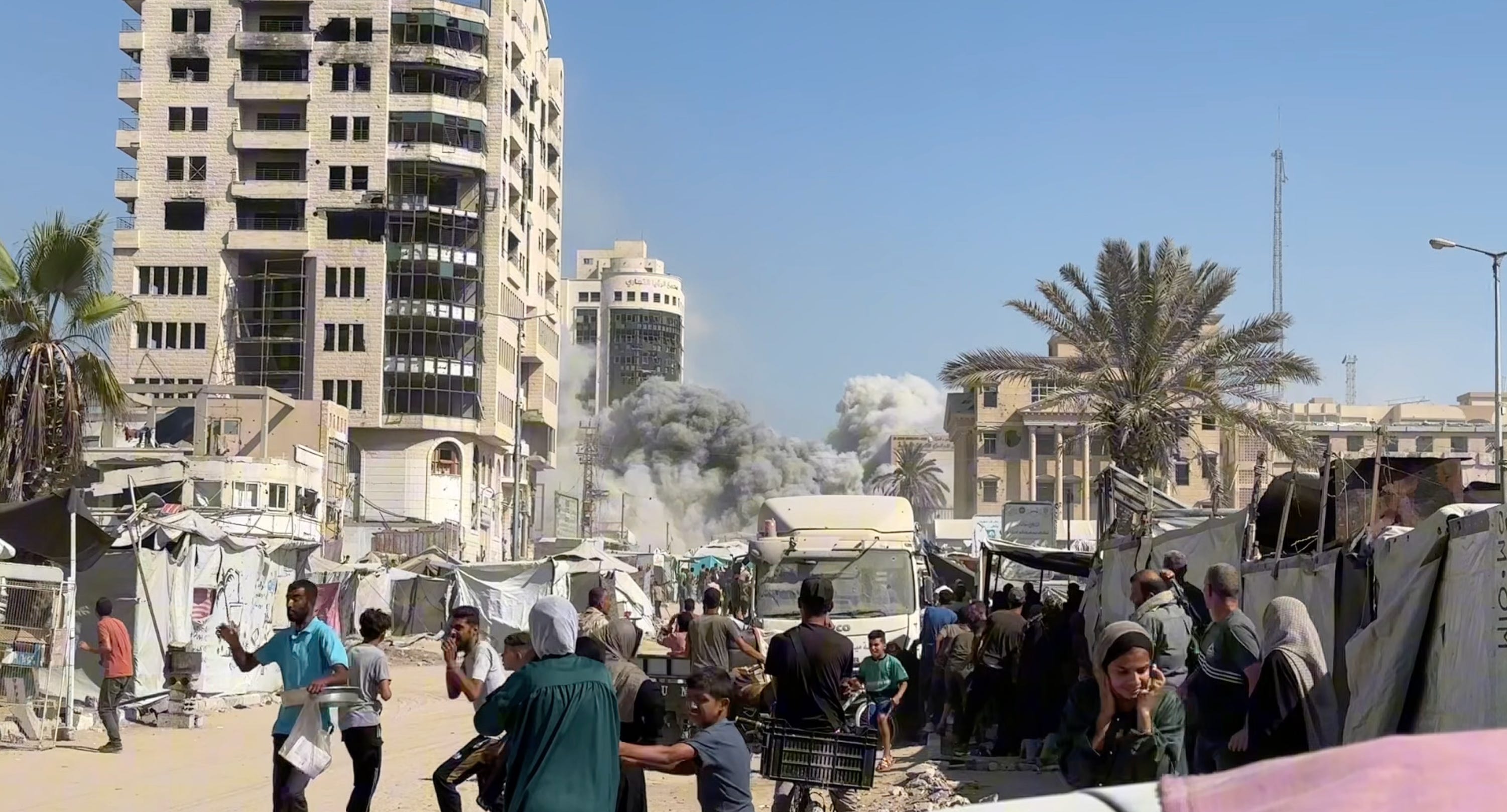
Israeli airstrikes target the the Al-Rouya residential tower in Gaza City on September 7, 2025. (Screen shot of video by Abdel Qader Sabbah.)
GAZA CITY—The Israeli military is waging an all-out, aerial assault concentrated on Gaza City, targeting dozens of high-rise towers in the heart of the city and reducing them to rubble. The destruction of residential buildings and tent encampments nearby is part of its stated operation to ethnically cleanse the entire area of the nearly one million Palestinians sheltering there and force them south.
“I promised you a few days ago that we would destroy Gaza’s terror towers. This is exactly what we are doing,” Israeli Prime Minister Benjamin Netanyahu said in a video statement from the Defense Ministry headquarters in Tel Aviv on Monday. “In the past two days, 50 of these towers have fallen. The air force brought them down. Now all of this is just an introduction, just a prelude, to the main intense operation—a ground maneuver of our forces, who are now organizing and gathering in Gaza City,” he said, adding, “And so I say to the residents of Gaza, I am taking advantage of this opportunity, and listen to me carefully: You have been warned. Get out of there!”
On Sunday, Israeli airstrikes destroyed the Al-Rouya residential tower in Tel al-Hawa, a neighborhood in southwest Gaza City. The massive blast toppled the high-rise building, sending massive plumes of smoke and ash into the air. Residents say they were barely given any warning to flee the area before the strike.
Israeli airstrikes destroy the Al-Rouya building in Gaza City on September 7, 2025. Video by Abdel Qader Sabbah.
“They threatened to target the tower about an hour ago, and then told us to evacuate. We didn’t have time to take anything,” Hayam Saad, who was living with her husband, children and other relatives in a tent encampment next to the Al-Rouya building, said as she she stood in the rubble alongside destroyed tents and shredded belongings. “I left my things as they were and ran away, with small children in tow.” Saad and her family were displaced from the eastern Gaza City neighborhood of Shujaiyya three months ago after an Israeli airstrike on their apartment that killed Saad’s daughter-in-law. “There was blood everywhere in the apartment. We couldn’t find a leg, a head, or anything. We then left the area,” she said.
“There’s nothing, as you can see. Where are we supposed to go now? Who’s going to give us tents? Who’s going to house us? We don’t know where to go,” she said. Her husband, Ahed Al-Abed Saad, said they lost their meager belongings in the attack. “We’ve come here and found nothing. No clothes, no food, no water, not even tents,” he told Drop Site. “All of this is to force people to scatter to the south. Right now, we have nothing, we’re going to sleep on the rubble.”
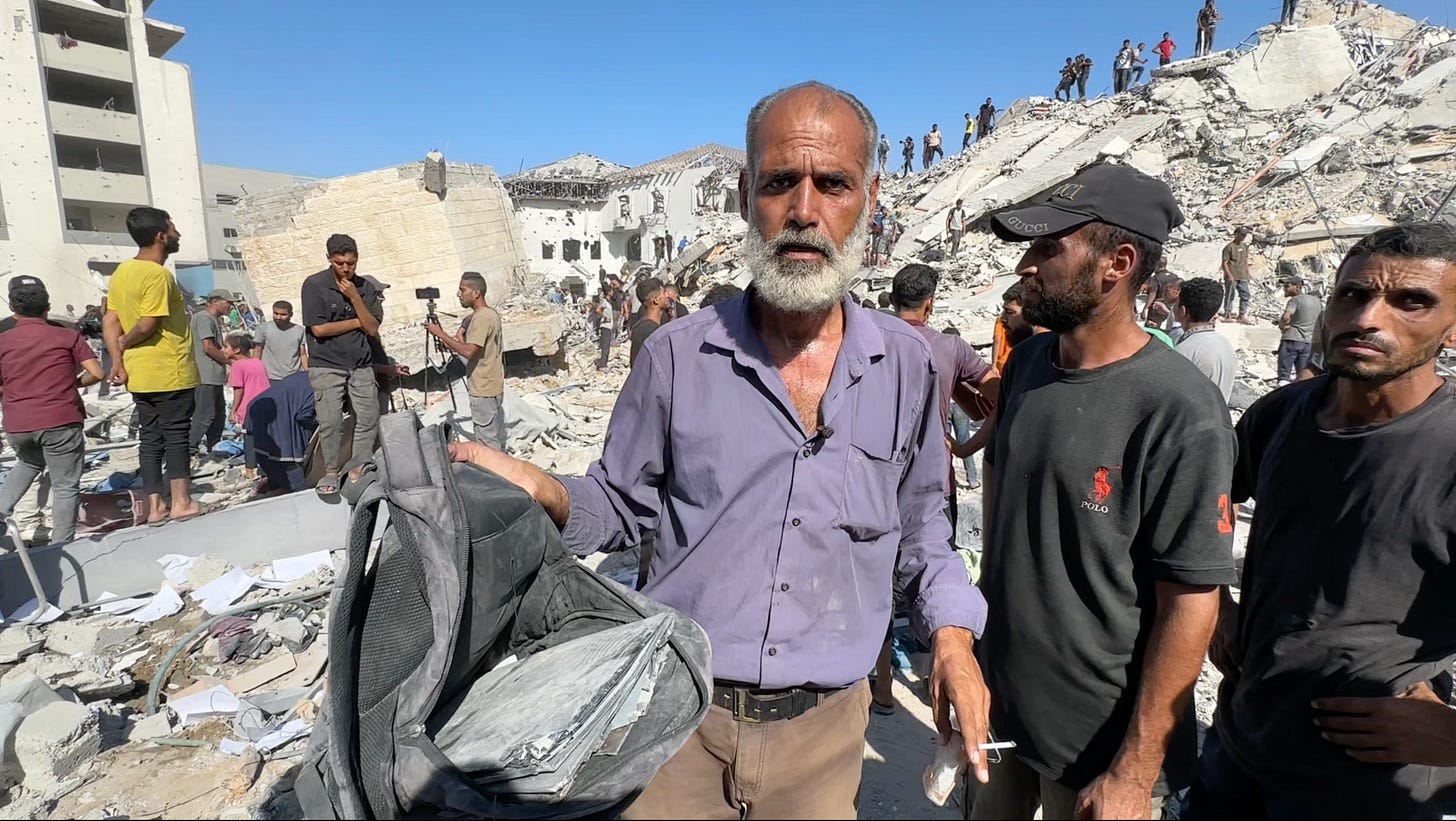
Ahed Al-Abed Saad standing near his tent by the rubble of the Al-Rouya building in Gaza City. September 7, 2025. (Screenshot of video by Abdel Qader Sabbah.)
Hundreds of other displaced families were sifting through the debris to try and salvage what little they could. “They didn’t give us enough time to remove the necessary items from the tents for the displaced or from inside the tower itself for some of the displaced people,” Mahmoud Naim, a 33-year-old from Beit Hanoun, told Drop Site as he stood amid the rubble of the Al-Rouya building on Sunday. “The tower was bombed in less than an hour, and the area was completely destroyed. The tents of the displaced were also destroyed. These tents housed hundreds of displaced people from various areas—from the north, from central Gaza, from Gaza City, from Beit Hanoun, Beit Lahiya, Jabalia refugee camp, Shujaiyya, Al-Tuffah, Al-Sabra, and all areas of Gaza.”
Israeli leaders have openly bragged about destroying Gaza City as part of a campaign to force out all of the Palestinians living there, as they have in other cities like Beit Hanoun, Rafah, and elsewhere.
The Israeli military first announced the intentional targeting of multiple high rises as part of its assault on Gaza City on Friday, claiming without offering any evidence that they were being used by Hamas fighters. The Israeli military only circulated a video showing the Mushtaha Tower, a 16-story building in a densely crowded western area of the city, with a graphic rendering of a supposed camera on the top of the building as “proof.” In the following days, they destroyed at least 50 buildings.
On Monday, Israeli Defense Minister Israel Katz posted on X: “A mighty hurricane will hit the skies of Gaza City today, and the roofs of the terror towers will shake. This is a final warning to the murderers and rapists of Hamas in Gaza and in the luxury hotels abroad: Release the hostages and lay down your weapons - or Gaza will be destroyed, and you will be annihilated.”
The Israeli targeting of the Mushtaha Tower on Friday also destroyed a mass tent encampment next to the building, where hundreds of displaced Palestinians had fled from neighborhoods in the northern and eastern parts of the city as the Israeli military invaded.
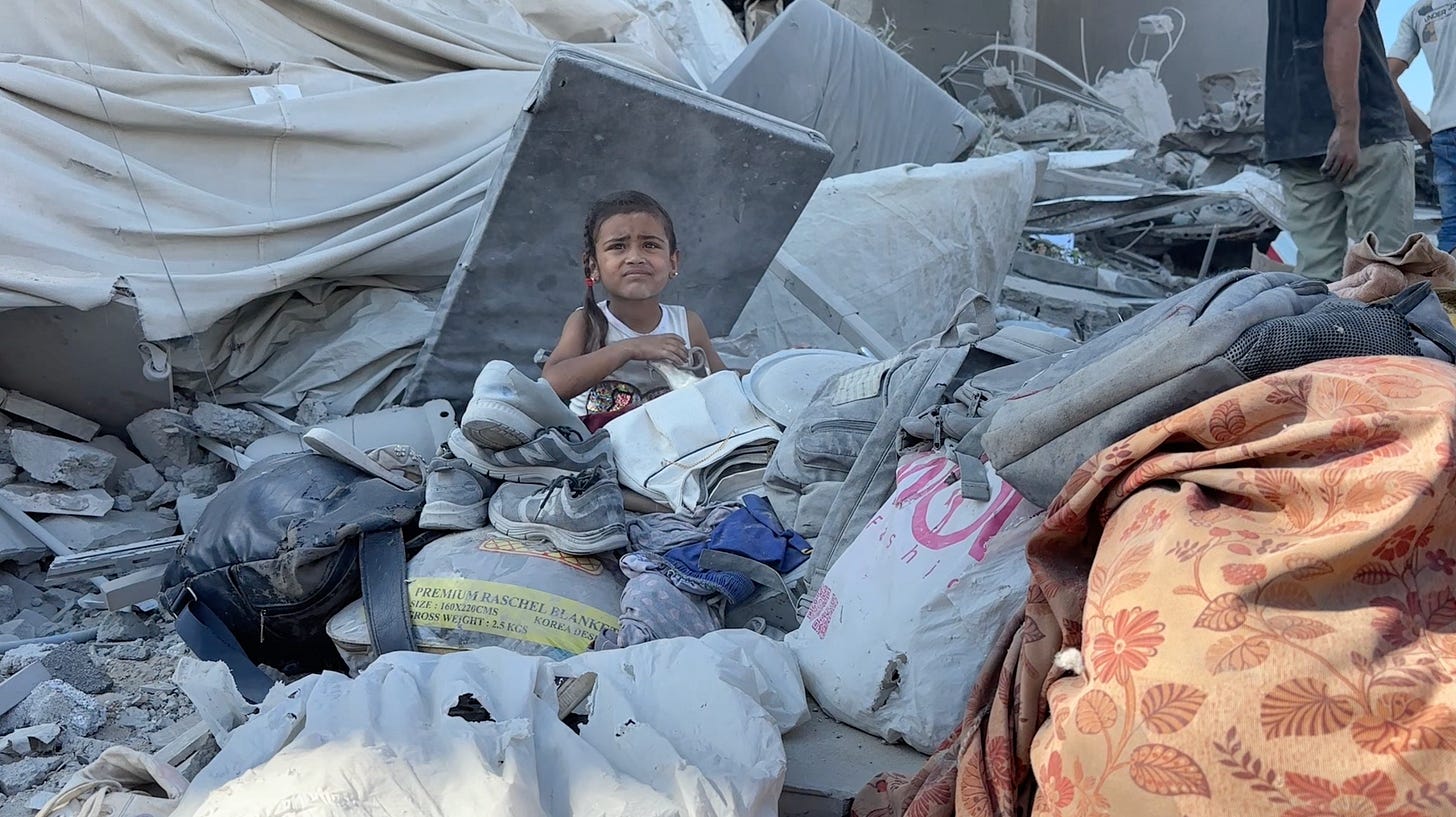
Um Samir al-Ajlouni, who was displaced from the Zaytoun neighborhood, was sitting in front of her tent near the Mushtaha Tower on Friday when everyone around began shouting that the Israelis were about to bomb the building. Less than half an hour later, the massive structure was reduced to rubble. “When I returned to my tent, I found nothing. The tent was leveled to the ground, and our family’s belongings were scattered and lost. Even the bread I was preparing for my children, I couldn’t find,” al-Ajlouni told Drop Site. She said she thought of trying to go south in a desperate attempt to seek shelter but she couldn’t afford it. “I don’t have any money to pay for transport, and my tent was completely destroyed, so I no longer have any shelter,” she said. “We will have to walk on foot for a long distance… we have no other option. The tent we used to live in cost 200 shekels ($60), and today its price has risen to 4,000 shekels ($1,200), an amount most families cannot afford.”
 ]
]
A girl sits among the wreckage of her family’s tent after Israeli airstrikes destroyed the nearby al-Rouya building in Gaza City. September 7, 2025. (Screenshot of video by Abdel Qader Sabbah.)
Civil Defense spokesman Mahmoud Bassal confirmed the offensive on Gaza City that began last month is the most violent attack on the city since Israel broke the ceasefire on March 18 and resumed its genocidal scorched earth campaign.
“Over the past two days alone, at least 50 residential buildings have been completely destroyed and 100 others were partially damaged that were housing thousands of displaced people,” Bassal told Drop Site. “The strikes also targeted mosques and playgrounds and led to the destruction of more than 200 tents belonging to displaced people living near the targeted buildings.” Bassal added that Civil Defense teams are trying to respond to multiple distress calls reporting people trapped under the rubble. “In not all cases do residents have a chance to escape. Most of the strikes that targeted buildings were carried out without evacuation warnings, causing the martyrdom of the residents.”
Among dozens of Palestinians killed on Monday was Osama Balousha, a photojournalist who was killed in an Israeli airstrike that targeted his home in the Sheikh Radwan neighborhoods of Gaza City, bringing the number of journalists killed to nearly 250, according to Gaza’s government media office.
In addition to housing hundreds of families, many of Gaza’s high-rise buildings were home to businesses and recreational centers. “This tower is not just a building, as you can see, it’s not just floors stacked on top of each other. These are memories. The tower is the days we have lived. I used to train and spend my days at the gym here,” Maher Haboush, a fitness coach who used to train at Oxygen Club, a well-known gym inside the Al-Rouya building, told Drop Site as he stood amid the rubble on Sunday. “There are no friends left, no money left, and nothing to remember. Even the memories, they are taking them away from us.”
Sharif Abdel Kouddous and Jawa Ahmad contributed to this report.
37
38
15
Trump Sanctions Palestinian Orgs That Called for UN to Investigate Israeli War Crimes
(www.commondreams.org)
39
40
41
28
Team Leader at Gaza Aid Distribution Sites Belongs to Anti-“Jihad” Motorcycle Club, Has Crusader Tattoos
(theintercept.com)
A lead contractor for a company providing security at the Gaza Humanitarian Foundation’s controversial food distribution sites is a member of a Crusader-inspired motorcycle club that touts its opposition to the “radical jihadist movement.”
Johnny “Taz” Mulford belongs to a Florida chapter of the Infidels, a biker group for veterans of U.S. wars and private military contractors like Blackwater. In May, Mulford began recruiting among his Facebook network for an unspecified job opportunity, asking anyone who “can still shoot, move and communicate” to contact him.
Reached by phone on Friday, Mulford confirmed to The Intercept that he is currently in Israel, adding that he was “on his way to a checkpoint,” but declined to comment further. Two sources directly familiar with the Gaza operations of UG Solutions, including former contractor Anthony Aguilar, confirmed Mulford’s employment to The Intercept. Mulford’s ties to the motorcycle group were first reported by Zeteo.
UG Solutions is a contractor providing security at aid distribution sites run by GHF, the aid effort in Gaza backed by the Trump administration and Israel.
“They’re in a primary Arab Muslim population, delivering food at the end of the gun.”
Mulford’s membership in the Infidels and numerous tattoos widely linked to the Crusades and contemporary far-right movements raise questions about his role as a contractor for the GHF mission. Among other posts on Facebook, Mulford nods to Christian Zionism by sharing a post calling Israel “God’s chosen nation” and a video mocking pro-Palestine protesters.
“If I went into Israel with a Nazi swastika on my arm and said ‘Heil Hitler,’ what would people think of me?” said Aguilar, a former Green Beret and UG Solutions contractor who has become a public critic of the GHF, raising concerns about Mulford’s tattoos and Infidels affiliation in the Middle East. “They’re in a primary Arab Muslim population, delivering food at the end of the gun.”
Mulford and the GHF did not immediately respond to requests for comment. The Infidels national umbrella and a local Florida chapter did not respond to requests made, respectively, to an online form and a chapter official.
“Johnny Mulford is a respected contractor in the industry, with over 30 years of cleared service supporting U.S. government and allied efforts. Any allegations suggesting otherwise are categorically false and defamatory,” Drew O’Brien, a UG Solutions spokesperson, said in a statement. “We do not screen for personal hobbies or affiliations unrelated to job performance or security standards. Every team member undergoes comprehensive background checks, and only qualified, vetted individuals are deployed on UG Solutions operations.”
O’Brien declined to comment on Mulford’s tattoos.
The Infidels were founded in 2006 by an American mercenary in Iraq nicknamed “Slingshot,” according to the club’s website, which says the early members were security contractors and military veterans. According to its website, “Infidels Motorcycle Club is a veteran formed and based MC for Patriotic Americans and our supporting allies.”
“Bearing in mind that we support the war against terrorism, and many of our Club members have and are serving in Iraq and other locations worldwide as either members of the military or as civilian contractors, our political views may not be shared by everyone,” says the national umbrella group in a Facebook post. “We neither support nor tolerate the Jihadist movement and those who support it. If on the other hand you do support the country’s efforts against Islamic extremism, then support your local Infidels MC!”
Read our complete coverage
Israel’s War on Gaza](https://theintercept.com/collections/israel-palestine/)
In 2015, the Infidels’ Colorado Springs chapter threw a pig roast barbecue party “in defiance of the Muslim holiday of Ramadan,” according to an event flyer that also “included comparisons of Muslim men to pedophiles,” a local outlet reported at the time.
Mulford, who registered the local chapter in Florida, is an active member of the Infidels, according to his and others’ social media postings. He is frequently shown in photos online posing with fellow club members at meet-ups. The Infidels wear matching leather vests bearing the club name and a red cross on the back. In one photo, Mulford’s vest has an embroidered patch on the front that says “Original Infidel.”
Crusader Iconography
The Infidels — including Mulford — frequently employ Crusader iconography in their tattoos and apparel.
Photos of Mulford show him tattooed with crosses affiliated with the Crusades and, more recently, right-wing Christian movements.
A photo of Mulford on Facebook shows him without a shirt after an apparent outing to fish. On his right forearm is an American flag rendered in flames and overlain by a so-called Templar symbol: a shield emblazoned with a red cross, styled after the Christian military order of the Knights Templar. His left bicep displays another Templar shield. A tattoo on his right forearm displays the Jerusalem or Crusader cross, a squared-off cross with smaller crosses in each of the corners.
In another photo, Mulford can be seen wearing a vest that includes both the Infidels name and an amalgamation of several Crusader-style crosses.

A photo that appears on the Facebook page of Johnny "Taz" Mulford. Screenshot: The Intercept
According to Matthew Gabriele, a medieval studies professor at Virginia Tech and an expert in Crusader iconography, the Jerusalem cross and Templar shield are frequently embraced by white supremacists and the far right, — a nod to an imagined “existential conflict between Islam and Christianity” in the Middle Age, Gabriele said. Crusader iconography of this kind doesn’t reflect the historical record, but rather a sort of Christian revenge fantasy.
“It doesn’t have a whole lot of specific attachment the Middle Ages themselves, but a nostalgic version in which this existential conflict between Islam and Christianity, that has gone back to Islam’s founding, has always put Christianity on the defensive,” Gabriele said. Crosses and shields “symbolize that during the Crusades, Christianity struck back in a positive way. It really is a particular stance toward Islam and the Middle East.”
The Crusader aesthetic and the proud self-labeling of oneself as an “infidel” grew in popularity during the war on terror and have remained as gestures of anti-Muslim sentiment on the right.
“It was a way for a particular kind of American soldier,” Gabriele said, “to kind of reflect back Al Qaeda’s rhetoric: ‘Yeah we are the crusaders, we’re going to come there and kick your ass.’”
Crusader symbols have attracted scrutiny when worn by figures like Defense Secretary Pete Hegseth, who was questioned about his Jerusalem cross tattoo during Senate confirmation hearings. Hegseth defended the cross as a symbol of Christianity.
In July, while the GHF’s food distributions were ongoing, Mulford posted an illustration on Facebook of a kneeling Crusader knight with a glowing cross in the background and a superimposed biblical quote.
Other Facebook photos shared by Mulford show him with Crusader-style crosses on his arms and the number 1095 across his chest — the year Pope Urban II called for the First Crusade.
The date of 1095 has been cited as symbolically important by violent right-wing actors, Gabriele said, from Norwegian mass shooter Anders Breivik to Brenton Tarrant, perpetrator of the anti-Muslim massacre in Christchurch, New Zealand.
The date 1095, Gabriele said, represents a worldview in which Muslims are “a threat to be killed” and driven from the Holy Land.
In 2018, the national Infidels umbrella group shared a photo montage from what it describes as a “Crusader ride” organized by its members.
Security Contractor
Mulford served in the Marine Corps from 1982 to 1985 before a stint in the Army from 1987 to 2007, when he saw multiple deployments to Iraq and Afghanistan, according to an Army spokesperson. Subsequently, according to a personal website, he served overseas as a “security agent” for a “government agency.”
His service records include numerous commendations and achievements. A report stated that Mulford was “debarred” following “nonjudicial punishment” under military disciplinary rules related to an alleged scheme where “Mulford received a kickback from a contractor who provided skydiving training to Fort Bragg Soldiers.” Mulford’s debarment, a designation the military uses in deciding to award contracts, was terminated in 2007, shortly before his retirement from the Army at the rank of master sergeant.
The company employing Mulford is one of at least three U.S. contractors for the GHF, the nonprofit distributing food in Gaza with Israel’s approval.
To distribute what it says are over 108 million meals so far, the foundation has hired a pair of U.S. companies — one helmed by a former CIA official, the other by a Green Beret veteran — to provide logistics and armed private security contractors. Other aid organizations say the idea of staffing aid distribution sites with armed contractors violates basic principles of neutrality and have refused to work with the GHF.
One of UG Solutions’ partner organizations has already drawn scrutiny for its leader’s views on Islam and Palestinians.
In July, independent journalist Jack Poulson reported that Matthew Murphy, the president of a small relief organization called the Sentinel Foundation that partnered with UG Solutions to distribute aid in Gaza earlier this year, had a record of making bigoted remarks against Muslims generally and Palestinians in particular. In a podcast interview last year, Murphy referred to Palestine as “a little shithole.”
“Killing and beheading and raping and treating, you know, Christian and Jewish women as lesser-than and slaves is not just something terrorists think, it’s Islam,” Murphy said.
The Sentinel Foundation was co-founded by former Green Beret Jameson Govoni, who went on to found UG Solutions.
The GHF and its partners have drawn worldwide scrutiny since they began aid distributions in May.
At least 1,373 Palestinians have been killed seeking food since the foundation began its work in Gaza, including 859 people near distribution sites and 514 along food convoy routes, according to the United Nations. Palestinians say that many have died under gunfire from the Israeli military.
In job listings, UG Solutions describes itself as “a fast-moving, mission-driven private security company with global reach.” The Charlotte-based company first got involved in the conflict earlier this year when its private soldiers were tasked with manning checkpoints during a ceasefire.
The company has sought out former U.S. Special Forces veterans, according to job listings.
Four Democratic members of Congress last week wrote to UG Solutions and another GHF contractor, warning them that the companies’ employees could be held liable if war crimes have been committed. Working closely with the Israeli military, those members warned, has exposed the company’s staffers to great legal risk.
UG Solutions has denied mistreating Palestinians in Gaza, while acknowledging that its contractors have used pepper spray and “warning shots” to disperse crowds.
The post Team Leader at Gaza Aid Distribution Sites Belongs to Anti-“Jihad” Motorcycle Club, Has Crusader Tattoos appeared first on The Intercept.
42
43

45
46
47
13
Starving child in Gaza was killed minutes after receiving aid, former US military contractor says
(www.middleeasteye.net)
48
49
50