Louis Rossmann

515 readers
4 users here now

Louis Rossmann Community on Lemmy.world: For fans/supporters of Louis Rossmann and his work

About Louis Rossmann

Louis Rossmann is a repair shop owner and a vocal supporter of the Right To Repair movement. He runs a YouTube channel with a variety of content - from board repair videos, to news and updates in the technology space.

His insightful and reasonable opinions on technology and product ownership tend to attract a lot of attention.

Community Guidelines

  1. Be nice
  2. Respect others' perspectives
  3. No advertising
  4. Follow the rules of the instance we're hosted on: https://mastodon.world/about

Interested in being a moderator for this community? Positions are currently open.

founded 2 years ago
MODERATORS
1


they put this on billboards: "FIXING YOUR CAR HELPS IRAN & NORTH KOREA" 🤦‍♂️vs right to repair. @louisrossmann

https://www.youtube.com/watch?v=KRFdhO3CQyQ

2


My interviewer wishlist for @pluralistic about his #enshittification book (and, in the case of Steve from GN), on the #DMCA abuse by Bloomberg to censor the #GamersNexus documentary about GPU smuggling:
• Steve of GamersNexus, of course;
• @louisrossmann, the Katharine Hayhoe of #RightToRepair and #RightToOwn; and
• Jordan Harbinger, who has a very large and loyal audience spanning a wide political spectrum, listening to long-form intellectual interviews of experts about their books and research.

(Paging @anneapplebaum.bsky.social: You've spoken to Jordan recently. Maybe mention the book and author to him?)

It will taker a wider audience to effectively build a base for campaigns to restore #competition: the restoration of #antitrust and the repealing of pro-monopoly laws.

3


cross-posted from: https://lemmy.world/post/35129112

Video Deacription:

  1. Show Up Anyway - Don't Let Austin City Council Win [09:20 | AUG 27 2025 | https://youtu.be/iscDYp6dtl8]
  2. Austin Votes on $2M AI Park Surveillance in 48 Hours - Thursday 10AM City Hall. Show Up [13:18 | AUG 25 2025 | https://youtu.be/g4vL1ERdZ9Y]

About Channel:

I started as a studio repair technician at Avatar & started a Macbook component level logic board repair business. This channel shows repair & data recovery work & shows how to perform these repairs step by step. There are many things that make it hard to fix things now; willful actions from manufacturers to limit access to parts & schematics. I talked about this to try and spark mainstream recognition of the "Right to Repair" movement.

Restrictions placed on repair were just a canary-in the-coal-mine for many of the anti-ownership, anti-consumer practices that would become common in every industry, which I discuss & try to push back against every day.

4
3
submitted 4 months ago* (last edited 4 months ago) by Forester@pawb.social to c/louisrossmann@lemmy.world


As far as I can tell, this should not violate any rules. If I have violated any rules I would like to apologize in advance. I just thought that based on recent topics, this was a very relevant tune to share.

5


cross-posted from: https://lemmy.world/post/34315143

SponsorBlock, Timestamps, and Generated Summary below:


SponsorBlock Timestamp:

  1. 12:45.994 Highlight
  2. 12:46.550 - 13:43.619 Tangents

Video Description:

Links:

  1. https://fulu.org/newsletter/
  2. https://consumerrights.wiki/Main_Page
  3. https://leginfo.legislature.ca.gov/faces/billPdf.xhtml | State of California | Assembly Bill No. 2426

Generated Summary:

This video discusses the purpose behind the recent "Clippy" profile picture trend and how it's intended to be more than just a symbolic gesture. The goal is to mobilize people to advocate for pro-ownership and right-to-repair, creating real-world change by working together.

Key Points:

  • Inspiration vs. Legislation: Changing minds is crucial before changing laws. Even after laws are passed, enforcement requires continued public awareness and pressure.
  • The Problem of Apathy: Apathy and the feeling of being alone are the biggest obstacles to activism. The video aims to demonstrate that many people share the same concerns and are willing to take action.
  • Moving Together: The "Clippy" movement is about creating a sense of unity and coordinated action. The speaker uses the analogy of cars at a red light to illustrate how collective action can be more effective than individual efforts.
  • Real-World Examples:
    • An example is given of a national grocery store chain where broken wheelchair carts are too expensive to repair, highlighting the need for repairable products.
    • Another example involves a company wanting to prevent firmware downgrades on a smart device to lock users into future paywalls, showcasing the importance of individual employees standing up against such practices.
  • Consumer Rights Wiki: The speaker encourages viewers to contribute to Consumer Rights Wiki to create a well-curated database of anti-ownership practices, which can be used to support arguments for pro-repair legislation.
  • Future Plans: The speaker mentions upcoming announcements regarding bounty winners for solutions to anti-ownership practices related to smart home devices and Echelon bikes.
  • Newsletter: Viewers are encouraged to sign up for a newsletter to stay informed about opportunities to help push the movement forward.

Highlighted Information:

  • The core message is that collective action is essential for creating a pro-ownership society. Changing a profile picture is just the first step; the real work involves speaking up and taking action in everyday situations.
  • The speaker emphasizes that even small actions can make a difference when everyone is on the same page and working together.
  • The video addresses the common sentiment that individual efforts are futile, arguing that this is precisely the mindset that needs to be overcome.

About Channel:

I started as a studio repair technician at Avatar & started a Macbook component level logic board repair business. This channel shows repair & data recovery work & shows how to perform these repairs step by step. There are many things that make it hard to fix things now; willful actions from manufacturers to limit access to parts & schematics. I talked about this to try and spark mainstream recognition of the "Right to Repair" movement.

Restrictions placed on repair were just a canary-in the-coal-mine for many of the anti-ownership, anti-consumer practices that would become common in every industry, which I discuss & try to push back against every day.

6


SponsorBlock, Timestamps, and Generated Summary below:


SponsorBlock Timestamp:

  1. 4:08.668 Highlight
  2. 7:40.800 - 7:51.921 Endcards/Credits

Video Description:

Links:

  1. https://www.judiciary.senate.gov/committee-activity/hearings/a-time-for-truth-oversight-of-metas-foreign-relations-and-representations-to-the-united-states-congress |https://web.archive.org/web/20250811152014/https://www.judiciary.senate.gov/committee-activity/hearings/a-time-for-truth-oversight-of-metas-foreign-relations-and-representations-to-the-united-states-congress | https://archive.ph/yu1Kj | LIVE: Senate Judiciary Committee hearing on Meta’s foreign relations [01:54:59 | APR 09 2025 | Associated Press | youtu.be/KiRr5J8Alm4]
  2. https://futurism.com/facebook-beauty-targeted-ads | https://archive.ph/7O2kg
  3. https://en.m.wikipedia.org/wiki/United_States_v._Microsoft_Corp. | https://wikiless.com/wiki/United_States_v._Microsoft_Corp.

Generated Summary:

This video argues that modern tech companies are engaging in anti-consumer practices far exceeding those of the past, and proposes a symbolic act of resistance: changing your profile picture to Clippy. The speaker suggests that Clippy, despite being annoying, represents a simpler time when software wasn't designed to exploit users for data or subscription revenue.

Key Points:

  • Modern Tech Exploitation: Companies now profit from user data and manipulate them through subscriptions and planned obsolescence, unlike the simpler software of the past.
  • Clippy as a Symbol: Clippy represents a time when software, though flawed, primarily aimed to help users without ulterior motives.
  • Sons of the Harpy Analogy: The speaker draws a parallel to the Sons of the Harpy from Game of Thrones, suggesting that a collective display of dissent (represented by Clippy) can challenge corporate overreach.
  • Specific Grievances: The video lists several grievances against tech companies, including:
    • Changing terms of service after purchase.
    • Ransomware-like practices that disable purchased products.
    • Censorship and biased content moderation.
    • Data mining and privacy violations.
    • Obstructing users from repairing their own devices.
  • Call to Action: The speaker urges viewers to change their profile pictures to Clippy on various platforms (YouTube, Slack, etc.) to signal their discontent and solidarity.
  • Cultural Battle: The speaker emphasizes the importance of winning the "cultural battle" by raising awareness and fostering a collective understanding of these issues.
  • Small Acts of Rebellion: The video suggests subtle ways individuals within companies can push back against anti-consumer practices.

Highlighted Information:

  • "Clippy simply wanted to help." This phrase is repeated throughout the video to contrast Clippy's innocent helpfulness with the perceived malicious intent of modern tech companies.
  • The speaker hopes that a mass display of Clippy avatars will make company CEOs realize that "they no longer live in a world where they can get away with over the consumer."
  • The speaker acknowledges the duty not to infringe IP rights in the process, noting that "It is in fact the manufacturers who have the relevant rights, not consumers."

About Channel:

I started as a studio repair technician at Avatar & started a Macbook component level logic board repair business. This channel shows repair & data recovery work & shows how to perform these repairs step by step. There are many things that make it hard to fix things now; willful actions from manufacturers to limit access to parts & schematics. I talked about this to try and spark mainstream recognition of the "Right to Repair" movement.

Restrictions placed on repair were just a canary-in the-coal-mine for many of the anti-ownership, anti-consumer practices that would become common in every industry, which I discuss & try to push back against every day.

7
8


Timestamps and Generated Summary Below:


Video Description:

Links:

  1. https://wiki.rossmanngroup.com/wiki/Mozilla_introduces_TOS_to_Firefox
  2. https://wiki.rossmanngroup.com/wiki/Mozilla
  3. https://librewolf.net/

Timestamps:

  1. 00:00:00 - tl;dr solution use librewolf
  2. 00:00:52 - my tl;dr thoughts
  3. 00:01:08 - what mozilla did
  4. 00:02:28 - mozilla crashed archive.org.....
  5. 00:03:03 - Louis gets trolled by a monster
  6. 00:03:56 - firefox' removes statement on not selling personal data.
  7. 00:04:40 - terms were changed without explicitly alerting users
  8. 00:05:08 - mozilla did this at the WORST POSSIBLE TIME
  9. 00:07:05 - the worst communication policy
  10. 00:07:14 - California consumer protection act
  11. 00:08:03 - The suspicious part mozilla put in
  12. 00:08:26 - What is "selling data" ?
  13. 00:08:54 - Existing business practices exist in grey areas to CCPA
  14. 00:12:46 - Just use librewolf to avoid all this....
  15. 00:16:27 - Privacy policy is still fairly strong
  16. 00:17:20 - How money for nothing destroys people & companies

Generated Summary:

This YouTube video analyzes Mozilla's recent controversial changes to its terms of service and privacy policy, arguing that the company's financial success has led to complacency and poor communication.

Main Topic: The video critiques Mozilla's handling of its terms of service update, focusing on the poor communication, the ambiguity surrounding data usage, and the potential conflict with the California Consumer Privacy Act (CCPA).

Key Points:

  • Poor Communication: Mozilla's announcement and explanation of the changes were poorly worded, confusing, and caused significant user backlash. The changes were implemented before users were notified.
  • Ambiguous Data Usage: The updated terms, while not explicitly stating Mozilla sells user data, created the impression that it might be doing so, particularly in light of the CCPA's broad definition of "selling data." The video highlights the existing practice of sharing data with partners like Google in exchange for financial compensation.
  • Financial Complacency: The core argument is that Mozilla's substantial financial stability (largely from Google's payments to be the default search engine) has led to a lack of urgency and accountability. High executive salaries are cited as evidence of this complacency.
  • Alternative Browser: The video promotes LibraWolf, an open-source fork of Firefox that removes telemetry and sponsored content, as a privacy-focused alternative.
  • CCPA Compliance: The video discusses the CCPA and how Mozilla's practices, particularly its data sharing with Google, might fall into a gray area of compliance.

Highlights:

  • Comparison of Mozilla's old and new FAQ pages regarding data selling, showing the removal of the "we don't sell your data" promise.
  • Analysis of the CCPA's definition of "selling data," demonstrating how Mozilla's existing practices could be interpreted as violating it.
  • Discussion of Mozilla's revenue streams, emphasizing the reliance on Google's payments and investment income.
  • Contrast between Mozilla's approach and Brave's proactive marketing campaign to address ad-blocker issues.
  • The presenter's personal preference for LibraWolf due to its default privacy settings.
  • The presenter's assertion that Mozilla's problems stem from financial success leading to atrophied communication and responsiveness.

About Channel:

I started as a studio repair technician at Avatar & started a Macbook component level logic board repair business. This channel shows repair & data recovery work & shows how to perform these repairs step by step. There are many outside forces that make it hard to fix things now; willful actions from manufacturers to limit access to parts & schematics. I talked about this to try and spark mainstream recognition of the "Right to Repair" movement.

I realized that restrictions placed on repair were just a canary-in the-coal-mine for many of the anti-ownership, anti-consumer practices that would become common in every industry, which I discuss & try to push back against every day.

9


Welcome! This page is very large and there are many steps, please take your time. If you would like to edit (you're welcome to fix errors even without an account!), please read this first. Thank you!^[[1] https://wiki.futo.org/wiki/FUTO:About]

Preface

Dedication

Thank you to Tim Gilles, aka Slipperman, whose remarks on what makes someone a “real professional” stuck with me for a lifetime. I listened to Tim on the mixerman radio show. Tim wanted to demystify his craft in a way that anyone could understand; that would inspire EVERYONE to pick up a microphone & a tape machine and give it a shot themselves. He did this with his own “unique” writing style. His work inspired me to do the same with everything I’ve done, from board repair to self-managed servers. Tim passed away two years ago. I hope his legacy lives on through everyone who tries to open doors for the next generation rather than gatekeep information via ego inflating elitism.

Picture of Tim Gilles, aka Slipperman:

Intro

I started using GNU/Linux in 2002, back when I saved up the $79.99 necessary to buy SuSE Linux 8.1 Professional as a boxed set from the Best Buy across the street from the Staten Island mall for my 14th birthday. I started hosting my own servers in 2005, and put together systems for my own business’ use since early 2011. I didn’t do everything outlined here immediately; it was slowly built piece by piece over a long time. I never documented it in a way that would allow my grandma to use it. In 22 years, I can’t remember reading GNU/Linux documentation that felt like it was designed for normal people. That’s what I’m looking to do here.

Image of SuSE Linux 8.1 Professional:

From 2002 to the present, two things remain true:

-You can do cool things with GNU/Linux.

-These cool things are hidden behind a labyrinth of

  • Half baked software.
  • Horrible UI.
  • Forum elitists & gaslighting assholes who will make you think YOU’RE the crazy one for expecting things to work.
  • People that will tell you to “RTFM” with no regard for whether that documentation actually works.
  • black boxes. I mean literally hidden behind actual black boxes. For six months. Unfixed. On the stable version of a server operating system (that bug is present in 24.10 long-term-stable even today).

So much of the open source user experience is not designed for normal people. Whether it was using NDISwrapper 20 years ago to get wifi to work or messing with SCSI emulation to burn a CD, GNU/Linux is pain. It’s all pain.

It’s painful enough that people will happily trade their data, sovereignty, privacy, and their rights to avoid ever having to deal with it; and I can’t blame them.

This has to change. As of 2024, most of you live your life:

  1. Dependent on closed source software.
  2. Running on someone else’s server where you can be kicked off at any time.
  3. Forced into forced arbitration or your device won’t work anymore.
  4. With no privacy.
  5. Training AI with your creations.

Now is a time like no other for you to feel empowered to build systems that you control & understand.

My goal with this guide is not to tell you the way you HAVE to do something, or to imply that my way is the best. My goal is to inspire you by showing you what’s possible. You don’t have to be a computer engineer or someone with an IQ of 160 to figure this all out. And, admittedly, to inspire capable developers to look at the pain points scattered throughout this guide (of which there are many) and decide “enough is enough; let’s make this better”.

The fun here is in building your own system, your own way. This is my sovereign cloud; there are many like it, but this one is mine. I can’t wait to see how you build yours.


View edit history of this page.^[[2] https://wiki.futo.org/index.php?title=Introduction_to_a_Self_Managed_Life%3A_a_13_hour_%26_28_minute_presentation_by_FUTO_software&action=history]


Edit: format, added missing quotes on sections/titles/points

10


I love Louis and I've been following his videos for a long time. What he does is supremely important to our messed up society.

But here's the thing: for the past few months, I've had the distinct feeling than each of Louis' videos is slightly more unhinged than the previous one.

I mean I'm fully aware Louis' videos are not mainstream, and until recently, I've always felt there was a clear method to the randomness. But lately, it¨s been more randomness than method for me, and it's reached a point where I feel it's doing a disservice to the causes of right to repair and sovereign ownership.

Am I the only one who feels this way?

I really hate to come out saying this, but I really think there's something going on with Louis, and beyond the causes he fights for on our behalf - and goodness knows I'm eternally grateful for what he's achieved - I'm honestly a bit worried for him.

11


I don't see this story being shared on Lemmy and I don't know why. The Youtuber in this video has been shoved onto the front lines by a greedy company that can't own up to it's own failed product and instead wants to sue for defamation for a poor review.

Share, like, subscribe, donate if you can. The "AllOffroad 4x4 Adventures TV" channel could use a little love.

12


cross-posted from: https://lemmy.world/post/17699965

I use this channel to post repair videos from Rossmann Repair Group Inc

I also discuss random things of interest to me. This is, and always will be, my personal variety show.

I teach Macbook component level logic board repair from a common sense, everyman's perspective. I try to make it seem viable, and entertaining. I also go over business concepts & philosophy that will be important to running & maintaining a sustainable, profitable business.


Summary

  1. The speaker expresses frustration with YouTube's decisions, feeling that the platform does not focus on improving the experience for content creators that viewers want to see.
  2. They mention a specific content creator who provides responsible firearm use and ownership content, which they believe is valuable.
  3. The speaker criticizes YouTube's new firearm policy, which could potentially lead to the removal of a significant portion of creators' content.
  4. They argue that YouTube should support and promote responsible firearm content instead of unfairly targeting it.
  5. The speaker discusses the issue of media companies not effectively moderating their comment sections, contrasting their own lack of resources with the financial capabilities of larger companies like ABC and CBS.
  6. The speaker criticizes YouTube for focusing on certain issues like firearm ownership instead of addressing persistent problems like sex bots and scamming ads.
  7. They emphasize the importance of finding ways to navigate these issues in the current digital landscape.
  8. The speaker expresses frustration about being scammed by someone named Mr. Roberts, who was recommended for investment.
  9. They question the motives behind certain policies on a website and express annoyance at the lack of viewership despite spending time editing videos.
  10. The speaker also mentions a comparison between Google's Anti-Trust lawyers and lawyers who do not understand an API.
13
14


A customer RMA'd their ROG Ally handheld console for a faulty joystick replacement - only to have Asus refuse warranty repair due to a tiny scratch on the top of the device.

Asus then invoiced the customer $200 to carry out the joystick repair outside of warranty, or have the handheld console returned to them in a disassembled state.

Pretty low from Asus in my opinion 🤦‍♂️ can't say I'm a fan of supporting a company who treats their customers like this.

Louis' video is related to other coverage on this by the Gamers Nexus channel, which covers this in much more detail.

15


Associated links with video:

Timestamps:

  • 00:00 - Intro
  • 00:17 - Apple cancelling Jon Stewart
  • 00:34 - Who is Lina Khan?
  • 00:59 - My contributions to the FTC
  • 02:05 - I became a little blackpilled on this but that's besides the point
  • 02:31 - Why would Apple start a show with Jon Stewart if they are this sensitive to what he has to say, or who he speaks to?
  • 03:38 - You know what type of content Jon Stewart makes!
  • 04:16 - Even someone worth 20-50 million dollars can be deleted if a tech company doesn't like them
  • 05:19 - Why I didn't sell out to vice TV
  • 05:55 - Why not being able to criticize the content network is a serious problem
  • 08:48 - Why it matters
  • 09:27 - The point of the internet!

Short Summary

  1. The speaker discusses John Stewart's show called "The Problem with John Stewart on Apple TV," where he could talk about various topics.
  2. The show was canceled because Apple did not want him to talk to FTC chair Lena Khan, known for her critical views on big tech companies like Google, Apple, and Facebook.
  3. The speaker mentions creating a white paper on the right to repair and engaging with the FTC but not receiving the desired response.
  4. Expresses disappointment in the lack of support for right to repair initiatives.
  5. Questions why Apple would start a show with John Stewart if they were not willing to address the issues he typically discusses, especially when facing scrutiny from regulators like the FTC.
  6. Discusses censorship and control over content by large companies like Apple.
  7. Highlights the case of John Stewart being reportedly pulled off the air for criticizing Apple, despite having a large audience and influence.
  8. Shares their own experience with Vice Television, where they were asked to sign a contract limiting their ability to upload content freely on their YouTube channel.
  9. Emphasizes the importance of being cautious as a content creator, as signing such contracts can make one vulnerable to censorship and control by platforms or companies.
  10. Underscores the need for alternative platforms prioritizing freedom of expression to prevent worsening censorship issues in the future.
16


Edit:

  • added yt associated links and added timestamp section

Associated links with video:

Timestamps:

  • 00:00 - Intro
  • 00:10 - Edison Motors
  • 02:42 - Edison Motors Grant application
  • 03:23 - Where this all goes downhill...
  • 03:53 - Where this becomes bs
  • 08:44 - Cat
  • 09:15 - editing
  • 09:35 - I support edison motors
  • 10:48 - Edison Motors' own words

Short Summary

  1. Edison Motors focuses on making electric truck conversion kits using off-the-shelf components that users can repair themselves.
  2. The company aims to serve the commercial trucking market with economically viable electric trucks.
  3. These trucks utilize regenerative braking to recharge the battery while going downhill, reducing diesel fuel consumption and emissions.
  4. Edison Motors values repairability, sustainability, and ownership of products.
  5. The company applied for a grant from the government of British Columbia but was denied.
  6. Suspicion arose regarding potential conflicts of interest in the grant application process.
  7. Despite meeting criteria for lower emission vehicles, Edison Motors was denied the grant.
  8. Concerns were raised about potential corruption involving a company offering grant writing services.
  9. The NDP government blocked an official investigation into a program run by the company.
  10. The speaker expresses frustration with the process and believes there should be a serious investigation into the grant allocation process.
17


Links in video description:

Short Summary

  1. The speaker discusses concerns about the company Roku and their practices related to consent.
  2. They criticize Roku for forcing users to agree to new terms to continue using their television, likening it to a violation of consent.
  3. Mention of a patent application by Roku that would allow advertisements to be inserted into content even without user agreement.
  4. Argument that users who pay for content should not be subjected to ads.
  5. Advice for viewers to use ad-blocking tools to avoid unwanted advertisements and maintain their privacy.
  6. Emphasis on the importance of using ad blockers as a consumer to avoid being bombarded with intrusive ads.
  7. Frustration with the predatory nature of the advertising industry, where personal data is mined without consent.
  8. Encouragement for viewers to be mindful of their privacy and support content creators and journalists in ethical ways.
  9. Highlighting the need for viewers to take a stand against practices that invade privacy and to respect privacy settings on devices like smart TVs.
  10. Mention of hidden settings on smart TVs that allow for data collection and personalized advertising.
18


Links in video description:

Short Summary

  1. The speaker expresses concerns about cloud-connected security cameras, citing examples of companies like Vava, Sun Valley Tech, Arlo, and Wyze.
  2. They prefer security cameras that connect to a local NVR with hard drives to avoid risks associated with internet connectivity, monthly fees, and potential data breaches.
  3. The speaker criticizes the trend of modern cameras limiting users' ability to connect to their own systems and highlights the issue of forced arbitration in the industry, exemplified by TPLink's cameras.
  4. They argue that companies should provide options for local NVR usage to prevent data breaches and hold them accountable for negligent security practices.
  5. The speaker expresses concern about a forced arbitration agreement imposed by camera manufacturers that require users to use their own cloud-hosted solutions to access their cameras.
  6. They believe that users should have the right to hold companies accountable in court, especially in cases where personal data is compromised due to negligence.
  7. The speaker highlights the history of arbitration and expresses a desire to see forced arbitration declared illegal in the United States.
  8. They emphasize the importance of consumer rights and express hope to not have to make another video on this topic in the future.
19


Short Summary

  1. The speaker contemplates turning their repair channel into a sex toy repair channel due to challenges in sourcing Macbook repair parts.
  2. They discuss the profitability of specific repairs and express frustration with instruction manuals and customer service.
  3. The speaker demonstrates opening a remote control to fix water damage, showcasing their repair skills and attention to detail.
  4. They mention past experience with a Blackberry Curve 8330 and a pride tool.
  5. The speaker discusses various tools and equipment used for repairing electronics, emphasizing the importance of proper soldering techniques and avoiding excessive heat cycles.
  6. They emphasize the importance of proper ventilation and safety measures when working with soldering equipment.
  7. The speaker recounts a conversation advising a company to focus on their original product rather than engaging in legal battles over a new product.
  8. They share a negative experience of being unexpectedly charged $500 for shipping by a company they had been loyal to for 10 years, expressing frustration with the company's behavior.
  9. The speaker reflects on moments of feeling overwhelmed and making impulsive decisions to find peace in a remote location.
  10. They emphasize the importance of quality products and maintaining a legacy of integrity.
20


Edit:

  • links fixed and added missing yt link

Links in video description:

Short Summary

  1. Importance of forced arbitration in cases involving expensive products that can harm consumers, such as laptops or smartphones with design defects.
  2. Companies like Roku and Blizzard using forced arbitration agreements manipulatively, making it difficult for consumers to opt out of these terms. 3 Criticism of companies opting consumers into arbitration agreements via email, while requiring them to send a physical letter to opt out, which is inconvenient and deters many people from taking action.
  3. Unfair and limiting nature of this unequal process on consumers' rights.
  4. Negative experience shared with Best Fitness NAS, a gym with challenging cancellation procedures.
  5. Criticism of the gym's practice of easy online sign-ups but difficult cancellations, likening it to a disrespectful and scammy practice.
  6. Argument for customers to be able to cancel online if they signed up online and not be forced to go through such a hassle.
  7. Frustration with companies like LA Fitness that have similar cancellation policies.
  8. Emphasis on the importance of consent and criticism of assuming consent if there is no response, comparing it to a disturbing scenario involving dating.
  9. Strong condemnation of companies engaging in such behaviors, likening it to a "rapist mentality" and stating that companies engaging in such behavior deserve to lose customers.
21


Short Summary

  1. The speaker shares their experience trying to get a $200 statement credit by signing up for a credit card when booking a flight with American Airlines.
  2. Despite initially being declined for the card, they later received a new account from City Bank with a credit limit.
  3. They highlight receiving a physical card with an annual fee of $99, which they consider a scam.
  4. The speaker mentions having 3565 Advantage miles but finding out they need more miles to book a flight, indicating discrepancies in the rewards program.
  5. They caution against credit cards with annual fees and advise against falling for such scams.
  6. The speaker discusses their frustration with misleading advertising of the card and the limitations of using miles only with a specific vendor.
  7. They touch on the concept of "buy now, pay later" services and the potential pitfalls of accumulating debt.
  8. The speaker talks about their efforts to avoid debt in their life, even in the early days of their business.
  9. They emphasize the importance of being aware of service terms, annual fees, and the actual value of rewards to avoid falling into misleading credit card schemes.
  10. The speaker criticizes certain companies like American Airlines and Citibank for deceptive practices related to credit card sign-ups and fees, urging viewers to push back against unethical business practices becoming more common in various industries.
22


Edit:

  • fixed summary format

Links in video description:

Short Summary

  1. The video discusses the issue of forced arbitration in consumer agreements, specifically focusing on Google's arbitration clause in their sales terms for the purchase of a Pixel 8 phone.
  2. The clause prevents customers from taking legal action against Google through a class action lawsuit in the event of a dispute related to the product.
  3. The importance of holding companies accountable through legal means is highlighted, citing examples such as Apple's past engineering failures and how class action lawsuits have led to free repairs for customers.
  4. The speaker discusses issues with Google Pixel phones, such as random boot loops and green streaks on the screen, which they claim can be fixed with a software upgrade.
  5. Mention is made of the high cost of the phones and the poor service compared to competitors.
  6. Emphasis is placed on the importance of class action lawsuits as a means for customers to hold companies like Google accountable for faulty products.
  7. Criticism is directed towards the trend of companies limiting consumers' ability to seek legal recourse through forced arbitration.
  8. The speaker advocates for consumers' rights to hold companies accountable through legal means and expresses concern about companies selling defective products without consequences.
23


Links in video description:

Short Summary

  1. Companies are increasingly using forced arbitration to take away consumer freedom by changing terms after purchase and restricting product use until new terms are accepted.
  2. Examples include companies like Roku and cloud hosting provider [Vultr] locking users out of their accounts until agreeing to updated terms of service.
  3. The importance of obtaining consumer consent before making such changes is emphasized, contrasting it with the ethos of open-source software where consent is key.
  4. Concerns are raised about cloud hosting provider's terms of service being unethical and potentially abusive to customers.
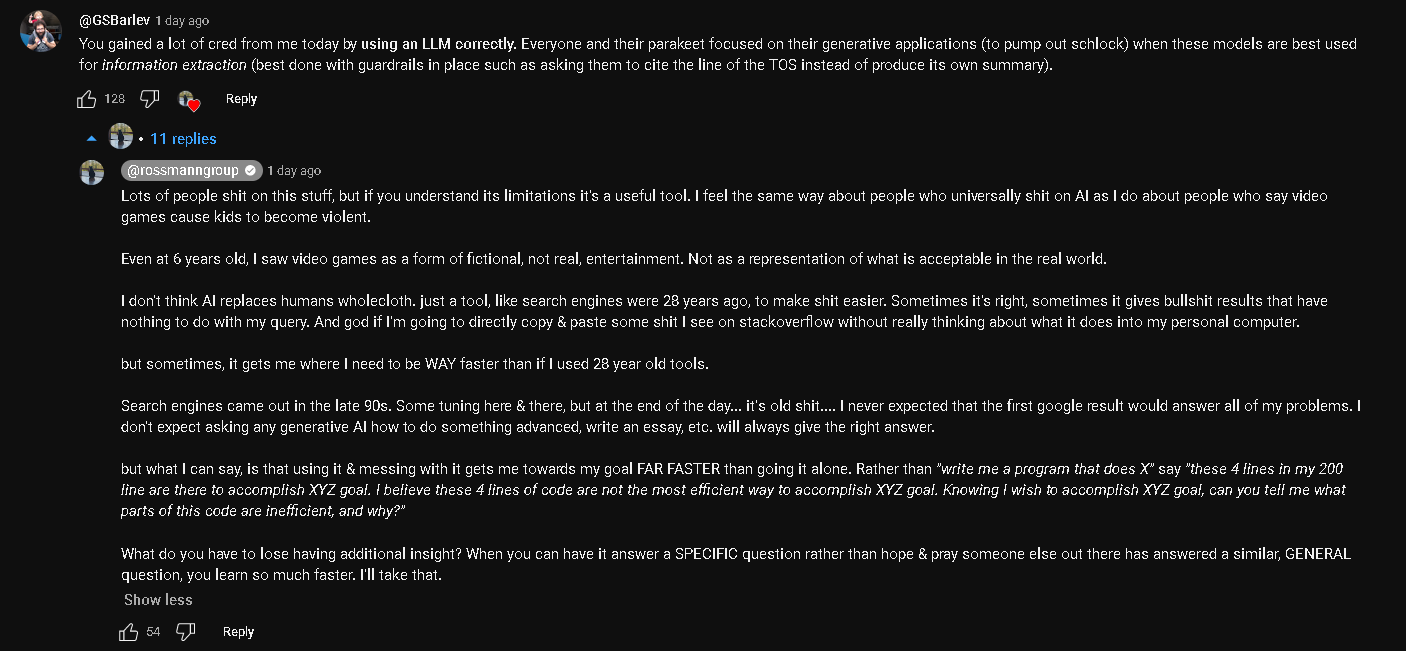
  5. Emphasis on understanding the terms of service before agreeing to them and using large language models to analyze and identify any abusive clauses in such agreements.
  6. Frustration with the provider's behavior and questioning the morality of their practices is expressed.
  7. Viewers are encouraged to be cautious and informed when choosing a hosting provider and prioritize their rights as consumers.
  8. Providers should carefully review their terms of service to ensure they are not engaging in abusive practices such as changing terms after a sale.
  9. Taking action to protect consumer rights is emphasized to prevent the issue from becoming more widespread.
  10. The importance of taking action to protect consumer rights, similar to the right to repair movement, is highlighted.

Pinned comment:
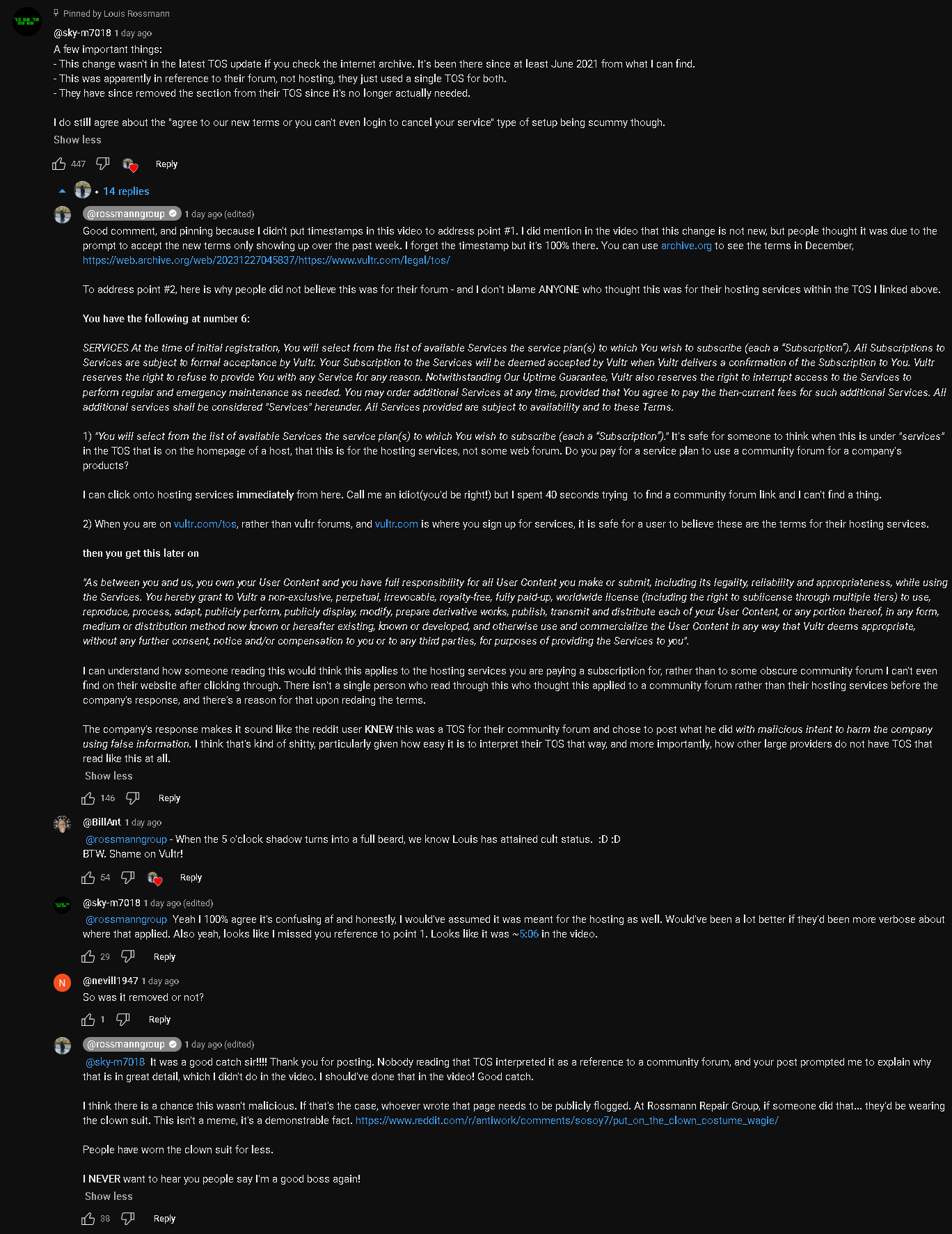
LLM and AI/search engine comment:
24


Links associated with video:

Short Summary

  1. The speaker discusses End User License Agreements (EULAs) and compares them to the behavior of a rapist using the tactic of "ruying" to manipulate consent.
  2. Criticism is directed towards companies like Sony and Roku for burying important terms in legal agreements and forcing users into agreements without the option to disagree.
  3. The video focuses on Roku's decision to implement a forced arbitration agreement on existing customers, removing their rights to legal recourse.
  4. The speaker argues that this move was likely a response to security breaches and hacking incidents, with Roku blaming users for weak passwords.
  5. The importance of transparency and consent in business practices is highlighted, and companies are criticized for taking advantage of consumers.
  6. The speaker questions the responsibility of companies like Roku and LG for attempting to change terms after a sale, such as holding customer devices hostage for agreeing to arbitration terms.
  7. Roku is criticized for denying any relation between new dispute resolution terms and hacked accounts, suggesting it's a cover-up.
  8. Distrust towards companies connecting devices to the internet is expressed, opting for secure options like pfSense routers and Linux computers.
  9. The video concludes by asking viewers for their thoughts and signing off.
25


Automakers Are Sharing Consumers’ Driving Behavior With Insurance Companies [Kashmir Hill | Mar 11 2024 | NYTimes]

https://www.nytimes.com/2024/03/11/technology/carmakers-driver-tracking-insurance.html

https://web.archive.org/web/20240311090514/https://www.nytimes.com/2024/03/11/technology/carmakers-driver-tracking-insurance.html

Short Summary

  1. The video discusses the concept of ownership in relation to modern technology and products, focusing on companies making it difficult for consumers to repair or control their belongings.
  2. It questions whether individuals truly own items like cameras, baby monitors, computers, and even cars when companies collect and sell data without explicit consent.
  3. An example is highlighted where a man's car insurance rates increased due to data collected by his car's manufacturer, General Motors, and sold to insurance companies.
  4. The video emphasizes the violation of consent and privacy in such practices, likening them to a form of digital violation.
  5. It mentions the practice of "ruffian end-user license agreements" where companies use deceptive tactics to obtain consent for data collection.
  6. The issue of usage-based insurance and the importance of explicit consent in data collection practices are discussed.
  7. Criticism is raised regarding the accuracy and safety of AI systems used to assess driving behavior, particularly highlighting issues with hard braking detection in Tesla vehicles.
  8. The speaker discusses the primary feature of a car being fast acceleration, emphasizing responsible use on a racetrack rather than public roads.
  9. Companies are criticized for engaging in anti-consumer practices such as lack of transparency in data sharing and not sharing profits made from selling customer data.
  10. The speaker stresses the need for consumer solidarity to protect their rights and prevent exploitation by corporations.
view more: next ›