ken

joined 2 weeks ago
[–] ken@discuss.tchncs.de 1 points 6 hours ago

Centralization and monoculture is a mistake.

[–] ken@discuss.tchncs.de 1 points 6 hours ago

In case it swings your judgement either way, Njalla is run by one of the three Piratebay founders.

[–] ken@discuss.tchncs.de 1 points 7 hours ago* (last edited 6 hours ago)

Dev here! Thanks for your interest!

Aw. On Artix, it wants to pull in wayland. No thanks.

Hm, I guess you're just running text mode browser on that machine..? On Arch the wayland package is pulled in as transitive dependency of the gtk3 package. I don't believe it will actually be loaded at runtime. However, I think that gtk3 might not be a hard dependency at all anymore (it used to be for Firefox in the past so this might be a leftover that konform inherited).

If you're comfortable with makepkg I could suggest trying the konform-browser-bin AUR package and simply remove gtk3 as dependency from the PKGBUILD, run makepkg -si and fingers crossed that might work. More details in konform-browser/Arch repo, where contributions are also welcome. If you go the source route, see the note about profiling without wayland.

EDIT: OK I took a look and unless Artix is repackaging some core packages, I don't see a way to make it work on Arch at least: xorg-server depends on libglvnd depends on mesa depends on wayland. Among others. Are you actually able to run an X server at all without having the wayland package installed? Or is thsi for headless use without any graphical environment...? Curious about the use-case! You can also try the binary tarball or just tar -xfing the arch package and invoke the konform binary directly.

Aw. https://gpo.zugaina.org/Search?search=konform no ebuilds on any listed overlays for Gentoo yet.

FWIW, it's not planned at the moment but here's the issue currently tracking Gentoo packaging: https://codeberg.org/konform-browser/source/issues/9

[–] ken@discuss.tchncs.de 5 points 1 day ago* (last edited 7 hours ago)

One thing to keep in mind as new is that "VPN" is a technical term with pretty clear meaning among the technical people but it has a very fuzzy meaning in marketing and branding. Referring here to "VPN apps" that may just be a local DNS relay (ie: it will only tunnel and filter your DNS requests; all your actual traffic still goes through your normal connection as clear as always). Oftentimes, it's what we would call a proxy. Android has not at all helped here.

In either case, yes, you can usually chain things. What if any benefits you get from that depends on both technical specifics (which protocols) and your circumstances and threat model.

For example, if we consider only Wireguard (one of the VPN protocols Mullvad offers).

No VPN/proxy: Your ISP sees everything

1 proxy: ISP sees that you are connecting to proxy but not what servers you're actually talking to. VPN provider now sees everything instead.

2 proxies: Proxy A sees your encrypted traffic to Proxy B. Proxy B sees all your traffic but doesn't know where you are.

3 proxies: Congratulations, you have manually built a shitty onion circuit (Tor works like this)

Mullvad has their own "multi-hop" feature which chains two Mullvad nodes but i have to question using that strictly for privacy reasons, considering it's by the same provider and the ports make it predictable from the ISP.


Hi Beehaw people! New here and hope some of you will take interest in this toolkit and accompanying writeup. :3


Set up a framework to fully man-in-the-middle my own browsers' networking and see what they're up to beyond just looking at their DNS queries and encrypted tcp packets. We force the browser to trust our mitmproxy cacert so we can peek inside cleartext traffic and made it conveniently reproducible and extensible.

It has containers for official Firefox, its Debian version, and some other FF derivatives that market a focus on privacy or security. Might add a few more of those or do the chromium family later - if you read the thing and want more then please let us know what you want to see under the lens in a future update!

Tests were run against a basic protocol for each of them and results are aggregated at the end of the post.


Apart from testing browsers themselves it can be useful for putting extensions under the lens. Making a modern browser properly accept a proxy and trust the mitmproxy cert is a lot more obscure and fiddly than it might seem so hopefully this can be helpful in empowering and pushing other people to peek inside what's actually going on inside their own systems without spending hours or days figuring out what actually makes it tick.

Rewritten cross-post. First Thread @ https://discuss.tchncs.de/post/53845514

[–] ken@discuss.tchncs.de 2 points 2 days ago

What about gwenview?

[–] ken@discuss.tchncs.de 1 points 2 days ago* (last edited 2 days ago) (1 children)

good point for the offlineimap cronjob, I’ll take note of that.

I might as well go as far as suggesting to start there with your current mail provider if the local/offline-first flow is something that could work for you (and assuming it's not something you already do, in which case carry on). Once you've adapted to a local-first mail reading flow with any client that's separate from the "app" or webmail tethered to your mail service, then rest of migrations should be smoother and hopefully feel less daunting. Doesn't mean you have to keep doing it that way only forever but establishing the infra and habit once for a while can help with both resilience and confidence in everything that follows.

If you're roaming between devices and places enough that local-first feels untenable then the "syncbox" could be a little SBC or whatever; it could be the machine you also use read and write mail from but doesn't have to be.

NP and good luck!

[–] ken@discuss.tchncs.de 1 points 2 days ago* (last edited 2 days ago) (3 children)

No experience with Migadu but yeah, I think 1 account = 1 login is the intended meaning in their FAQ.

At $19/year couldn't just gifting a separate micro sub to your SO might be a option if you adminning her email feels weird to either of you?

Am I missing something else?

You don't mention how you'll be accessing your emails so maybe this is something you already solved for: Regularly syncing down all mail locally means you won't have to rely on the mail provider as a single-point-of-failure for keeping your emails safe, secure, private and available. This could consist of anything from a simple offlineimap cronjob to a full-blown "offline" separate mail server.

[–] ken@discuss.tchncs.de 2 points 2 days ago* (last edited 2 days ago)

Maybe. But be careful about putting in that PIN or connecting it to your network when you get home, in case you get it back after...

[–] ken@discuss.tchncs.de 4 points 2 days ago* (last edited 2 days ago)

Hi, I'm new here, first time posting to this community, was hoping this could be well-received here.

I see this starting to attract downvotes - is this considered breaking any rule, are cross-posts frowned upon in general, is the content too basic for you 1337 h4xx0rz, title not serious enough, or some other issue with the post? Feedback appreciated.


Set up a framework to fully man-in-the-middle my own browsers' networking and see what they're up to beyond just looking at their DNS queries and encrypted tcp packets. We force the browser to trust our mitmproxy cacert so we can peek inside cleartext traffic and made it conveniently reproducible and extensible.

It has containers for official Firefox, its Debian version, and some other FF derivatives that market a focus on privacy or security. Might add a few more of those or do the chromium family later - if you read the thing and want more then please let us know what you want to see under the lens in a future update!

Tests were run against a basic protocol for each of them and results are aggregated at the end of the post.

Posting with ambition that this can trigger some follow-ups sharing derived or similar things. Maybe someone could make a viral blog post by doing some deeper tests and making their results digestible ;)


Cross-post. Original Thread @ https://discuss.tchncs.de/post/53845514

[–] ken@discuss.tchncs.de 2 points 2 days ago* (last edited 2 days ago)

Appreciate the links!

And the option "Always show scrollbars" enabled because I have not found the preference to do it through the configuration file.

The labeling makes it less obvious but that maps to widget.gtk.overlay-scrollbars.enabled=false so also part of Konform upcoming update :) In general I find the quickest way to identify the mapping of a UI configuration and the about:config key is to:

  • launch a clean profile
  • open about:config
  • click Show only modified preferences
  • open about:preferences
  • change the thing
  • tab back. what's new?

BTW, widget.non-native-theme.enabled is a no-op since the direct GTK integration was removed a while back: https://bugzilla.mozilla.org/show_bug.cgi?id=1726283#c4

[–] ken@discuss.tchncs.de 1 points 3 days ago* (last edited 3 days ago) (2 children)

You know, I think we should do at least something about those scrollbars^1^ too. Not sure how close this is to what you prefer but hopefully a more sane default with more traditional fixed-width scrollbars should be part of next release. In general aiming to keep subjective and aesthetic UI tweaking to a minimum but I think the usability argument supports this one at least until anyone voices a different opinion.

So ty for that suggestion and also thank you for the warm feedback you left on the repo! :3

^1^: Not only are they thin; they change the width dynamically when hovered and overlay on top of content. The potential for misclicks is not great.


Set up a framework to fully man-in-the-middle my own browsers' networking and see what they're up to beyond just looking at their DNS queries and encrypted tcp packets. We force the browser to trust our mitmproxy cacert so we can peek inside cleartext traffic and made it conveniently reproducible and extensible.

It has containers for official Firefox, its Debian version, and some other FF derivatives that market a focus on privacy or security. Might add a few more of those or do the chromium family later - if you read the thing and want more then please let us know what you want to see under the lens in a future update!

Tests were run against a basic protocol for each of them and results are aggregated at the end of the post.

Posting with ambition that this can trigger some follow-ups sharing derived or similar things. Maybe someone could make a viral blog post by doing some deeper tests and making their results digestible ;)


Good time-of-day, Linux users! I hope you will take kindly^1^ to coming here to tell you about Konform Browser and what it is. And also ask you to try it out in case this is your cup of tea :)

In short, Konform Browser is a web browser with the goal of promoting user freedom and access to the rights of security, privacy and anonymity. It is intended as a general-purpose browser fit both for daily online surfing as well as targeted deployments in secure or untrusted environments. It is fundamentally a patched build and custom configuration of Mozilla FireFox ESR. It started as a fork of LibreWolf and now stands on its own four feet.

Some highlights to give an idea to those familiar with LibreWolf or other FF fork:

  • Security: Konform is based on Firefox ESR instead of Rapid Release. This means a more stable base without missing out on the latest security updates, in exchange for longer time waiting for the newest features from Firefox. It also enables shorter lead times to backport upstream updates.
    • In this sense (and a few others), Konform Browser is closer to IceCat/GNUZilla than it is to Librewolf.
  • Freedom: Konform allows a higher level of customization. It gives the user control and trusts you with that responsibility. Some examples:
    • Allows enabling dark mode and following system theming even when Resist Fingerprinting is enabled
    • Allows installing your own self-built unsigned add-ons
    • "Spoof referer source" user configuration option
  • Privacy and security: Disables all browser features relying on external network connections.
    • "RemoteSettings" is completely disabled^2^.
    • No cloud "AI" integrations. You can run Konform on a disconnected network and not notice any reduced functionality.
    • All telemetry, metrics, and ads from the browser disabled.
    • OCSP turned off (but we have CRLite).
    • tcpdump and see the difference!

I should add that even if we contrast with LibreWolf above, this is not at all meant as a dig or criticism. I think they have done and continue to do great contributions for the benefit of all of us. That we chose it as upstream and that it's the easiest to compare with is a testament both to how closely aligned we are and that Konform has a lot to thank Librewolf and the wider Firefox customization community for. Like they built from Librefox and Arkenfox to bring private browsing to a wider audience, so are we but the next to try help widen and deepen the browser ecosystem.

The recommended installation method is building from source but there are also binary packages for x86_64 and arm64 built by Codeberg CI. Currently Linux only, considering Android next and could use some assistance with that.

Doors open for users, testers and contributors. Looking forward to hear what you think and if there's anything missing!

^1^: Disclosure: Am dev. This is a rewritten crosspost.

^2^: This means that local full-page translation is also unavailable even if in principle it should be possible to bundle and run translations fully locally. It's just the way Mozilla built it. Patches towards allowing users to enable fully offline translations would be very welcome.


Sources: https://codeberg.org/konform-browser

Deb / RPM / Tarball / Container image

See releases for details.

Arch User Repo package

Arch User Repo binary package

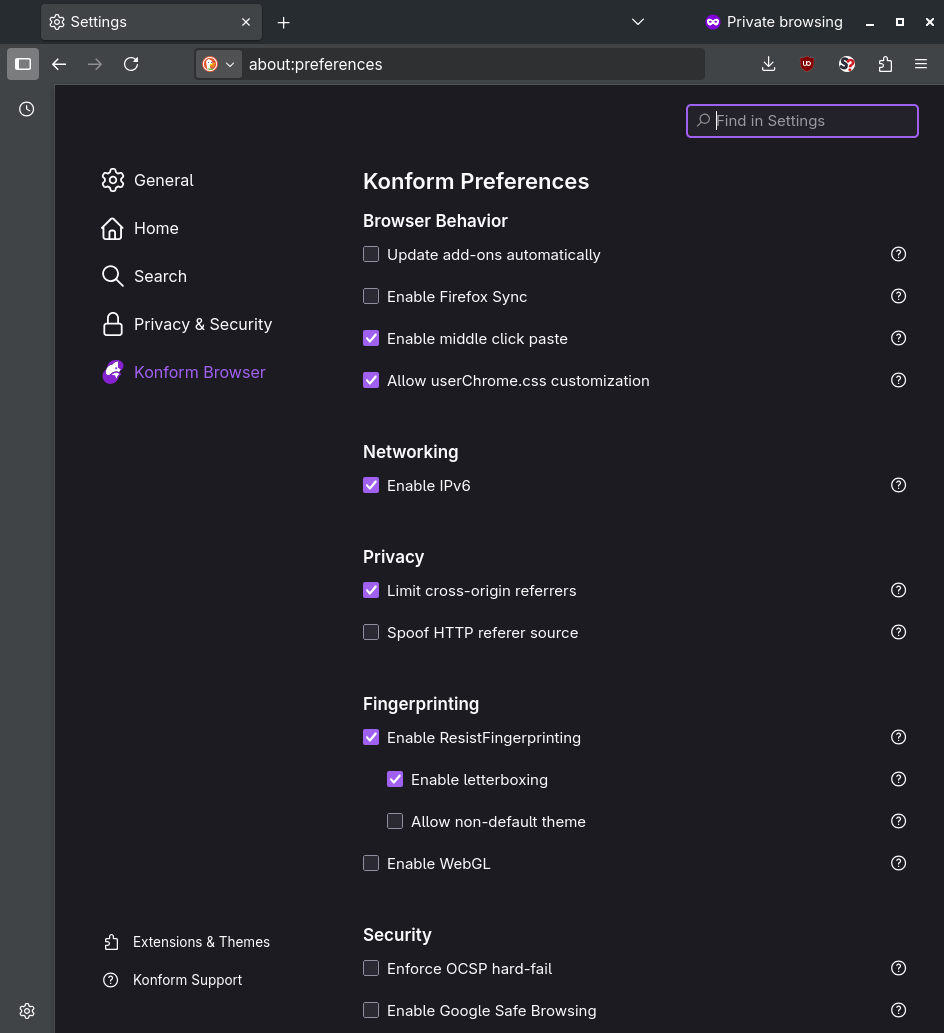
Screenshot


There is a new Firefox fork in town: Konform Browser. Its focus is privacy, security and user freedom. Yes, I know this sounds familiar - but hear me out, I do think we have something to bring to the table!

The project started as a fork of LibreWolf and now stands on its own four feet.

Some highlights to give an idea to those familiar with LibreWolf or other FF fork:

  • Security: Konform is based on Firefox ESR. This means a more stable base without missing out on the latest security updates, in exchange for longer time waiting for the newest features from Firefox. It also enables shorter lead times to backport upstream updates.
    • In this sense (and a few others), Konform Browser is closer to IceCat/GNUZilla than it is to Librewolf.
  • Freedom: Konform allows a higher level of customization. It gives the user control and trusts you with that responsibility. Some examples:
    • Allows enabling dark mode and following system theming even when Resist Fingerprinting is enabled.
    • Allows installing your own self-built unsigned add-ons
    • "Spoof referer source" user configuration option
  • Privacy and security: Disables all browser features relying on external network connections.
    • "RemoteSettings" is completely disabled^1^.
    • No cloud "AI" integrations. You can run Konform on a disconnected network and not notice any reduced functionality.
    • All telemetry, metrics, and ads from the browser disabled.
    • OCSP turned off (but we have CRLite).
    • tcpdump and see the difference

I should add that even if we contrast with LibreWolf above, this is not at all meant as a dig or criticism. That we chose it as base and that it's the easiest to compare with is a testament both to how closely aligned we are and that Konform has a lot to thank Librewolf and the wider Firefox customization community for. Like they built from Librefox and Arkenfox to bring private browsing to a wider audience, so are we but the next to try help widen and deepen the browser ecosystem.

The recommended installation method is building from source but there are also binary packages for x86_64 and arm64 built by Codeberg CI. Currently Linux only, considering Android next and could use some assistance with that.

Doors open for users, testers and contributors. Looking forward to hear what you think and if there's anything missing.

^1^: This means that local full-page translation is also unavailable even if in principle it should be possible to bundle and run translations fully locally. It's just the way Mozilla built it. Patches towards allowing users to enable fully offline translations would be very welcome.


Sources: https://codeberg.org/konform-browser

Arch User Repo package

Deb / RPM / Tarball

See releases for details.

Screenshot


Redmond97-SE is a living continuation of the now unmaintained Redmond 97.

"Redmond" style themes for GTK, Xfce, Metacity, WINE.

Includes both old-school retro variants to emulate Win9x/2000/XP, plus more modern darks for the productivity-focused desktop.

AUR packaging for Arch Linux just dropped.

44
submitted 2 weeks ago* (last edited 2 weeks ago) by ken@discuss.tchncs.de to c/unixporn@lemmy.world
 
  • Distribution: QubesOS 4.3
  • Desktop Environment: Xfce
  • Theme: Redmond97-SE
  • Window Manager: Xmonad
  • Terminal: xterm + tmux
  • Launcher: Rofi^1^
  • Bar: xfce4-panel

Windows

Top-left to bottom right:

  1. neovim "IDE" with integrated terminal editing dotfiles (Debian)
  2. dom0 admin terminal (Fedora)
  3. Qubes Manager looking at some templates (Fedora)
  4. Thunar File manager about to move a file between qubes (Whonix)
  5. Konform Browser browsing codeberg (Arch Linux)

Each app and window can belong to a separate qube (Xen VM), visually discriminated by differing color schemes.

Thanks to Ben Grandes qusal which was very helpful as base for setting things up.

This is a setup optimized for productivity and efficiency, which is reflected in the lack of eye-candy and gratuitous margins.

^1^: Not pictured - I figured the screenshot was busy enough. If y'all want to see more LMK.


For those of you still not satisfied with the Firefox fork ecosystem, we propose to you Konform Browser. Yes, it's another one about privacy and security with a canine logo. But I do think we have something to bring to the table.

This started as a fork of LibreWolf and now stands on its own four feet.

Some highlights to give an idea to those having used LibreWolf or another FF fork:

  • Security: Konform is based on Firefox ESR. This means a more stable base without missing out on the latest security updates, in exchange for longer time waiting for the newest features from Firefox.
    • In this sense (and a few others), Konform Browser is closer to IceCat/GNUZilla than it is to Librewolf.
  • Freedom: Konform allows a higher level of customization. It gives the user control and trusts you with that responsibility. Some examples:
    • Allows enabling dark mode and following system theming even when Resist Fingerprinting is enabled.
    • Allows installing your own self-built unsigned add-ons
    • "Spoof referer source" user configuration option
  • Privacy and security: Disables all browser features relying on external network connections^1^.
    • "RemoteSettings" is completely disabled^2^.
    • No cloud "AI" integrations. You can run Konform on a disconnected network and not notice any reduced functionality.
    • All telemetry, metrics, and ads from the browser disabled.
    • OCSP turned off.
    • tcpdump and see the difference

Oh, and it actually builds on Arch, in contrast to IceCat^3^. In fact, currently the only supported distribution channels are source on Codeberg and AUR.

While it's not entirely newborn, it's still early days so we won't say "trust me bro" here - this is currently not ready for a non-technical audience but rather looking to engage with people who might already be building their own Firefox or Chromium forks. Continuing work on what we consider a production-ready browser while not rushing to ship a single binary is intentional.

I should add that even if we contrast with LibreWolf above, this is not at all meant as a dig or criticism. That we chose it as base and that it's the easiest to compare with is a testament both to how closely aligned we are and that Konform has a lot to thank Librewolf and the wider Firefox customization community for. Like they built from Librefox and Arkenfox to bring private browsing to a wider audience, so are we but the next to try help widen and deepen the browser ecosystem.

Doors open for users, testers and contributors. Looking forward to hear what you think and if there's anything missing.

^1^: One notable exception is allowing the bundled uBlock origin to perform filter lists updates.

^2^: This means that local full-page translation is also unavailable even if in principle it should be possible to bundle and run translations fully locally. It's just the way Mozilla built it. Patches towards allowing users to enable fully offline translations would be very welcome.

^3^: For now; I'm sure they will fix it too. Lots of respect for the GNUZilla/IceCat people.

https://codeberg.org/konform-browser

https://aur.archlinux.org/packages/konform-browser

Screenshot


For those of you still not satisfied with the Firefox fork ecosystem, we propose to you Konform Browser. Yes, it's another one about privacy and security with a canine logo. But I do think we have something to bring to the table.

This started as a fork of LibreWolf and now stands on its own four feet.

Some highlights to give an idea to those having used LibreWolf or another FF fork:

  • Security: Konform is based on Firefox ESR. This means a more stable base without missing out on the latest security updates, in exchange for longer time waiting for the newest features from Firefox.
    • In this sense (and a few others), Konform Browser is closer to IceCat/GNUZilla than it is to Librewolf.
  • Freedom: Konform allows a higher level of customization. It gives the user control and trusts you with that responsibility. Some examples:
    • Allows enabling dark mode and following system theming even when Resist Fingerprinting is enabled.
    • Allows installing your own self-built unsigned add-ons
    • "Spoof referer source" user configuration option
  • Privacy and security: Disables all browser features relying on external network connections^1^.
    • "RemoteSettings" is completely disabled^2^.
    • No cloud "AI" integrations. You can run Konform on a disconnected network and not notice any reduced functionality.
    • All telemetry, metrics, and ads from the browser disabled.
    • OCSP turned off.
    • tcpdump and see the difference

Oh, and it actually builds on Arch, in contrast to IceCat^3^. In fact, currently the only supported distribution channels are source on Codeberg and AUR.

While it's not entirely newborn, it's still early days so we won't say "trust me bro" here - this is currently not ready for a non-technical audience but rather looking to engage with people who might already be building their own Firefox or Chromium forks. Continuing work on what we consider a production-ready browser while not rushing to ship a single binary is intentional.

I should add that even if we contrast with LibreWolf above, this is not at all meant as a dig or criticism. That we chose it as base and that it's the easiest to compare with is a testament both to how closely aligned we are and that Konform has a lot to thank Librewolf and the wider Firefox customization community for. Like they built from Librefox and Arkenfox to bring private browsing to a wider audience, so are we but the next to try help widen and deepen the browser ecosystem.

Doors open for users, testers and contributors. Looking forward to hear what you think and if there's anything missing.

^1^: One notable exception is allowing the bundled uBlock origin to perform filter lists updates.

^2^: This means that local full-page translation is also unavailable even if in principle it should be possible to bundle and run translations fully locally. It's just the way Mozilla built it. Patches towards allowing users to enable fully offline translations would be very welcome.

^3^: For now; I'm sure they will fix it too. Lots of respect for the GNUZilla/IceCat people.

https://codeberg.org/konform-browser

https://aur.archlinux.org/packages/konform-browser

Screenshot

view more: next ›