Chemistry

762 readers
1 users here now

founded 4 years ago
MODERATORS
1


What are your thoughts on glove use in an organic chemistry lab setting?

I was trained from my Bachelor's to always wear gloves in lab unless using equipment and lab computers with clear instructions stating otherwise. Even in the safety course during my Ph.D., we discussed the benefits of wearing gloves as an extra layer of protection that buys time to reduce chemical exposure. No glove can behave as a barrier to all chemicals, but I was trained to be vigilant to chemical exposure on my gloves and remove them as quickly as possible.

I have recently joined another academic lab as a postdoc, and I learned that this chemistry department takes the exact opposite stance to glove safety. Here, gloves apparently only give researchers a false sense of security that can dull the sense of touch and prevent you from recognizing chemical exposure. This delay can then increase your chemical exposure as the chemical absorbs through the glove. I always see my labmates and others grab chemicals and solvents without gloves.

Before you get judgemental, I'm not a complete prude. I have been known to grab clean looking bottles and containers without gloves. But some of these people have been trained to the point where they are comfortable grabbing nasty ass bottles as if there isn't an increased risk.

Honestly, people can do what they want. I am mostly salty about the gentle reprimands I get every month of lab safety and my misuse of gloves.

2
3


https://en.wikipedia.org/wiki/Hexanitrogen

Hexanitrogen (diazide, hexaaza-1,2,4,5-tetraene) is an allotrope of nitrogen with the formula N6. The six nitrogen atoms are all covalently bonded in a single molecule: two azide units linked to each other. Its stability and structure were theorized in 2016 and its synthesis was reported in 2025. It is stable at cryogenic temperatures.

4


Four Thieves Vinegar Collective talking about building medications DIY on CCC, shared on kolektiva.media.

5


cross-posted from: https://lemmy.dbzer0.com/post/52150351

My bicycle was simply sitting at rest indoors when it exploded. A slit about ~6mm long was in the tube. I thought it might be too big to patch, but I happen to have some quit big patches to try. I cleaned the area w/denatured alcohol then roughened the surface w/the sanding tool. I covered the whole patch footprint area with rubber cement. Around 90 sec. later applied the patch and lightly clamped it down. About 5 min later: installed the tube and inflated to 4.5 bar.

Couple min later it exploded again. As the image shows, it blew exactly along the line of the original slit. AFAICT, I could not have applied this patch better. That is, the air went through the patch instead of around it.

Why did this happen? The patch is thicker and harder than the tube. So if the adhesive does its job well, then I would expect the patch to be stronger than the rest of the tube. The elasticity is lower in the patch, so I suppose that must be the problem.

So I have to wonder: would it be more or less effective to cut previously damaged spare tubes to use for patching, instead of a patch? I wonder if larger holes need patches with more elasticity.

Rubber cement vs. contact glue

Patch kits include a tiny tube of “rubber cement”. The instructions say to wait 3 min before applying the patch. That’s similar to contact glue instructions. The only difference is contact glue instructions direct us to glue BOTH surfaces then press them together a few min later, whereas the repair kits never say to put glue on the patch (why is that?).

Are the two glues chemically different? I ask because it may not make sense for me to buy another patch kit when I happen to have a very big tube of contact glue for shoe repair.

6
7


Dr Thomas de Prinse undertakes the fourth and fifth steps of his large-scale cubane synthesis, the Diels-Alder and the double deprotection.

Previous episode

8
9
10


Recent Veritasium video on per- and polyfluoroalkyl substances.

11


cross-posted from: https://mander.xyz/post/31227704

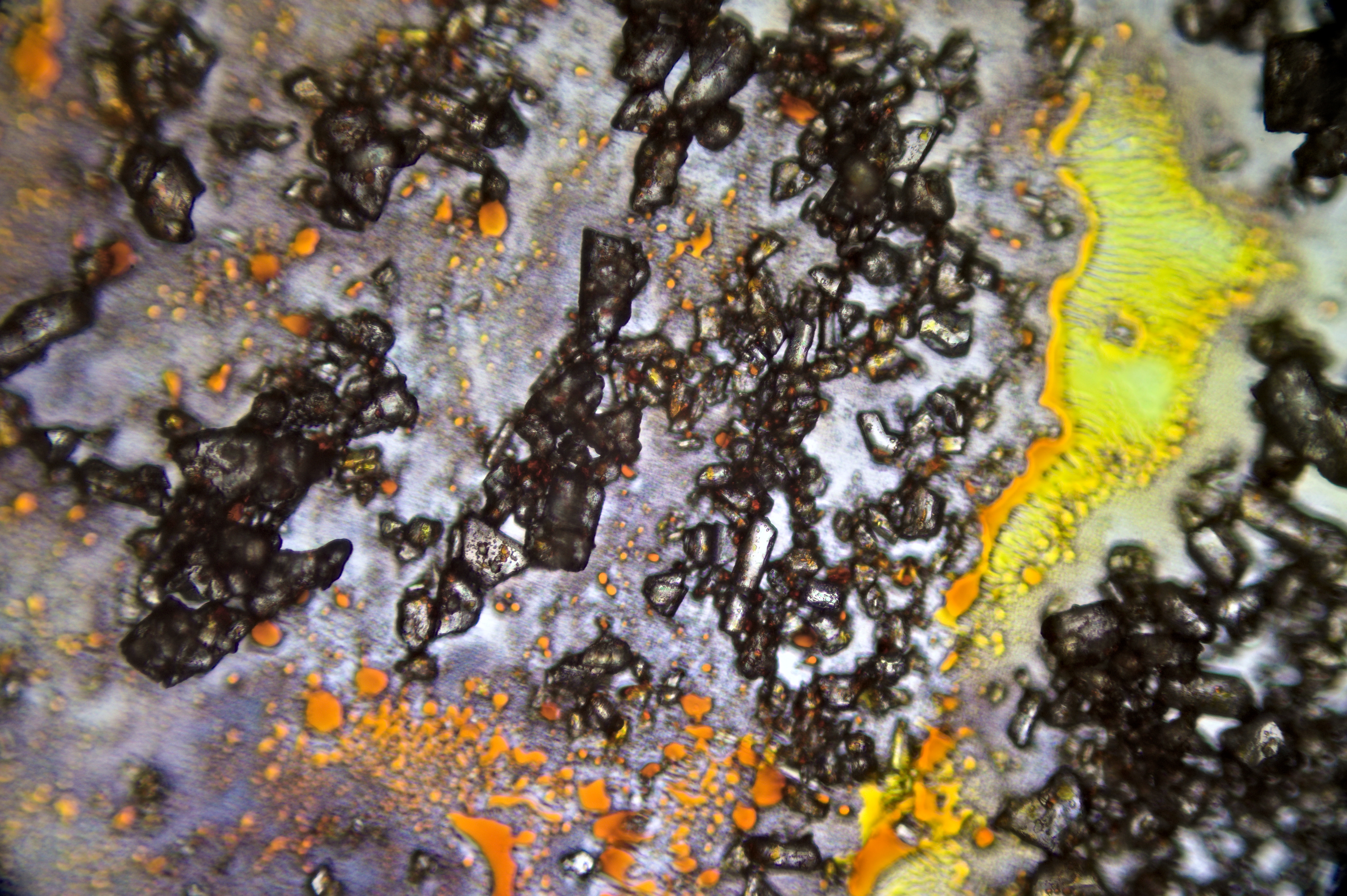
This weekend I did some experiments with turmeric powder. Here are some images of the results, and the description of how to create these microscopic chemical landscapes is given below.

Turmeric powder is a fantastic material to play with. The powder has a high concentration of colored and fluorescent curcuminoids and volatile turmerone oils.

When you use a polar solvent to extract these compounds, what you get is a kind of fluorescent oily resin called a turmeric 'oleoresin'.

The curcuminoids are yellow at acidic and neutral pH, but they become bright red at high pH due to keto-enol tautomerization. There is a lot of cool things you can do with the curcuminoids in terms of photo/electrochemistry.

I have been playing with very simple chemistry under the microscope, and I have noticed that you can create some cool-looking micro-landscapes. During this process you can also see different types of physico-chemical processes happening in real time.

Procedure to do this:

  • Place a few grams of turmeric powder into a glass container
  • Add enough isopropanol to cover the material, and a bit more
  • Mix
  • Wait for the solids to settle
  • Collect a bit of the isopropanol liquid from the top and place on a glass coverslip
  • Wait for the isopropanol to evaporate.

At this time, you can see under the microscope that golden oil droplets have been deposited, and that the surroundings are also yellow. The drops are oleoresins, which consist of curcuminoids suspended in turmerones and other oily compounds. Thin curcuminoid films might also be forming in between these droplets.

  • Add a sprinkle of baking soda crystals (sodium bicarbonate) on top of the coverslip. You can blow on the coverslip if you accidentally add too much.

  • Add a small drop of water, and wait a bit.

At this time you can see that the crystals are dissolving under the microscope, but the colors are not changing. The water and oils are not mixing, and so you get this film of alkaline water surrounding the oil droplets, but nothing is yet really changing.

  • After waiting a few minutes, add a drop of isopropanol.

Now the isopropanol will re-dissolve the oleoresin and mix with the alkaline water. The carbonate ions are now able to react with the curcuminoids, and when they do, they go into the ketone form and instantly turn red. Under the microscope you can see quite dramatic movements of yellow and rad streaking as well as turbulent movements of the baking soda crystals.

  • Wait some time for the liquids to evaporate again

  • You will end up with a landscape that combines yellow resins, red resins, sodium bicarbonate crystals, and several different patterns.


You can vary the parameters - the amount of sodium bicarbonate, the position and size of the drops, you can pre-mix the water and isopropanol, etc. Small changes can drastically affect the resulting landscape.

12
13


From the description:

We're at GSI in Germany where rare samples of enriched isotopes are fashioned into targets for their epic accelerator.

Featuring Sir Martyn Poliakoff speaking with Dr Bettina Lommel in the Target Lab.

14


Dr Thomas de Prinse undertakes the third step of his large-scale cubane synthesis, the bromination of the ethylene ketal of cyclopentanone to its tribromocyclopentanone derivative.

Previous episode

15
16


A humorous look at FOOF by the inimitable Derek Lowe

17


This is not some sort of fancy new development, but it's such a classical experiment that it's always worth sharing IMO. Plus it's fun.

When you initially mix both solutions, nothing seems to happen. But once you wait a wee bit, the colour suddenly changes, from transparent to a dark blue.

There are a bunch of variations of this reaction, but they all boil down to the same things:

  • iodide - at the start of the reaction, it'll flip back and forth between iodide (I⁻) and triiodide ([I₃]⁻)
  • starch - it forms a complex with triiodide, with the dark blue colour you see in the video. But only with triiodide; iodide is left alone. So it's effectively an indicator for the triiodide here.
  • some reducing agent - NileRed used vitamin C (aka ascorbic acid; C₆H₈O₆), but it could be something like thiosulphate (S₂O₃²⁻) instead. The job of the reducing agent is to oxidise the triiodide back to iodide.
  • some oxidiser - here it's the hydrogen peroxide (H₂O₂) but it could be something like chlorate (ClO₃⁻) instead. Its main job is to oxidise the iodide to triiodide. You need more than enough oxidiser to be able to fully oxidise the reducing agent, plus a leftover.

"Wait a minute, why are there a reducing agent and an oxidiser, doing opposite things? They should cancel each other out!" - well, yes! However this does not happen instantaneously. And eventually the reducing agent will run dry (as long as there's enough oxidiser), the triiodide will pile up, react with the starch and you'll get the blue colour.

Here are simplified versions of the main reactions:

  1. 3I⁻ + H₂O₂ → [I₃]⁻ + 2OH⁻
  2. [I₃]⁻ + C₆H₈O₆ + 2H₂O → 3I⁻ + C₆H₆O₆ + 2H₃O⁺

(C₆H₆O₆ = dehydroascorbic acid) Eventually #2 stops happening because all vitamin C was consumed, so the triiodide piles up, reacts with the starch, and suddenly blue:

18


Dr Thomas de Prinse makes yttrium oxide doped with erbium and ytterbium.

Upconversion: Material absorbs two infrared photons, emits one visible photon.

19


A chemist told me rust does not spread. The top of my refrigerator gives me some doubt. It’s covered in these spots. The center of every spot is a small break in the paint, but the rust all around those spots is on top of the paint.

20


cross-posted from: https://lemmy.ca/post/39143995

The authors of the academic study, published in the Journal of the American Chemical Society on Thursday, had to get the smell from inside the sarcophagus without interfering with the mummy inside.

The researchers, from UCL and the University of Ljubljana in Slovenia, did so by inserting a tiny tube so they were able measure the scent without taking any physical samples.

If you want to smell the smell too

They say recreating the composition of the smells chemically will allow others to experience a mummy's whiff - and help to tell when the bodies inside may be starting to rot.

"We want to share the experience we had smelling the mummified bodies, so we're reconstructing the smell to be presented in the Egyptian Museum in Cairo," Cecilia Bembibre, one of the researchers, told BBC Radio 4's Today programme.

21


It's not really "professional" but you can look at the process, see the results and come to your own conclusion about it's viability.

22
23
24
25


[Maurycyz] points out right up front: several of the reagents used are very corrosive and can produce toxic gasses. We weren’t sure if they were trying to dissuade us not to replicate it or encourage us to do so. The project in question is making strontium aluminate which, by the way, glows in the dark.

The material grows strongly for hours and, despite the dangers of making it, it doesn’t require anything very exotic. As [Maurycyz] points out, oxygen and aluminum are everywhere. Strontium sounds uncommon, but apparently, it is used in ceramics.

view more: next ›