
Explanation: In the medieval period, the Byzantine Empire, the successor state of the Roman Empire of old, faced down continual assaults by Muslim polities from its eastern border.
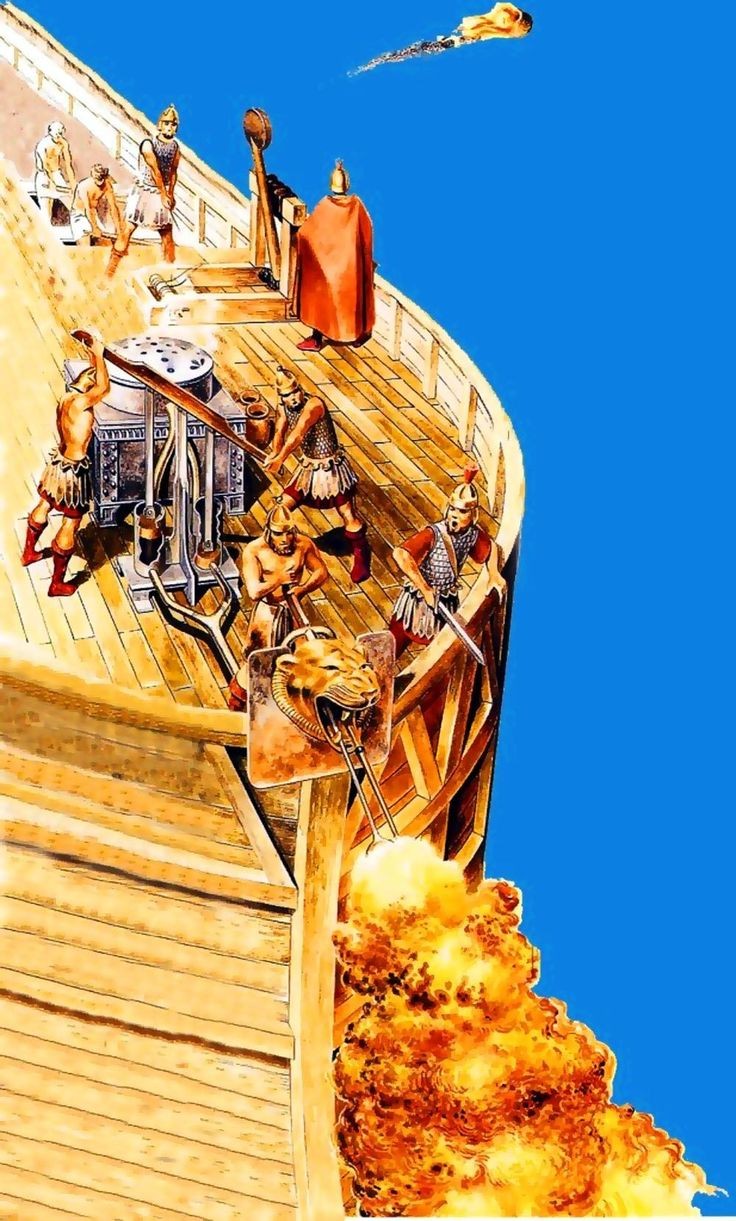
Against this threat, they had Greek Fire - a marvelous and terrifying concoction something like napalm. They would use hand-pumps and siphons to spray it onto enemy ships, at which point the enemy ship was pretty damn done-for. This would give them a disproportionate advantage in naval combat until Constantinople (now Istanbul) was sacked by Western Crusaders (see below statement on Byzantine and Christian unity), after which its usage appears to drop off sharply.
... they didn't have much else. The Byzantines were a terribly fractious bunch, prone to coups, counter-coups, and civil wars, and without strong, lasting institutions other than the Christian Church (... itself prone to coups, counter-coups, and civil wars).
Despite the Sunni/Shia split, the Muslim polities to their east were generally coherent and cohesive enough to form a enduring and credible threat, and thus were capable of taking advantage of any period of Byzantine weakness, instead of needing the stars of "Not being fucked over by internal politics" and "Ruled by someone competent" to align.
Islam's core holy text, the Quran, includes fairly thorough instructions not just on theology and religious law, but also how a (Muslim) society should be organized, which offers less room for the "New tax system just dropped! Whoops, Old Emperor died; old tax system came back! New Emperor was just couped by Old Emperor's partisans, new old tax system came back! Coup Emperor decrees a reformed tax system; half the bureaucrats in the Empire ignore it and use either the new or old tax system!" level chaos that defined the later Byzantine Empire.
Institutional continuity, even just in "Everyone knows how the process is supposed to go" is... often underrated as a strength of societies.
Also Mashallah and whatnot