ReadFanon

joined 2 years ago
[–] ReadFanon@hexbear.net 7 points 1 year ago

Mr Beast has achieved the Platonic level of political-philosophical development!

Only about another 2.5 millenia to go before he catches up. Look out world, here he comes.

[–] ReadFanon@hexbear.net 1 points 1 year ago

Here's a couple of photos of some emus I encountered once upon a time. I was in a vehicle and they kinda dashed by fairly quickly so I didn't get a chance to take some really good shots but it was neat to see them in the wild.


[–] ReadFanon@hexbear.net 2 points 1 year ago (1 children)

I like thinking about my birthdays as being anniversaries of my survival. I'm not sure if it's going to be suitable for your situation but for me instead of thinking back to my childhood or my shitty family, I like framing it as being a yearly marker where I've succeeded despite the odds.

This feels safer and more comfortable for me because it allows me to acknowledge hardships that I've faced and I don't feel compelled to feel enthusiastic or to celebrate things that don't really resonate with me. I can be like "Fuck yeah, I worked hard at this and I made it through another one". This also has the upshot of taking the pressure off of me from feeling the pressure to celebrate it with others because my survival is a very personal affair and I wouldn't feel inclined inclined to invite other people to join in this because it's not about them and it's not for them. Although this also allows room for change too because I am able to welcome people into this experience of celebrating my survival, if I choose to.

There are things to hold out for. The world is changing very rapidly these days and the advances in medicine are pretty astonishing. I completely understand what it's like to question whether it's worth continuing on if things are going to remain as they are right now but try to allow space for the fact that choosing to continue means that you are allowing for the opportunity for things to improve, and that's truly invaluable. I know that it it probably doesn't feel like it's true but I genuinely mean it when I say that it is.

I also want to mention that a typical person tends to underestimate themselves. A person who struggles with serious challenges in their lives and especially in their mental health tends to underestimate themselves even more. You are stronger, more intelligent, more valued, and more resourceful than that part of you which wants to convince you otherwise.

In other news, a little while back I made a post about how anticapitalist and socialist discourse has become super normalised in the media and I keep on coming across random, basically apolitical content where people shit on capitalism openly and directly. I've even seen the milquetoast progressive-ish left which is very hostile to radical politics engaging with concepts and symbolism of the radical left and I think that's because they do not feel comfortable in ignoring it any longer. The anti-landlord discourse has also kicked up massively in the past couple of years especially, at least in my corner of media consumption and it has already become completely normalised. People who aren't diehard communists will do things like mention Mao in comments sections when landlords get discussed lol. I used to feel like the fringe lunatic ranting and raving about radical stuff in most mainstream corners of social media. These days I routinely come across ideas and comments where I simply agree with no notes to add and often there will be comments that surprise me in how openly radical they are.

Also I'm putting a freshwater shrimp tank together for the first time in my life. It's been a bit delayed due to a period of worsened mental health for me and being broke/putting too much money towards causes but soon enough I'm going to have an aquarium for the first time in my life and I'll have some little critters doing their thing in the tank. Not that exact type of shrimp but something similar. I'm looking forward to trying my hand at doing some aquascaping and seeing how I go with setting up the aquarium, and I'm excited share some pics of what I put together. I hope I'll be able to show you the completed project sometime soon.

Anyway, I hope that things go smoothly for you. Of course in the long term but especially in the next week or so.

[–] ReadFanon@hexbear.net 3 points 1 year ago

There is no fundamental difference between someone sitting at a wordprocessor and someone holding the codes to the most powerful nuclear arsenal in the world and having command of the world's largest military.

Also, yet another example of a lib trying to do political analysis but only being able to muster an analogy.

[–] ReadFanon@hexbear.net 2 points 1 year ago

Much more difficult to remove than typical stickers but don't presume that they are impervious.

You can use solvents to attack the adhesive and mechanically removing them with a flat bladed scraper of some description is still going to do the job.

Good for higher trafficked areas where people are inclined to opportunistically rip stuff down and where wheatpaste + makeshift eggshell-esque posters which have razor slashes through the paper aren't suitable. Cost is a consideration though.

[–] ReadFanon@hexbear.net 2 points 1 year ago

Seconding this recommendation

If you invest a few bucks in a decent controller that can connect to android and PC then it opens up a ton of options to you.

I know Bitdo does some popular controllers that seem to be in that sweet spot of decent quality and but I've never tried any of them.

I have a Gamesir T4 pro, which gets recognised as an Xbox controller on PC so it's good for steam games and it has all the features that make it an ideal all-rounder in my experience. It comes with a controller mount so you can attach a smartphone to it as well but I've never used it.

[–] ReadFanon@hexbear.net 1 points 1 year ago* (last edited 1 year ago)

The EZLN does not identify with the western political paradigm and thus they are not anarchist and they openly reject the label, but they are radical and they are opposed to MLism, not in an absolute opposition sort of way but in a strongly critical sort of way.

Subcommandante Marcos has written criticisms of MLism and similar stuff. One of his big communiques in this respect is the unequivocal I Shit On All the Revolutionary Vanguards of this Planet which is a response to criticisms leveled against the EZLN.

For something a bit more dry and measured is Listen, Marxist! by Murray Bookchin, who is a contentious figure in anarchism as he too doesn't truly fit within anarchism as he broke with it later in his life, although this piece was written prior to this development in his politics so I'd say it's a decent example of an anarchist counter-argument to what MLs argue for.

For a longer-form defense of the anarchist position in a more general sense, one that addresses ML criticisms without necessarily responding directly to them, is Anarchy Works by Peter Gelderloos. It's not really something that attempts to deconstruct the ML position but I think that it will still be valuable in challenging your beliefs.

[–] ReadFanon@hexbear.net 3 points 1 year ago

Not a big fan of his overarching narrative, especially in matters of history.

He lavishes glowing praise on anything anarchist in a way that is entirely blinkered to the realities and is without critical analysis. For example, he will extol the virtues of the economy of the Spanish Republic but he refuses to actually engage in the (scanty) historical scholarship and acknowledge that there were critical flaws within the Spanish Republic and clear problems especially especially to do with labour discipline, or he will deny the Eichenfeld massacre.

He's extremely dogmatic.

I have had very productive discussions with anarchists about these sorts of matters. If you can acknowledge that an anarchist revolution is going to have excesses and that, historically, excesses have occurred and that they need to be learned from in order to mitigate the risk of them happening in the future then we're going to get along just fine.

If you look me dead in the eye and deny the Eichenfeld massacre or claim that valid criticisms of Makhno's personal conduct as de facto leader of the Makhnovshchina that came directly from a member of the Military Revolutionary Council are merely Bolshevik propaganda, without actually having done any research into these things, then we are not going to get along.

In my experience, Anark falls into the latter category. He is not a person I would be comfortable with even back when I was an anarchist.

[–] ReadFanon@hexbear.net 20 points 1 year ago (1 children)

The immediate defense for accusations of it being racist are that it cannot be since it originated in China. Because Chinese people, obviously, cannot be racist and lateral violence does not exist. Also meaning is fixed and there is only one interpretation of any given thing and that's the original intent of the creator. That's why the Roman salute and the swastika don't have any fascist implications.

The easiest way to dismiss this defense is not by engaging it but by saying "You should go and find your nearest black community and use the terms they refer to eachother by to see how far this argument gets you."

I find that one of the best ways to shut down debate perverts is to encourage them to try out these ideas they so vehemently attest to holding in the real world. At best, they shut up about it because they know they are wrong and at worst they'll double down and keep trying to convince you that they are right and you can just brush them off and ask them to report back once they've enacted their ideas.

Another thing that has a similar vibe because it embraces someone's foolishness that I've been using recently is, when I come across a person who is really doggedly anti-intellectual or completely detached from reality, I'll explain why they are wrong and then tell them that this is part of the attitide/culture that is undermining the country (since it's usually the US, although this also works for countries like the UK as well) and because I am eagerly looking forward to the country's inevitable demise I applaud their contributions towards this effort and I encourage them to do more of it.

Basically I tell them that they are a fool, how they are a detriment to society, and that I want them to keep it up because if everyone is like them then their country is destined to collapse.

You can apply this to anything - vehemently anti-trans person? Applaud them for failing to grasp that decades of neoliberalism and class warfare from the ultra-rich are what is causing the rot at the core of the country and instead by wasting all of their energy on the culture war and on being outraged that trans people exist they are accelerating the destruction of the country. (Obviously this argument is not a Marxist one but you've gotta pitch things at the level the audience is at - I'd rather have a chance at them walking away from the exchange dazed and confounded, and hopefully poisoning their bigoted crusade, than to have them instantly reject what I say because they've identified me as a communist.) If they are anti-BLM or anti-communist or anti-tankie or whatever else, you can usually apply the same basic formula. It even works on Vaushites.

[–] ReadFanon@hexbear.net 25 points 1 year ago (3 children)

If only there were some way of mobilising the masses to go out and vote. Unfortunately, having already won the war of ideas, there is no point considering what might do that or how Obama managed a 65% turnout because there's no need to engage in ideas anymore.

The only thing left to do is to continue to shame people into voting and to triple down on Biden. The DNC cannot fail, it can only be failed 🫠

[–] ReadFanon@hexbear.net 4 points 1 year ago* (last edited 1 year ago)

Big Leon Blum energy

Allow me yoto explain: this dork was the leader of the SFIO, which was ostensibly opposed to colonialism.

Blum sought a course of appeasement with Britain and was weak-willed about it, providing precious little support to the Spanish Republic during the Spanish Civil War (France sharing a large border with Spain, of course).

You want to talk about who betrayed the revolution in Spain?

It's the country which was one of the wealthiest, most developed, and with a sizeable army that was headed by a so-called socialist.

He stood by and did fuck all while Stalin sent what he was able to but as a member the coalition of the milquetoast due to circumstance (made up of Britain, France, and the USSR), the USSR alone was not capable of pushing an agenda as Britain was obstructing all efforts to prevent Italy and Germany from resupplying Franco's forces.

If Blum had pushed back, Britain might have been dragged along by virtue of being outnumbered.

There was even an account of an Italian chargé d'affaires who literally admitted to Italian troops being deployed in Spain, in violation of the Non-Intervention Pact, to Blum's face knowing that he wouldn't do anything about it.

Instead of pushing Britain to enforce the terms of the pact, Britain simply held Gibraltar (making it impossible for Republican forces to blockade Franco's navy travelling to and from Morocco) and allegedly provided Intel to Franco on movements of the Spanish and Soviet forces. They also watched idly by as Franco's forces were transporting Moroccan regulares to the frontlines, which arguably turned the tide of war and ultimately achieving a victory for Franco.

The Spanish Republic, having a fraught relationship with Moroccan regulares due to prior military actions and due to the course of the civil war, was sued for independence by the Moroccan people, on favourable terms for the Spanish government but the Republic chose to rebuff these overtures as they clung to their colonial aspirations for Africa and because they didn't want to upset the French government, headed by Leon Blum, by kicking off a national independence movement in North Africa thus threatening the French colonial holdings in Morocco and potentially beyond.

This would ultimately determine the course of the Spanish Civil War as the Republic not only had the opportunity to cut off a steady supply of troops to Franco's forces but also they foreclosed upon the opportunity to be supported by Moroccan troops and potentially to have Franco's forces split between two fronts - one in Spain and one in a newly-independent/partially independent Morocco.

All to appease the anti-colonialist Leon Blum who didn't want to let go of the French colony in Morocco, and potentially in other parts of Africa, by kicking off a movement of decolonisation. I believe (don't quote me on this) that Blum advised the Republican government to reject the proposal for (Spanish) Moroccan independence.

Wonderful!

I really do have a lot of loathing for people who identify themselves as leftists for this exact reason – it's the same playbook, it's the same crowd, it's the same "socialists" who put on airs of being anti-colonialism and anti-imperialism but when you get down to brass tacks, they really only oppose the idea of these things as a matter of political expediency and they don't give a fuck about putting in effort to oppose this stuff when it comes to what their own shithole countries are inflicting on the world.


Preparing for an ADHD assessment is a big task. Here's some things that I'd recommend sorting out to get the best outcomes:

  • Complete ADHD screening test(s), make special note of things that you struggle with or that you have strategies to compensate for. This one is a fine place to start with screening tests, scroll down to get to the questionnaire itself.

  • Any prior diagnoses, even ones that have been later ruled out and provisional diagnoses.

  • A general history of the psychiatric medications that you have taken and how you have responded to each.

  • School reports or a summary of how you performed in school, especially if it comes from family members - general trends, key themes that appeared repeatedly especially regarding "needs to apply themselves more", "is often distracted/distracts others", "is held back by being disorganised", "performs well in class but rarely completes homework", "struggles with time-management", "always leaves things to the last minute", "engages well when interested in the topic but refuses to engage with anything they find boring or tedious", along with anything to do with behavioural and emotional problems.

  • Any learning difficulties or developmental delays, any unusual childhood assessments that you underwent even if you don't know what it was measuring or the outcome of it, being put in any remedial classes or alternative education streams.

  • Informal statements or reports from the people close to you - friends, partners, family, even managers if you're on good terms with them. Make special note of if certain people have been nagging you about the possibility of being ADHD or a diagnosed ADHDer basically outright telling you "Bro, you got the ADHD - you realise this don't you?". Doesn't need to be a written letter of introduction, but just a collection of impressions from the people around you based on what they have observed. You might consider polling them and asking if they think you might have ADHD and relaying their responses to the doctor.

  • Anything that therapists have remarked upon to you that is contributing evidence for possible ADHD.

  • (Optional, depends on your relationship with the doctor in question) Your experience with consuming street drugs that are stimulants. This includes MDMA. If possible, pay particular attention to your ability to focus, your level of motivation, and your internal experience of being distracted etc. This can be a little bit dicey because you don't want to come off as drug-seeking but if you have an open-minded doctor or one that knows you well then you're probably alright to level with them about this.

  • Similar caveat to the above, make note of any difficulties with addiction or impulse control (binge eating, problematic impulse shopping, gambling, gaming, alcohol and other drugs etc.) even if it's sub-clinical, so for example you might not be a diagnosable sex addict but you know that you compulsively seek sexual gratification in a way that interferes with your relationships or your employment and in a way that is notably outside of what is typical for others.

  • How you function without caffeine.

  • Your coping strategies, such has having a bag you always carry with you which contains everything you could possibly need - food, an umbrella, spare medication, etc. because otherwise you will be unprepared and you'll forget everything. Or it might be having strategic caches of meds at your parents' house, your partner's house, your work desk etc. because you always forget to take your meds and to bring them with you. Or it might be a complete dependence upon an electronic calendar and alarms to tell you what you're supposed to be doing and when but without this your life would immediately collapse. That sort of thing.

  • Spending time thinking about what you were like as a child, especially compared to your peers. This works best if you can talk it through with someone who knew you as a child such as a close school friend or especially a caregiver. Try to piece together if there were any things that you particularly struggled with or where you were behind compared to your peers.

  • Developing a holistic understanding of the particular symptoms that make you suspect ADHD and how they present. If you have been diagnosed with major depressive disorder, for example, it can resemble ADHD in a lot of ways but if you can clearly remember struggling with focus and motivation as a persistent theme in your life prior to being depressed, this is crucial info. Or if you struggle with anxiety, do you find that even at home when you are calm and settled that your ability to focus or remember where you put things is still impaired, indicating that your ability to focus cannot be attributed exclusively to the anxiety?

  • Write everything down, collate hard copy evidence if you can (an ADHD screening test, medical reports, school reports etc.), and make sure that you take all of this info, including personal experiences and anecdotes, that you've brought together to the doctor so that you don't miss anything. If possible, make something like a bullet point list with prompts for all the critical bits of information you want to present to the doctor so you don't overlook anything and to help keep you on track.

Some words of advice:

  • You don't need to get all of this together in order to be prepared for an ADHD assessment. Don't feel like you have to achieve every one of these things above, this is just the example of what someone would have prepared in a perfect world situation. Do your best, don't let the list become a barrier to seeking a diagnosis because it's really just advice and guidelines. Seek support from someone close to you to help you with this if it feels a bit overwhelming.

  • Tell your doctor that you asked a peer worker who is diagnosed with ADHD for their advice on how to prepare for an ADHD diagnosis, which is why you are so organised.

  • Give the doctor your honest assessment of how difficult it was to get this together and what your experience would be if you didn't have this structure and advice while pursuing an ADHD diagnosis.

  • Be prepared for them to want to eliminate other potential causes of ADHD-like symptoms, especially depression and anxiety and bipolar, before they are willing to progress to considering ADHD.

  • Know that there are non-stimulant meds that can treat ADHD symptoms so if you come away from your appointment disappointed that instead of an ADHD diagnosis you have a prescription for some antidepressant like venlafaxine or bupropion, keep in mind that your doctor might be using this as a diagnostic probe to get a clearer picture of your symptoms and how you respond to meds. It's best to play ball, unless the doctor really shows a complete lack of interest in even considering ADHD, because they might be approaching an ADHD diagnosis with due caution and skepticism.

  • ADHD suffers from a lack of understanding, even amongst psychiatrists, especially in adults with late-diagnosis and if you're AFAB or a person of colour then your experience of ADHD is much more likely to fall outside the stereotyped understanding of ADHD, so you may find yourself pushing shit uphill. That's just how it is and it sucks but be prepared to seek a second opinion or to ask for a referral to specialist doctors or clinics for a more comprehensive ADHD assessment by people who know what they're dealing with when it comes to ADHD.


Posting it here especially for the heat-sensitive comrades.

The video goes into a great amount of detail so I'm not going to add much myself. There are applications for making a cooling blanket/pad and cooling vest, which would make hot weather much more tolerable.


I know I spend a lot of time talking about autism and ADHD in this comm so I wanted to make an effort to spread the focus a little and talk about how PTSD and ADHD can feel very similar and where symptoms can overlap, with a focus on PTSD and the internal experience of it. In talking about PTSD there's necessarily going to be a big

[CW: Discussions of trauma and abuse, mostly from an abstract perspective or an internal experience]

I'm going to rely a lot on this fight/flight/freeze/flag/faint curve. This isn't perfect and it's not definitive but it'll do:
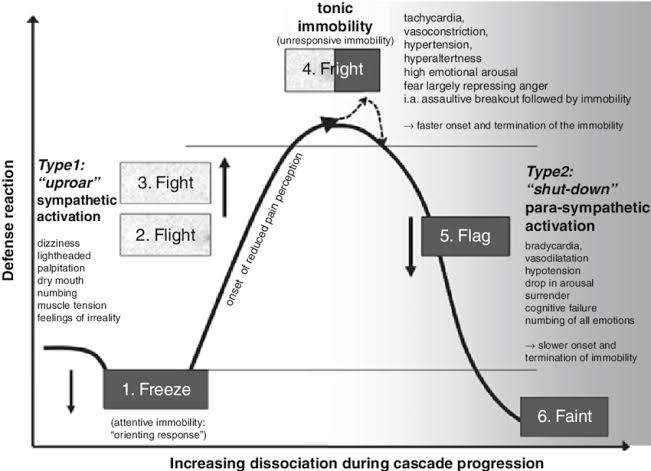
It's worth noting that this is the typical curve but you may not find that you progress linearly through the spectrum, you may cycle very quickly through the first stages or you might just instantly switch to one of the latter phases. This is not uncommon at all.

So with PTSD it's really common to experience hypervigilance. This is when you are in a state where your mind goes into threat-detection mode and you become extremely attuned to your environment, often to the expense of other considerations including things like your biological needs. Hypervigilance is closely associated with the fright part of that curve diagram but it also happens in the freeze, fight and flight parts too.

This experience of hypervigilance might be for 10 minutes, it might be for days. Hypervigilance associated with PTSD grips you like a vice. For me it feels like my sense of time recedes as I become so acutely aware of every little sound, every little change in my environment that nothing else even registers as a concern. Hypervigilance is usually triggered by external environment - a door slamming, a car backfiring, a person yelling or screaming. But it can also be triggered by internal experiences emotional states or thought patterns or recalling memories, especially in cases of CPTSD. Hypervigilance can look a lot like ADHD inattentiveness because your ability to regulate and direct your attention is overridden by a survival and self protection instinct. You might be in the middle of a conversation and notice a person out of the corner of your eye who resembles an abuser and suddenly it feels like you've zoned out completely. Or maybe it sounds like someone is walking up behind you and your brain immediately devotes all of its attention away from what someone is saying to you and towards detecting and responding to this potential threat that is approaching.

Dissociation is another common experience of PTSD. This is associated with the far end of the spectrum, from flag to faint (imo there needs to be a fawn between those two points but I'll try to elaborate on this later in the post).

Dissociation feels very checked out and disconnected from anything. For me it feels like my head is under water - things still register but everything feels very muted and distant. I stop feeling things in my body. I often need to have prompts or stimuli multiple times before it registers in my brain that I need to respond. This might be the classic, almost-ADHD situation where a person needs to click in front of your eyes and say "Hey... Hey! Are you even listening??" or it might be a timer or an alarm going off for a solid 60 seconds before that sound connects to the I'm supposed to respond to this stimulus with an action thought process.

Both hypervigilance and dissociation can bring with it the impression that you have a sensory sensitivity that can resemble ADHD or autistic traits. You may find yourself in an extremely uncomfortable situation physically but this doesn't really register in your awareness until it manages to burst through the hypervigilance or dissociation where you suddenly feel the overwhelming need to address this situation. The same thing happens with other biological needs besides the sensory, such as hunger and tiredness. With PTSD you may not register your tiredness or hunger (or the need to pee or feeling uncomfortably cold or any other biological need for that matter) until it is bordering on an emergency.

This can feel like poor interoception or like sensory sensitivity. The difference between autistic or ADHD traits and PTSD symptoms here is that a person will only experience these things some of the time, during periods of abnormal psychological states; I'm autistic - I always hate the feeling of velvet and velour, and I always have. When I'm struggling with my own PTSD symptoms and I'm hypervigilant or dissociated, I can lose connection with my physical experience and I can fail to notice my physical discomfort until it starts becoming excruciating, at which point I respond. But this is not my baseline experience. I have always hated rough wool and been unusually sensitive to it, throughout my entire life, because I'm autistic. I sometimes don't register that my skin is itchy due to hayfever until it feels like my skin is on fire because PTSD symptoms make me check out from my internal experience. (Hopefully that helps make a clear distinction between the two experiences where they appear to overlap.)

With PTSD, after the peak comes the inevitable crash. For example, if you're hypervigilant or in a state of flight for a long period then a crash is inevitable as your brain and body cannot sustain this heightened state permanently.

The hangover from these PTSD symptoms feels very similar to executive dysfunction. Maybe you were hypervigilant and barely slept a wink last night, you were too anxious to eat much, and now your brain is fried from the psychological state alone without even mentioning the impact of your blood sugar being a disaster and the impacts of insomnia on yourself. Or maybe your day has been one triggering event after another and you've been putting a huge amount of effort into keeping it together and you're just mentally drained from the constant strain. This is by all measure the exact same as executive dysfunction and it would be borderline impossible to tell the difference between typical ADHD executive dysfunction and a PTSD hangover (not a legitimate term btw, just one that makes sense to me and which doesn't feel inherently pathologising). The difference is in what caused this experience - with ADHD or autism, it's the consequence from trying to focus, dealing with sensory overload, masking and stuff like that. With PTSD there should be a very clear triggering event and a heightened psychological state that directly preceded your brain turning to mush temporarily as you recover.

The last big thing that comes to mind is that it's common for people who experience PTSD to go into fawn mode. This is particularly common in CPTSD and afab peeps.

Fawn roughly comes between flag and faint on that curve above. The fawn response feels very similar to masking, to the point where there's a discussion to be had about whether autistic people pleasing/fawning is itself a direct response to social rejection and trauma due to socialising, but that's something for a different post.

The fawn response is where you become extremely compliant, where you lack appropriate boundaries and the ability to maintain them, where you engage in people-pleasing behaviours, and where you attempt to appease others especially where they feel like a threat (this doesn't mean they are towering over you and making threats against you, it may be a particular type of person who fits closely to an abuser's characteristics, it may be an authority figure, it may be difficult to identify what about someone tells your brain "This person is a threat!!"). Conflict avoidance and codependency are super common in the fawn response, and out of the spectrum above I'd argue that the fawn response is probably one that is much more difficult to identify since it can feel very similar in the level of arousal as what is more or less typical and since it is the most sustainable over a long period of time, at least in my experience.

The fawn response, to me, is one where I find myself entirely focused on the emotional state of others without any connection to my own emotional state or beliefs (think principles, morals, ethical positions etc.) A person in a fawn response state might find themselves laughing at a racist joke, agreeing with a reprehensible opinion, or a violation of their bodily autonomy, in contradiction to their own values, because they are instinctively trying to avoid coming into conflict with another person by being assertive and maintaining boundaries, although this is just an example of the many ways it can manifest. How do you tell the difference between PTSD fawning and autistic or ADHD masking? That is a complicated question and it's very tricky.

As a general rule, a person who experiences PTSD will only experience this state intermittently and often as a response to identifiable threats but, because of the ability to sustain a fawn response and because it's kinda pernicious rather than being extremely obvious like the other states, this is only a rough guide and it may take a lot of work to figure out when you're experiencing the fawn response and how to identify the signs of it.

To conclude the main part of this post, those with PTSD you should find over time that the symptoms generally become diminished (with a strong caveat that sometimes processing trauma can make other stuff bubble up to the surface, making it feel like you're doing worse or going backwards, and sometimes you can bring about a sort of healing crisis as you bring old traumatic experiences to a head). With ADHD or autism, often the more you process things the more you become aware of your inherent traits like executive dysfunction, masking, people pleasing and so on. But they tend to be much more stable and persistent across (mostly) your lifespan whereas PTSD has a clear demarcation before and after the traumatic event(s), although of course CPTSD is the confounding factor due to the fact that it in particular is associated with early and developmental trauma so it's not always possible to remember back to a time where there was a "before", and for many survivors of child abuse there actually isn't even a "before" (with some pretty clear evidence that traumatic experiences in utero can produce PTSD symptoms in children after being born).

So hopefully this helps to clarify things for you if you're trying to understand what you're experiencing or the ways that PTSD and ADHD (and in some respects autism) can seem to overlap. I know I haven't paid any attention to when they co-occur and this is because it's an extremely complex matter and it would take an entire post in itself to cover this (although I'm not sure if I'd be able to do that subject justice tbh).

Just as a final passing thought, I think that a key strength of the neurodivergence umbrella is that for example, due to the significant overlap in experience of these different conditions, PTSD survivors may find a lot to be gained by borrowing from insights into sensory modulation and dealing with poor interoception coming out of the autistic part of neurodivergence (research, theory, and self-advocacy) and autistic people might likewise find there's a lot to be learned from managing people-pleasing and the fawn response from PTSD survivors. Of course there's a lot more that we can learn from one another too but that's the most obvious examples that spring to mind.

(Turns out that I ended up talking about autism more than I anticipated. Oh well.)


This might be old news but it's kinda wild to me.

You might remember Doug Lain from being the publishing manager when Zero Books rose to prominence, back when Capitalist Realism by Mark Fisher made a big splash way back when. He moved on to Sublation Media and seems to be doing roughly the same schtick after Zero got taken over by a different parent publisher. (History seems to rhyme for Doug, getting put into his position at Zero Books with the ouster of the old crew when John Hunt took over only for Watkins Media to take over John Hunt, ingloriously booting Lain out in the process.)

Doug has always been a part of the sorta eclectic post-New Left cultural critique, in that milquetoast style of BreadTube broad left "YouTube Killed The TV Star: Adorno, Benjamin, and the desolate media landscape of late capitalism" or "One-Dimensional Marvel: Marcuse and the MCU" style of slop. Y'know, the stuff where it's super pretentious and yet deeply tailist of pop culture trends with a smattering of a couple of the quotes from the key text referenced in the title, the same one that every textbook and every first-year student quotes, in order to give the impression that it's super serious marxist critique when it's actually just 20-60 minutes of anti-capitalist bellyaching combined with the latest fad.

Yeah, that sort of stuff. He's good buddies with Ben Burgis who is a hack that has been trying to position himself as the patron philosopher-saint of the progressive-to-socialish left for years now, to little avail.

Welp, turns out that Doug had Peter Coffin on for an interview a month ago here, where he's uncritically buying into the whole "woke ideology" narrative and all buddy-buddy with Coffin, who is Caleb Maupin's #1 fan (turns out that Peter Coffin isn't handling the divorce well). And apparently Doug has been doing some livestreams on Midwestern Marx and MAGA communism (I thought they abandoned that name, but Doug doesn't really have his finger on the pulse tbh) and he has an upcoming stream on Maupin and Coffin. I'm not sure if I'm going to be able to stomach multiple hours of livestreams from Doug Lain about PatSocs and Midwestern Marx to get a read on what his position is.

In one respect this development is totally on-brand for Lain, to be chasing whatever audience and principles be damned (the Angela Nagle bullshit didn't faze him - doesn't matter; sold copies, he was quite comfortable hanging out with the stupidpol crowd on Reddit too) but in another respect, his frequent collaborator Ben Burgis has always played at sheepdog to the left by policing the limits to radical left discourse and positioning himself as anti-authoritarian and buying into that anti-communist paradigm so it's kind of a weird pivot.

I think Peter Coffin's angle is pretty apparent - he's just courting a legitimate publisher so that a ghostwriter can do some turd-polishing for whatever he manages to draft, sparing him the indignities of having to self-publish next time around.

But it's still weird to me. Maybe they're proving horseshoe theory true and making a connection between the libertarian faux left of people like Lance from The Serfs, Beau of The Fifth Column, and Ben Burgis with the authoritarian faux left like MWM, Maupin, and Coffin where Doug Lain is the connecting point between those two trends. I guess if they're all on different grifts, and they are, then this would explain how it all fits together neatly.

But on the other hand idk. It feels like the online discourse on the left is reaching a weird inflection point. You have Gabriel Rockhill and his Critical Theory Workshop, Rockhill being closely associated with PSL and someone who should know better, courting the MWM audience. Then you have Doug Lain, who should also know better although I'm not surprised if he doesn't give a damn, doing a similar thing and he's broadening out to openly PatSoc audience and not just confining himself to the crypto-PatSoc MWM audience. It's giving Strasserist vibes tbh.

Luckily it's online and not the real world, I guess?

It's gonna be a really awkward moment when Hinkle, Haz, Maupin, Coffin, and MWM drop the pretense and finally jump the shark to become openly fascist, perhaps taking some of these courtiers with them. Imagine having the tankies screaming for years on end about these clowns being fascist in all but name and orbiting Larouchite cutouts with nobody listening because "tankie redfash", only for this position to be vindicated eventually. Though if history is any guide, those SocDems are gonna find themselves chanting PatSoc slogans side-by-side with the likes of Hinkle, Haz, Eddie and Peter to own the tankies:

We live in interesting times.

 

Interesting times ahead.

I was wondering what you all see happening from this point and what sort of timeframes you think these things will play out on.


Looks like Operation Gladio C is moving ahead at a respectable pace.

Apparently it's not a human rights issue to engage in political repression by target an ethnically russian population of civilians with indiscriminate violence.


So I dipped my toe into Reddit for the first time in a while. (Relapses are always difficult things to deal with.)

On r/Psychiatry there's a discussion running about Rejection Sensitive Dysphoria and there's a really interesting spread of opinions. That sub is supposed to be exclusively for qualified psychiatrists, although it's not very well moderated in that regard. Opinions ranged from being in favour, to fairly neutral, to extremely critical of the idea (and of ADHD itself [!!]).

This is what has prompted me to post this State of The ~~Union~~ Disorder Address today.

One thing that barely got any mention in the thread in question is the origins of the concept of, and I think even the term itself, Rejection Sensitive Dysphoria (don't quote me on that part - I could be misremembering). My introduction to the concept of RSD was through scrambling to get myself up to speed on ADHD and absorbing information from Dr Russel Barkley in particular and also Dr William Dodson, two of the leading experts in ADHD (although both of them are kinda old, with Dr Barkley being in retirement by this point). In older talks from both of them, they each outline the emotional dimension of ADHD that get overlooked by the diagnostic criteria and, tbh, the term ADHD itself which doesn't recognise the emotional aspect. I think one day, eventually, we are going to see the label itself shift to recognise that it's a disorder characterised by executive dysfunction and emotional dysregulation rather than hyperactivity (which is sometimes present but often not and sometimes wholly absent, especially as a person matures) and attention deficit (same as above - sometimes absent, sometimes present). Both of these parts of ADHD are, imo, manifestations of poor executive function and I'd argue that it's a dysregulation of executive function moreso than anything - it's extremely common for ADHDers to report experiencing hyperfocus but the problem is in the difficulty in regulation of that focus. This is not necessarily an example of executive dysfunction in the way that it's commonly understood, although the ability to regulate one's attention "appropriately" (however you want to define that exactly) does fit into the true definition of the term but I digress.

From memory, Dr Dodson referred to RSD by a different term. It seemed pretty obvious that he was working towards the same conclusion independently that Dr Barkley had also been working towards, and the concept didn't even have a conventionally-accepted label at this point.

As ADHD, and especially adult ADHD, has come into more mainstream acceptance and awareness, there has been a huge amount of peer knowledge and support filling what is honestly a pretty wide chasm of knowledge and understanding of the condition. (I realise I'm part of that phenomenon.) In an ideal world this wouldn't exist, but alas. This has led to what I think is some fundamental misconceptions about ADHD on both sides of the professional/lay person divide, and these definitely emerged in the discussion on the thread.

With regards to professionals, in my opinion, some major misconceptions are:

  • That ADHD is overdiagnosed

  • That it doesn't exist (ugh)

  • That it is just the result of trauma (lookin' at you Gabor Maté)

  • That it's some trendy diagnosis or that it's something that is used as a diversion from people averse to the diagnosis of BPD especially (this definitely came up in the thread)

  • That the emotional dysregulation dimension of ADHD doesn't exist or that it's is simply indicative of a co-occuring mental health condition

  • That RSD is just some tiktok trend that popped into existence out of nowhere

  • That RSD is just social anxiety or a trauma response, or something along these lines

On the other side, some of the misconceptions from lay people are:

  • The glamorising/quirkification of ADHD (no, staring out of the window at work or in class when you're bored is not the same thing as ADHD and nor is impulse buying shit online)

  • That ADHD is just about dopamine/it's just about a lack of dopamine (both are untrue)

  • That ADHD can be "cured"

  • That ADHD meds make you a zombie or that everyone responds to stimulants with better attention and so stimulants are just a crutch used by people who lack willpower or discipline

There's probably a lot of other misconceptions on behalf of lay people but I'm not going to bore you with all of them - you're probably aware of most of them already anyway.

One thing that stands out to me about all this is that ADHD, ironically, suffers from success - stimulant meds are the absolute envy of the rest of the psychopharmacological industry. (If an antidepressant had the rate of success that stimulant meds do for ADHD, it would be a defining moment in history akin to the advent of lithium in the treatment of bipolar.) What this means is that, for a long time, ADHD was diagnosed in mostly boys, and mostly the ones who exhibited a lot of hyperactivity, and the solution was to throw stimulants at the kid and move on because this would largely be seen to resolve the problem or the external and more disruptive aspects of it. Because of this, there's a big gap in research into adult ADHD, the underdiagnosis of afabs, and examining what exists beneath the superficial, external observations of ADHD.

Hence where we find ourselves today and why I'm writing this post.

So where does this leave us?

Well, firstly I think there's a lot of misunderstandings about RSD and incomplete understanding of RSD. (It's gonna get a whole lot more anecdotal and extrapolation-y from here, so he warned.)

From what the good doctors above describe, it's not really necessarily even rooted in rejection. The term RSD creates a fundamental misunderstanding that the experience is about feeling bad when people reject you or provide you with negative feedback whereas he experience itself is rooted in a very immediate, almost visceral emotional response to perceived mistakes and failures which is completely disproportionate to the situation. This can be something that occurs in a social setting, although not necessarily.

I think a good analogy of what it's like to experience RSD is that it is a frequently occurring emotional response to things that are typically smaller and it feels like that one time in school when you suddenly got called to the principal's office and you had no idea why. There's this sudden, gut-wrenching emotional response where you feel like you're in huge amounts of trouble for something and you don't have any idea of what it is. (But then it turns out that, idk, they just wanted to congratulate you on winning some scholarship that you had forgotten about or they wanted to ask if you for some basic information.)

The difference between RSD and a trauma response or serious anxiety is that RSD is felt strongly in the body and it is completely disproportionate to the experience. An attack of anxiety typically has a solid basis in reality, and it is generally fairly quick to resolve when the perceived cause is addressed. Obviously for generalised anxiety disorder and more severe anxiety disorders, this is not necessarily the case but that's its own discussion. Panic attacks often don't have a particular triggering incident, RSD does.

Trauma responses are ones where your previous experience of a traumatic event is brought into your immediate experience due to some similarities or resemblance to it that occurs in the present - a car backfiring or a door slamming are two good examples. With regards to the difference between a trauma trigger and RSD, a trauma trigger is going to bring you right back to a past feeling when you were traumatised and your responses will be based in that past experience. RSD can fire off from something tiny and it isn't something that dredges up an old traumatic experience for you while transporting you back to that moment in time and what you were thinking and how you were feeling back then.

RSD can kick off from really small things, like feeling as if you forgot to lock your front door this morning or maybe mispronouncing a word in conversation or arriving at an appointment at the right time but on the wrong day. A typical person might worry about their front door and go through the steps they took as they left the house this morning to arrive at the certainty that they did actually lock their door and then things feel okay again. A person with social anxiety might feel really nervous at that mispronunciation and it might really rattle them for quite a while or they might even freeze up or burst out into tears. Someone who finds out that they've arrived at their appointment on the wrong day might go beet red and feel extremely embarrassed. I've honestly done all of these things and experienced these responses before and RSD feels different.

RSD feels like a gut punch, and it often comes completely unexpectedly. I might often worry about forgetting to lock my door when I leave the house but today, inexplicably, today my response is different.

It's that feeling when you realise you forgot to send the email and you lost the big contract but there's nothing you can do because it's already too late by this point, that feeling when you realise you left your purse on the bus and everything in it is gone forever, that feeling when you realise that your partner has been cheating on you and you've only just put all the pieces together.

Except it's just some tiny little slip-up. Or maybe it's not even a mistake at all but it feels like it might have been one.

As someone who has and is diagnosed with PTSD, RSD genuinely hits different. I have trauma triggers. I have trauma triggers for things that I'm not even aware of the historical source of because of extensive childhood trauma. But it's taken me a really long time to realise that there's this other, separate phenomenon that I experience which feels similar in a lot of ways and, for me, which had blurred into the "it's just PTSD" narrative for the longest time, until I finally started developing my understanding that there was something else going on for me.

So anyway I hope that by rambling about the state of psychiatry, about being irritated by some shitty comments on Reddit (the horror!), and about my own experience of RSD along with the historical roots of the concept I'm helping to fill that gap in understanding and to push back against some of the misconceptions that exist surrounding RSD.


As per requests, this is my description of auDHD experience. As there is very little research into this, I'm going to draw primarily upon my own personal experience and I'll draw upon peer experiences and I'll draw in bits of research through this post here and there. I am diagnosed with both ADHD and autism, both adult diagnoses, and there is treatment history to establish these as being accurate diagnoses. The psychiatrist who diagnosed me with ADHD gave me a diagnosis of primarily-inattentive ADHD but I had come to my own conclusions that I was probably combined-type which has had its hyperactive aspects mostly buried under trauma. My psychiatrist also independently arrived at this same conclusion unprompted. It's worth noting that being combined-type will colour my experience of auDHD.

As a disclaimer, this is going to be my experience so it will be limited by that fact. This should only be taken as information and not the definitive guide or the be-all end-all of The One True™ auDHD experience.

To start, I think it's of fundamental importance to understand that my experience of auDHD is one of internal conflict - I have competing sets of needs and desires. This manifests in a lot of internal struggle and it also means that my autistic or ADHD traits can be more prevalent and I can feel "more" autistic or ADHD, depending on my circumstances. (Maybe I'm a Marxist because deep down, at a fundamental level, my ADHD traits exist in a dialectical relationship with my autistic traits lol.) This manifests in a lot of extremes and a lot of bouncing between one extreme to the other.

Ultimately this is why I think I was previously diagnosed with a mood disorder and why it's very common for late-diagnosed autistic/ADHD/auDHDers to be misdiagnosed with mood disorders.

So what does this look like in practice?

I thrive under most novel situations and under high pressure. I find it exciting and this really engages me. However, I also find that I hit my limit in high pressure situations very rapidly, so there's a sweet spot where things are just new or high pressure enough that I thrive. Less, I feel pretty bored and checked out. More, I become an anxious wreck.

However this is counterbalanced by my deep and abiding need for stability, routine, and structure. I need enough that I can count on in my life that I feel capable of dealing with high-pressure and novel situations. Too much change, especially unpredicted change, leaves me really rattled and out of sorts (and not just feeling a bit uncomfortable but it can put me into complete disarray). It can take ages for me to cope with too much change or unpredicted change because, although I can be quite adaptable and flexible, if my base circumstances change then the pace at which I find my feet again is truly glacial.

This is also sort of why I find that I am either extremely well organised or I'm an absolute disaster, with little room in between. Without having structure and organisation, my autistic needs aren't being met so I feel very dysregulated and I am far less capable of relying on this aspect of myself to manage my scatterbrained ADHD traits.

When it comes to socialising, I can be very gregarious. (It's worth mentioning that I'm pretty high-masking when I want to be, so that may also be a factor here.) I am capable of being the life of the party and of facilitating stuff like group work and educational spaces in an engaging and interactive way, and have done so professionally. But this comes with a high level of social anxiety and an extremely limited social battery. I find that I much prefer facilitating, or better yet public speaking, than I do participating in a group activity especially if it's unstructured or there are a lack of clear guidelines and expectations. So externally I vacillate between being very social to being extremely introverted, depending on a variety of factors.

Another aspect is that I genuinely do need a lot of time to recharge after socialising, even when it's great and I'm really enjoying myself. Sometimes days. I feel like this is very much my autistic needs taking the front seat.

With regards to interests, this is a little bit tricky on account of being combined-type but I have very long, stable persistent deep interests ("special interests" but I am loath to apply that term to myself tbh). I also have the classic ADHD sort of brief, intense, transient interests that breeze in and breeze out just as quickly. There are things that I will always be interested in doing or talking about, then there are things that I have a sort of wild fling with before I find that I've suddenly wrung all the dopamine out of it and I'm ready to discard it and move on.

I'm capable of bending my deep interests and sorta redirecting them to topics that I need to prioritise but I'm not sure whether this is a me thing, an auDHD thing, a combined-type thing, or something else.

With regards to sensory processing, I am a fairly typical autistic scattershot of being mostly sensory-avoiding with some atypically high degrees of sensory-seeking, as per the Dunn Sensory Profile 2 administered to me as an adult. I am acutely sensitive to a lot of sensory input however my ADHD is a countervailing force here and I can be completely oblivious to certain sounds or smells or tactile feelings until suddenly my awareness is drawn to this and it becomes borderline intolerable. This may also be due to me being high-masking, having poor interoception, or experiencing dissociation due to lots of trauma, mostly developmental so keep this in mind.

With regards to trauma and rejection sensitive dysphoria, there's evidence that ADHDers are more prone to developing PTSD symptoms. In my opinion one of the major factors in this phenomenon is the fundamental emotional reactivity inherent to the ADHD experience, especially if it's not appropriately medicated. My autistic traits lead me to ruminate a lot and so there's this unholy alliance that exists within me of my being more prone to traumatisation, having heightened emotional reactivity (even with regards to PTSD triggers that occur well after a particular event), and the classic autistic perseveration meaning that I get into ruts with my thinking that are very difficult to get myself out of. This is on top of the typical experience of PTSD and being emotionally and psychologically "stuck" in the traumatic experience. So it's a double whammy. Or maybe an exponential whammy idk.

I experience rejection sensitive dysphoria and I respond to treatment for it. I think that RSD in an auDHDer is especially difficult as being autistic means that I am just prone to making more faux pas, I'm going to unintentionally annoy or upset people, I'm going to miss cues, and ultimately that I'm going to face a whole lot more ostracism and social rejection than if I were allistic. So not only do I have a lot of the psychological consequences of trying to exist in a social world that is far from well-suited to an autistic person, I also have very visceral responses in my nervous system when I think I have fucked up or when someone gives me the impression of negative social feedback (whether imagined or real) and this has a pretty major impact on me. I am of the opinion that the ADHD traits that make me inclined to seek out social interaction and push me to be novelty-seeking means that I am much more socially engaged than I would otherwise be and since negative social feedback affects me unusually deeply, I think this is one of the major factors in why I am capable of being very high masking to the point of probably doing quite well at being neurotypical-passing if I care to.

It's my suspicion that most auDHDers are high-masking, not only because they tend to go undiagnosed and maybe even unaware of this personally for a lot longer and so they naturally develop strategies to compensate but because they tend to be more socially-oriented and I reckon they take knocks harder when socialising, all things being equal, so the end product is a person who is a sort of grizzled veteran who has learnt how to survive in the harsh wilderness that is the allistic social realm.

Moving on from that, I find that I am very extreme in how I experience fine details. I often plunge headlong into the deepest depths of detail but I am also quite careless and I can miss very obvious or critical details. I tend to shift between these two poles. Sometimes this also manifests in being so consumed by one aspect of the details that it's to the exclusion of all the other details as well, although that's more of a classic autistic experience imo. This might also be something specific to me but I am a voracious learner. Often I feel like my mind is like an odd-couple where I can get engrossed in a subject for virtually an unlimited period of time and I can be remarkably persistent with learning but I also have intense cravings for instant gratification and novelty which causes me to end up diving into one subject with great depth only to dive into the next soon after, and this pattern repeats itself constantly. It feels like half of my brain is constantly dragging me down one particular rabbit hole and the other half of my brain is desperately and impatiently dragging me to the next rabbit hole. This may also be something specific to me but I find that I'm actually quite a slow learner because of my needs to understand the intricacies of any given topic but, once I really grasp the fundamentals of something I tend to learn very quickly from that point onwards.

With regards to executive dysfunction, my experience is one of constant struggle lol. I feel as though I am constantly juggling too many balls - my need for novelty, my need for certainty and stability, my sensory diet, the need to stay focused and remember things, the need to observe the details so I don't make simple mistakes and so I don't find myself getting lost in any one particular detail, my need for routine and my fundamental incapability of maintaining a routine, attending to my interoception as I am very liable to not register that I'm hungry or thirsty or tired and so on. It feels like I am more or less constantly mediating the tensions between my different needs which often exist in direct contradiction to each other. So yeah, this means I burn out and I burn out hard lol.

I think ultimately my experience of auDHD is one where I can sometimes spot the very clear traits of either one shining through, such as struggling with pragmatics in communication and being completely capable of eating the exact same thing in perpetuity or being so forgetful and inattentive that I'll put my phone down in a drawer only to close it to later have zero recollection of what I did and having a real drive to experience new things. But more often it feels as though I am an odd mix of the two or that there's a sort of stalemate between the two and I feel like I'm kinda neither and yet both at the same time.

Sometimes this works really well, as my ADHD traits make me more adaptable and a bit more even in my interests and how I engage socially or as my autistic traits help me sustain my focus and to have a much better memory for things than I would otherwise have. I guess in short, being autistic keeps my ADHD traits more stable and consistent and my ADHD makes my autistic traits more flexible and it broadens my horizons. Each of them softens some of the rough edges of the other and I find that I can often lean into one in order to compensate for the deficits inherent to the other.

Unfortunately, the upshot of the autism and ADHD combo is that very often these needs compete and are in direct contradiction to one another as well. It's a weird sort of in between space to exist in, one where the only relatable parallel that I can think of that comes remotely closely is ennui - that feeling of being bored but where it's a conflicted or maybe a more existential sort of boredom; if you're just purely bored, you find something interesting or exciting and you have fixed the problem and the need has been addressed whereas with ennui there's a sort of restless interregnum-like quality where you experience a feeling of boredom but the thought of doing something exciting is also in itself boring somehow. That probably doesn't make a lot of sense lol. Also for my experience of auDHD it's not a feeling of being bored at addressing different needs but it's more like craving new things whie simultaneously craving the same things and the same routine, of craving excitement but also being overwhelmed and craving quiet and calmness at the same time. It's really quite odd to be honest.

Ultimately, while I identify with a lot of traits and experiences of pure ADHD or pure autism, I feel as though my experience of these are much more varied and they shift in intensity. I also think that the way that I present, even if I'm not putting in effort towards masking, is one where the traits of both are apparent but they aren't easy to pin down because I readily switch between, say, a classic autistic infodump monologue to being very socially-engaging and mischievous like you might expect from an ADHDer. Or I can be incredibly details-focused while also being seemingly oblivious to details. That sort of thing.

Anyway, I think that wraps up my own personal experience of auDHD from an internal perspective.


This is a war on pride.

They'll literally tell you "Happy pride!" instead of "Merry Queersmas!" because they want to destroy our traditional queer values and I am not gonna take it anymore!!


view more: next ›