Personally I don't like using CLATs but it's still nice to see this feature finally rolling out.
Scoopta
joined 2 years ago
Thanks, that is indeed dystopian
Can someone summerize the article, for some reason it thinks I'm using AdBlock despite not and won't let me actually read it
The very silly argument the FSF is trying to make is that device A is not programmable because the firmware is baked into the HW effectively making it part of the HW rather than a separate entity. Therefore it's a HW limitation and not proprietary software. Device B on the other hand has proprietary software uploaded to it which is not to be allowed under any circumstances and therefore must be neutered. I call it silly because as you so rightfully point out, the firmware blob could be literally the same exact blob, just stored differently
Yeah, that would be a much more consistent setup and I agree with everything you said here. I just don't understand how being less programmable is good, it isn't, I don't see any world in which it is unless there is truly NO firmware involved and it's pure HW.
This is exactly my sentiment on the matter too. Firmware is not software in practice although it is in theory. Proprietary firmware that can be upgraded is better than firmware burned into a ROM although the FSF disagrees. I personally run nearly 100% FOSS...S as in software, I have no open firmware, I wish I did...but it just isn't realistic at this point in time.
This is basically the same argument that caused the libreboot vs gnuboot thing and I just personally don't get it. It seems to me like the FSF is letting perfect be the enemy of the good. Having a FOSS driver isn't something to be celebrated it's something to be punished if the firmware isn't also FOSS. Yes, ofc, FOSS firmware is better than closed firmware, but when almost no modern hardware has that as an option, it's not even something you can really vote on with your wallet unless you just run ancient hardware all the time.
It matters because for me, a good chunk of the FOSS benefit is the auditability of code. Being able to make changes is nice and that's the freedom bit, but being able to audit it is also a huge benefit. If the code is not running on the main CPU then the driver on the main CPU can contain possible exploits of firmware using the IOMMU etc so it becomes more tolerable than a closed source driver. Basically a firmware vulnerability effectively becomes a hardware vulnerability as opposed to a driver running with full kernel privileges and no oversight or containment.
Was he worried about the kid or his network lol?
Yeah, he did that...and then kept going for some reason. A separate subnet in a separate firewall zone that doesn't forward anywhere but the internet should be sufficiently safe
Apologies, when I said free hardware I meant design as well as somewhat blending the term with free firmware. But either way the difference they draw isn't really all that different when you think about it. It's sort of irrelevant whether or not the firmware can be easily updated, what really matters is where the firmware is being executed. If it's running on the device then it can be isolated by the host system, if it's running on the host then it's not really firmware but rather part of the driver. The semantics don't change just because the firmware is "easily updatable." Having it be uploaded by the driver provides security benefits in that it can be patched by the manufacturer after the fact and having firmware in ROM which can't be patched doesn't guarantee it's more secure or even less complex in design. I guess I just see it as a somewhat arbitrary line and I personally don't agree with it
To be clear, I'm not saying I don't want open hardware, what I'm saying is I don't get the point of allowing closed hardware that doesn't require a firmware blob as opposed to closed hardware that does. That's a very arbitrary and silly line that does nothing useful. They're going on this crusade of "no blobs." But why? There's lots of hardware that already has closed blobs on the HW, but because it's not uploaded by the driver those blobs are ok? You either have to say all closed firmware is bad and we're going to take a stance against any devices which have any amount of closed firmware, even when shipped on ROM in the HW. Or, closed firmware is tolerable so long as the driver is fully FOSS. I love the idea of not having closed firmware but I just don't get the intellectual inconsistency here.

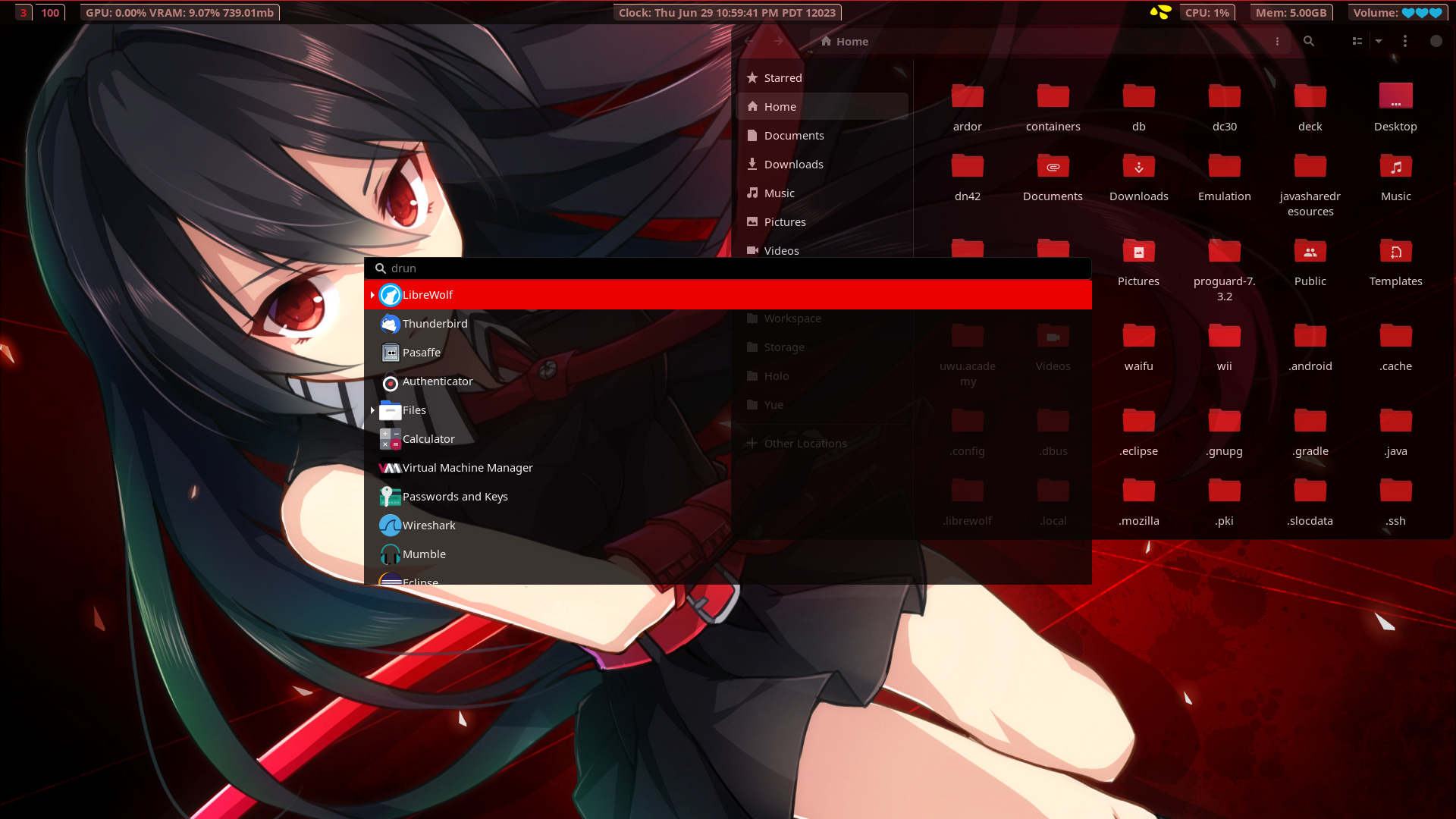
This has been my setup for a long time now and I have to say I still absolutely love it.
- Icons: Flat Remix Red Dark
- Theme: Flat Remix GTK Red Darkest
- Launcher: Wofi
view more: next ›
Further increase confusion by having error pages where all 3 are green