missingredient

joined 2 years ago
[–] missingredient@sh.itjust.works -1 points 2 months ago

tldr: yes, we do.

The article is on substack but is free to read. It contains links and images supporting his argument.


In February of 1989 a businessman from Arkansas named Jerry Jones bought the Dallas Cowboys. The Cowboys had been a once proud franchise. They had played in five Super Bowls in the 1970s, winning two, but by the late 80s the Cowboys were experiencing some of the lowest points in the franchise’s history.

Since the NFL rewards ineptitude by virtue of giving the worst teams the best draft picks, this was actually the best time for Jones to buy in. The year before he arrived the Cowboys had drafted future Hall of Fame wide receiver Michael Irvin. In Jones’ first year the Cowboys owned the first pick in the draft which they used to select future Hall of Fame quarterback Troy Aikman.

A year later the Cowboys should have owned the number one pick again but a questionable roster move made them forfeit the pick¹. Thanks to some big trades they ultimately ended up with the 17th pick which they used to select future Hall of Famer and the NFL’s eventual all time leading rusher Emmitt Smith.

Within two years of owning the team Jerry Jones had stumbled into three future hall of fame players who would carry the team to three Super Bowls between 1992 and 1995. Tremendous short term success that I’m sure no Cowboy fan who lived through it would trade for anything. It very much might have come at the expense of any long term success.

Jones built his wealth when the oil company he started in Arkansas became successful. He started the company himself and always did things his way. He believed in himself you could say to a fault, but this oil company hitting it big only served to vindicate him.

When Jones bought the Cowboys he brought the same I know what’s best and I’m going to do it myself attitude. Within a few months he fired longtime general manager Tex Schramm and named himself President and General Manager - two roles he still holds today.

The Cowboys are essentially Jerry’s play thing. No one has the ability to fire him and hire a real general manager. He calls all the shots. In his 35 years in charge he’s built the Cowboys into a financial juggernaut but after catching lightning in a bottle the first few years of his ownership, there hasn’t been any on-field success in 30 years.

At times Jones looked to surround himself with smart and knowledgeable “football men.²” He hired big name coaches with big personalities such as Jimmy Johnson and later Bill Parcells but he ultimately fell out with both of them when they disagreed with Jones’ ideas. More recently he’s gone with far less exciting names - such as Wade Phillips, Jason Garrett, and Mike McCarthy - whose tenures probably went on too long simply because they were “yes men” to Jones.

Jerry Jones is not the type of owner you want to emulate. You want an owner who buys the team, hires competent and qualified people to run the team, and empowers them to do their job while he sits back and just signs the checks. You don’t want someone who suddenly thinks they’re qualified to run a team simply because they had enough money to buy it.

Unfortunately for Manchester United, the tale of Jerry Jones is starting to hit a bit close to home.

It hasn’t even been two full years since Sir Jim Ratcliffe and INEOS bought a minority stake in Manchester United that gave them operating control of the club. The early returns do not give many reasons for optimism over the future.

INEOS had some early success as United won the FA Cup just a few months into their tenure. However that was coupled with - at the time - United’s worst ever Premier League finish when they fell to eighth. A year later United reached new lows, falling to 15th. They reached the Europa League final but lost 1-0 to Spurs in what was a truly tepid performance.

INEOS have been around for two summer transfer windows but many of their signings have been uninspiring while the team has gotten worse. Their handpicked manager has won just nine of 33 Premier League matches and is clearly out of his depth.

Read that again. 10 months into the job Ruben Amorim has just nine wins. Strip out the most difficult matches against the “Top Six” and the matches against the newly promoted clubs and Amorim’s record reads 3W 3D 12L in 18 games. He has lost 75 percent of his matches against the Premier League’s “middle class.”

It is simply astonishing that a club like Manchester United is allowing this to go on. It’s being allowed for one reason and one reason only. Mr Jim does not want to admit he made a mistake.

It’s almost impossible to believe that every high ranking member of the United brass including people with the C/V’s of Omar Berrada and Jason Wilcox are still behind Amorim. What is starting to look like the most plausible explanation of what’s going on at Old Trafford is that the only opinion that matters is Ratcliffe’s. If the boss wants to go in direction A, the club is going in direction A. If you don’t like it, get off the train.

Ratcliffe talked a great game when he first bought into the club. He talked about wanting to hire the best football people and let them make the decisions. He name dropped players that he believed were bad deals that the club needed to get away from. He talked about how the club was in the stone age when it came to data analysis and that the club’s financial situation and how FFP might limit what they could do in the immediate future of the market.

He sounded very competent but based on reports around the club, Ratcliffe’s action, and just seeing how he has managed the club over two years it can possibly be viewed from a different lens.

When Sir Jim first mentioned the PSR complications it sounded like he was trying to set reasonable expectations for the fanbase and explain complications. But then he kept talking about it, and the more he kept talking about it the more it started to sound like these were things he was just learning about himself.

Those players he name dropped in different interviews? They all “coincidentally” ended up in Ruben Amorim’s “bomb squad” this past summer. The one exception has been Casemiro - who was name dropped by Ratcliffe before he even bought the club and United have unsuccessfully tried to sell the past three transfer windows.

Consider this. Casemiro was United’s best player during Ruud van Nistelrooy’s short interim spell last season. When Amorim came in he followed the same schedule as Marcus Rashford: starts against Ipswich and Everton, dropped against Arsenal and Nottingham Forest, a start against Viktoria Plzen and then, with two weeks to go before the transfer window opened… that’s it³. He came back into the team against Newcastle only because injuries and suspensions left Amorim no choice.

Casemiro made a grand total of one appearance for 19 minutes in the month of January. Then, as soon as the transfer window slammed shut, Casemiro was back in the team - playing 89 minutes against Tottenham. Concerns over the lack of match fitness were non-existent. He played nearly every minute of the knockout rounds in the Europa League while being rested a little more in the Premier League - except for playing all 90 minutes against Liverpool and Manchester City, the two most difficult matches.

That doesn’t sound like a manager not liking a player or having issues with him. That sounds like a manager keeping a player in bubble wrap as management tries to sell him.⁴

Most fans probably believe they can run a football club better than the people who are currently doing it. Frankly, some of them probably can, but we’ll never get that opportunity.

Sir Jim had the means to buy that opportunity and his first priority has been trying to rid the perceived mistakes of the previous regime. I use the word perceive because Ratcliffe might have the same idea, he just doesn’t like that it was someone else’s.

This was most prevalent in United’s summer transfer window. Two years ago United signed a project striker in Rasmus Hojlund. After a promising season he took a major step back last year under Amorim. United decided they needed to replace him but not with a proven striker, but simply another project striker whose potential was much higher than anything we’d seen on the pitch so far.

Last season United signed Joshua Zirkzee who had a paltry three goals and 0.19 goals per 90. Yet it was Hojlund who was pushed out of the club this summer as The Athletic reported, “Hojlund was tarred by being bought by previous recruitment staff in a way that Joshua Zirkzee, signed last summer, was not.”

It wasn’t that Hojlund was bad. It was that he belonged to someone else. Sir Jim wanted his own Hojlund.

The decision to even sign Sesko after signing Mathues Cunha and Bryan Mbeumo is questionable. Ratcliffe talked about how United data analysis department was in the stone age so he set about hiring new people. Those people have even taken to LinkedIn to brag about the advanced data that lead to making these signings.

Except United’s recruitment didn’t look advanced at all. It looked rudimentary.

United did not score a lot of goals last year. They massively underperformed their against their xG. Rather than diving into why this might have been happening, the joke - which has been made by many - is that they simply went to the shooting table on Fbref, sorted it by npG-xG, and went for the top two players on the list⁵.

When you sign two players like Mbeumo and Cunha you’re signing them to carry the goal-scoring burden. In order to do that and maximize their ability you’re going to want to get them the ball.

According to The Athletic at this point United began weighing up moving for a midfielder only for the lack of goals last season to be brought up again and United to target a goal scorer. Ratcliffe backed that call.

This is such rudimentary analysis. To call it surface level might not even be accurate as it might be above the surface. This more aligns with some of the people I speak with at the pub who say things like just get us a proper striker and we’ll score goals. The age of those people tends to skew much closer to Ratcliffe’s age than mine.

For any paid data scientist to come to this conclusion would be concerning - particularly when you think of the future analysis they would be doing. There’s only two explanations here. One is that the data scientists United hired are really bad. The other is they’re not being listened to.

Maybe this nothing more than cope but the latter is starting to make an awful lot of sense.

On the recent episode of the Talk of the Devils podcast, Laurie Whitwell echoed previous reports - that former Director of Football Dan Ashworth was sacked for being the dissenting voice in the decision to hire Ruben Amorim.

This was literally what Ashworth was hired to do. Make decisions regarding football matters and if you don’t think something is a good idea, voice that opinion.

You can cover up Ashworth’s sacking by saying you want everyone to be on the same page. To a certain level that’s true, but at United it’s nothing more than Jim Ratcliffe’s page.

There have been whispered accusations that those at the top of the club, such as Berrada and Wilcox, are afraid to challenge Ratcliffe. That they are merely “yes-men.” The Athletic has reported that INEOS Head of Sport Sir Dave Brailsford is the only person who talks honestly with Sir Jim.

How is that going? In February Brailsford was described as being “all in” on Manchester United. He relocated his family from Monaco to Manchester so he could be present at Carrington every day. In June it was announced that Brailsford was stepping back from Manchester United. Maybe honesty isn’t the best policy?

There is no doubt that Ratcliffe meant it when he said he wanted to hire good football people. However it’s nothing more than self-validation. He wants the best people but he wants them to agree with him because if the smartest people agree with my ideas and think they are good, then I must be as smart as the smartest people.

If the top people might start losing their jobs for so much as disagreeing with the direction Ratcliffe wants to go they’re quickly going to figure out that they should keep any disagreements to themselves. At that point, it doesn’t matter how smart they are or how good they are at their jobs.

Jim Ratcliffe had the means to do what many of us wish we could - run the football club the way we want to. He may not have football experience but his success in the business world has made him believe that he’ll figure this out too.

It’s no different than Jerry Jones, only Ratcliffe didn’t inherit three future Hall of Famers to jump start his tenure.

I don’t have enough inside information to present any of this as fact. Maybe I’m just coping due to the general malaise of the club. But from where I’m sitting it looks like there are one of two options. Either Ratcliffe has hired bad people who have not made a lot of good decisions in their first year(s) on the job, or it doesn’t really matter who he’s hired because Ratcliffe is way too hands on and doing whatever he wants to do regardless of what any of the people he hired say.

I’m not sure which of those options is worse, but neither of them are good.

[–] missingredient@sh.itjust.works 3 points 3 months ago (3 children)

really don't like this. Bad ManUtd decision, bad footballing decision.


After the final whistle sounded at Craven Cottage on Sunday, Kobbie Mainoo strolled on to the pitch, dropped down on his haunches and contemplated having watched Manchester United’s first two games of the new Premier League season entirely from the substitutes’ bench.

Mainoo looked just as downbeat and ruminative as he quietly boarded United’s team bus for the trip home later that evening, his head hung low.

You did not need to be a body language expert to see that — according to those familiar with the situation, speaking on condition of anonymity to protect relationships — he has been left deeply frustrated by not featuring in either of United’s matches this season so far.

Still, this is nothing particularly new. Questions over Mainoo’s playing time and his role within Ruben Amorim’s system have abounded for months.

As a result, the 20-year-old United academy graduate is open to leaving his boyhood club before the transfer window closes on Monday, having discussed as much with team-mates. United, meanwhile, have been considering the prospect of selling him all summer, sources say.

Although not part of the four-man ‘bomb squad’ alongside Alejandro Garnacho, Antony, Jadon Sancho and Tyrell Malacia, who have trained separately following their returns to United’s Carrington base to begin pre-season, Mainoo — like striker Rasmus Hojlund — has been identified internally as a potential departure since the start of the window in June, and the club have been willing to sell him at the right price since as far back as January.

United sources insist they are not actively pushing Mainoo out the door, however, and staff are happy with him, albeit, like all players, he has areas to improve. People at Old Trafford expect him to remain a United player beyond next week’s deadline, with the caveat that anything can happen in the final days of a transfer window.

Mainoo is said to be training well at United (Ash Donelon/Manchester United via Getty Images) But aside from the pursuit of Carlos Baleba, a dream target who is considered too expensive to prise away from Brighton & Hove Albion this year, United’s summer-long search for a midfielder has focused more heavily on identifying an alternative to Bruno Fernandes. Somebody who would play alongside either Casemiro or Manuel Ugarte. One who would, in effect, replace Mainoo within the squad, as per Amorim’s latest description of his role.

Bayern Munich explored the possibility of a move for Mainoo but did not formalise their interest. New Bayer Leverkusen manager Erik ten Hag would have liked to reunite with a player he championed and promoted while in charge at Old Trafford, but a deal was thought to be out of the German club’s reach financially.

Mainoo is thought to prefer moving to the continent rather than staying in the Premier League — he explored options in Germany when coming through United’s academy — even though there has been interest from closer to home. When Chelsea enquired about his availability during the January window, Stamford Bridge officials were quoted a £70million asking price. There is a belief United would now accept around £45m, potentially even less as the deadline draws near.

Whether other exit routes open up for Mainoo between now and Monday night remains to be seen — he has also been linked with Tottenham Hotspur — but if he stays or goes, the fact is a local-born academy graduate is closer to leaving than ever for two principal reasons: his struggles for regular playing time under Amorim, and an impasse in discussions over a new contract.

Mainoo signed a four-year deal, with the option of a further year, in February 2023. At the time, he had only made two senior appearances, starting in a Carabao Cup quarter-final tie against third-tier Charlton Athletic, then coming on as a substitute in a FA Cup fourth-round against Reading, then of the second-tier Championship.

His first and only Premier League appearance that season — an 11-minute cameo against relegation-bound Leicester City — was still a few days away, and so the salary offered by United was typical for an academy talent with potential to break through into the first-team squad.

And yet a little more than a year later, he had established himself as a regular under Ten Hag, playing 32 games and scoring five times, including what proved the winner in a famous 2-1 FA Cup final defeat of Manchester City.

Then came his first major international tournament call-up with England, starting four games under Gareth Southgate at that summer’s European Championship, including the 2-1 loss to Spain in the final.

Mainoo was a regular in England’s run to the Euro 2024 final (Justin Setterfield/Getty Images) That rapid ascent is why even some who know Mainoo well can sympathise that, at a potentially critical juncture in his career, the next step is a difficult one to navigate for both the player and the club.

Mainoo is currently paid around £20,000 a week. Conversations over a new, extended deal have taken place over the past year and have understandably centred around a hike to that salary.

As a key player for the club, Mainoo was hoping for a substantial improvement to his terms — potentially up to 10 times those present wages. At one stage, he was starting in midfield ahead of Casemiro, a player on around £350,000 per week when United are in the Champions League. But the club were reluctant to meet that outlay even when he was playing regularly, believing he would only be ready to move up to such a pay grade after another year or two of development.

Right now, the prospect of any new deal looks remote. Those familiar with the situation say Mainoo currently has no intention of renewing, given his playing opportunities under Amorim. His willingness to leave was initially thought to be a bargaining position by many at the club but it has become a possibility, if not this summer, then in a future window.

Few players in Mainoo’s position would commit themselves to a club where they were not sure of regular minutes anyway, and concerns that the 20-year-old does not have a clear pathway to more game time within Amorim’s system are more relevant now than ever.

Ruben Amorim has doubts over Mainoo (Matt McNulty/Getty Images) Amorim reiterated on Sunday that Mainoo’s direct rival for a place is currently Fernandes — the club captain who started all but five of United’s 60 games in all competitions last season, and is set to predominantly play in midfield rather than at No 10 in this one after the summer arrivals of Matheus Cunha and Bryan Mbeumo.

This reconfiguration of the squad has pushed Mainoo to the fringes. But his minutes, and particularly his opportunities in central midfield, were diminishing long before Cunha and Mbeumo arrived. After missing most of November appointment Amorim’s first few weeks in charge through injury, Mainoo started as part of the two-man midfield pivot in six of United’s seven games from mid-December to mid-January, up until the 3-1 loss to Brighton at Old Trafford.

From then on, Amorim began deploying Fernandes in midfield more regularly, and experimented with Mainoo as a No 10 and a false nine. He did not start in midfield again before picking up another injury in February during a week of heavy training at Carrington, sidelining him until early April.

Once he returned, Mainoo’s only starts came as part of rotated line-ups in games before or after United’s critical Europa League knockout ties with Lyon and Athletic Club. Across those four legs, he played 59 minutes of a possible 390 — mostly during the extra-time period against Lyon, when he was introduced as an 86th-minute substitute, then scored a 120th-minute equaliser.

Despite that dramatic goal, and although United were trailing Tottenham throughout the second half, he was only a substitute again in the final itself, brought on in the 90th minute. His first competitive appearance since that match could come tonight (Wednesday) in the Carabao Cup second round tie away to fourth-tier Grimsby Town.

So why has Mainoo suddenly fallen out of favour, particularly as an option in midfield? Mobility is said to be one area of his game that Amorim has targeted for improvement. The manager said this summer that Mainoo needs to “increase the pace, the rhythm” of his play. “I’m always on top of that with Kobbie because he’s so good sometimes, but he can be better,” Amorim added.

When Mainoo returned to training after recovering from that injury in the spring, many at Carrington noted he had bulked up physically during his spell on the sidelines, adding more muscle mass to his then teenage frame, leading some to question whether that would help or hinder his agility.

There is an argument that, at his age, rotation-level minutes should be expected. United have arguably placed too much responsibility on young shoulders in the past. It should not be forgotten that Amorim was an international midfielder himself, playing 14 times for Portugal, and knows that you do not peak at such an early age.

Yet some figures close to Mainoo have been left dumbfounded by his fall from favour and surprised by a lack of communication from Amorim. Rather than provide specific instructions, the 40-year-old’s general attitude to concerns about playing time is to tell players to train hard and earn their spot. That applies to all of his squad, not just Mainoo — Casemiro found favour again after being out of the picture.

Mainoo celebrates scoring against FCSB last season (Vasile Mihai-Antonio/Getty Images) Yet whether it is the best approach for youngsters who require guidance and feedback is questioned in some quarters.

Mainoo, for his part, is said to be doing the right things and quietly going about his business around Carrington. He is close to fellow youngster Leny Yoro, with the pair doing fitness work together during the summer and also being seen socialising in Manchester.

The season is still only two games old, as sources at Old Trafford are keen to stress, and Amorim has repeatedly said there will be opportunities for younger players and those on the fringes further down the line. Yet those opening games have only demonstrated how difficult it will be for a talented academy graduate, who is immensely popular with supporters, to earn regular minutes in his best position. And, importantly, during a World Cup year, too.

In the two league games to date this season, when Amorim has turned to his bench with United searching for either an equaliser or a late winner, he chose to bring on Ugarte and Harry Maguire against Arsenal, and Ugarte, Maguire and Ayden Heaven at Fulham, apparently preferring players who could offer a threat from set pieces over Mainoo’s skill set.

There is also the connection with United’s youth record that Mainoo represents. There has been an academy graduate in every United senior matchday squad dating back to 1937. He was the only one in the 20 for last season’s Manchester derby against City at the Etihad Stadium, and should he leave, a run that stands at 4,323 games could be broken.

Mainoo’s rise has been fast, perhaps so accelerated that a period of readjustment was inevitable at some point, but there is increasingly a sense that it has now stalled, and further progress may only be possible away from his boyhood club.

Additional reporting: Adam Crafton

(Top photo: AJ Reynolds/Getty Images)


Some Manchester United players are "not good enough" and some are "overpaid", the club's co-owner Sir Jim Ratcliffe says.

Midfielder Casemiro, striker Rasmus Hojlund, goalkeeper Andre Onana, and wingers Antony and Jadon Sancho - who are on loan at other clubs - were namechecked by the billionaire in an interview with BBC Sport as players his regime had "inherited".

Ratcliffe, a lifelong Manchester United fan, is the chairman of petrochemicals company Ineos, which has a strong sport investment arm.

The 72-year-old last year spent £1.3bn for a 28.94% stake in the club in a deal which saw Ineos take control of football operations.

In a wide-ranging interview, Ratcliffe addressed the side's recent struggles on the pitch - they are 14th in the Premier League table - and repeated a pledge to deliver silverware by 2028.

And talking just a day after fans protested against United's ownership, he also spoke of the club's financial difficulties, saying it was set to run out of money by the end of the year without taking actions he admitted were "unpopular".

Some players 'not good enough and probably overpaid'

Ratcliffe lamented the fact the club still had payments owed on players signed before he took control, citing what he said was a £17m payment still to be made for Sancho this summer.

The England winger was a £73m signing from Borussia Dortmund in 2021 but returned to the German club on loan after falling out with then-United boss Erik ten Hag and was loaned to Chelsea at the start of the current season.

"If you look at the players we are buying this summer, that we didn't buy, we're buying Antony, we're buying Casemiro, we're buying Onana, we're buying Hojlund, we're buying Sancho. These are all things from the past, whether we like it or not, we've inherited those things and have to sort that out.

"For Sancho, who now plays for Chelsea and we pay half his wages, we're paying £17m to buy him in the summer."

Brazil winger Antony is another on loan, at Spanish club Real Betis, after struggling at Old Trafford following an £81.5m move from Ajax.

Compatriot Casemiro arrived in 2022 in a £70m deal, while Denmark striker Hojlund arrived the following year for £72m.

Cameroon international Onana joined the club in the same summer for £47.2m.

All those players have drawn criticism during their time at the club.

"It takes time for us to move away from the past into a new place in the future," Ratcliffe said.

When asked whether he was suggesting those players were not good enough for Manchester United, he said: "Some are not good enough and some probably are overpaid, but for us to mould the squad that we are fully responsible for, and accountable for, will take time.

"We've got this period of transformation where we move from the past to the future.

"There are some great players in the squad as we know, the captain is a fabulous footballer. We definitely need Bruno, he's a fantastic footballer."

'Amorim will be there a long time'

Portuguese head coach Ruben Amorim was appointed in November following the sacking of Ten Hag.

The change has done little for the side's fortunes in league table terms - United have lost nine of their 26 games under him and are 36 points behind league leaders and rivals Liverpool.

However a win at home to Real Sociedad this week will see them in the quarter-finals of the Europa League - and a step nearer to possible Champions League qualification, the prize for winning the competition.

And Ratcliffe has given the 40-year-old his unwavering backing.

He said "a long list of injuries" had hampered a coach who arrived mid-season into a tough league and with English as his second language.

"If I actually look at the squad which is available to Ruben, I think he is doing a really good job to be honest," Ratcliffe said.

"I think Ruben is an outstanding young manager. I really do. He's an excellent manager and I think he will be there for a long time.

"You are beginning to see a glimpse of what Ruben can produce. I think you saw a glimpse of it against Arsenal. How many players against Arsenal on the bench did you recognise? How many have ever worn a Manchester United shirt for [the first team]… as there's no squad left. We are down to the last 10 or 11 men in the squad really, of proper first-team players. Ruben is doing a super job."

He also praised Amorim for attempting to put his stamp on the squad - England forward Marcus Rashford was sent on loan to Aston Villa after it became clear he was not part of the new manager's plans.

Ratcliffe said Amorim will have money to spend in the summer - despite the financial issues at the club.

"Obviously that budget changes but upon who we may choose to sell because that would supplement the budget."

And he stressed young talents such as midfielder Kobbie Mainoo and winger Alejandro Garnacho would not be up for sale just to bring in finances.

"No no. We won't be selling players because of the state we are in financially," he said.

"The club had got bloated so we reduced that and will finish it with a lean and efficient organisation. That's how we will address the costs. The player decisions will all be focused on how we are going to improve performance. That's all."

'Club runs out of money at Christmas if we don't make changes'

When Ratcliffe and Ineos joined the Old Trafford hierarchy, many fans welcomed the arrival of a boyhood fan and billionaire to help restore the club's former glories.

However, a year on, the relationship with some supporters has soured.

A mid-season rise in some ticket prices affecting under-16s and pensioners, and hundreds of redundancies are among the moves taken by the club which have attracted criticism, with cost-cutting measures including the removal of free lunches for staff.

Ratcliffe admitted he knew moving into the club would have challenges, "but the scale of it is probably slightly bigger" than he expected.

"I don't enjoy reading the newspaper very much these days I have to say," he added. "I know it's unpopular, and this period of change is uncomfortable for people, and some of the decisions we have to make are unpleasant. But they are necessary to put Manchester United back on to a stable footing. If people want to see Manchester United winning trophies again then we have do all this stuff."

And he revealed just how stark the financial situation at the club had been: "Manchester United would have run out of cash by the end of this year - by the end of 2025 - after having me put $300m (£232.72m) in and if we buy no new players in the summer.

"We are in the process of change and it's an uncomfortable period and disruptive and I do feel sympathy with the fans.

"The simple answer is the club runs out of money at Christmas if we don't do those things."

He said costs had risen and the club had been spending more than it earned for seven seasons.

"If you spend more than you earn eventually that's the road to ruin," he said.

It was suggested to Ratcliffe that the club's level of debt and serving that debt - in the last financial year £37m was paid in interest - was a more pressing issue for fans.

"Interest is one of the costs but it isn't the biggest cost in this club," he said.

"And the club needs to get its house back into order so it's on a good financial footing for the future.

"Most clubs in the UK - most companies - have debt of some form. But if the club is really profitable, which I think it will be in years to come, then you can do the reverse. You can start paying down the debt. That's where I think Manchester United should be.

"Ultimately, if you look at running the club the size of Manchester United with an income of about £650m you spend a part of that £650m on operating the club and part of it on the squad.

"Where do you want to spend the money? Do you want to spend it on operating the club, or do you want to spend it on the squad? Because if you spend it on the squad you get better results. And at the end of the day what's Manchester United here for if it's not to win trophies and silverware? What we want to do is invest in the best players in the world if we can, rather than spend it on, I'm afraid, free lunches.

"My only interest here is returning Manchester United back to greatness again."

'We've made errors - but can win Premier League in three years'

Ratcliffe does, though, admit not every decision taken has been the right one.

"We are not perfect, and we are on a journey, and there have been a couple of errors along the way, but I think in the main all the things we are doing are the right things for the club," he said.

One of those errors was the hiring of sporting director Dan Ashworth - who then left the role after just five months.

Ratcliffe said the "chemistry" was not right, leading to his departure.

Backing Ten Hag in the summer, only for the Dutch coach to leave a few months later, he admitted was another mistake - it cost the club around £20m to compensate Ten Hag and his team and then bring in Amorim.

"I agree the Erik ten Tag and Dan Ashworth decisions were errors. I think there were some mitigating circumstances, but ultimately they were errors. I accept that and I apologise for that.

"If you look at the time we made the decision about Erik the management team hadn't been in place more than five minutes," he explained, adding that it was difficult to judge the Dutchman's performance under the previous regime.

"It became clearer three months later and we got it wrong, but we'd moved on. I think we corrected it and we are in a very different place today," he added.

Ratcliffe believes those changes, coupled with the operational changes, will help the club to move forward and repeated his target of winning the Premier League by 2028 - the club's 150th anniversary.

"I don't think it's mission impossible. I think it's good to have goals and objectives, Ratcliffe said.

"If you look at Arsenal, if you look at Liverpool, if you look at the period of time it took them to get the house in order and get back to winning ways, that's probably slightly on the short end of the spectrum. But it's not impossible."

The club is also preparing to announce plans that could see "the most iconic football stadium in the world" being built to replace the existing stadium, as part of a wider regeneration scheme.

An announcement is expected on Tuesday.

"The club's going to finish up in a very very different place in three years' time to where its been in the past, in my view," Ratcliffe added.

"I think it will become the most profitable club in the world. I think we may well finish up with the most iconic football stadium in the world, and I think we will finish up winning silverware again."


Tweet:

Manchester United agree deal with Newcastle United to appoint Dan Ashworth as sporting director. Move delayed by #MUFC & #NUFC struggling to compromise on compensation package but switch now sanctioned + 53yo expected to start immediately @TheAthleticFC

Article:

Manchester United have agreed a deal with Newcastle United to appoint Dan Ashworth as their sporting director.

Ashworth’s move to Old Trafford was delayed by the clubs struggling to compromise on a compensation package.

But more than four months after he was placed on gardening leave and it looked as though an independent hearing would be needed to break the deadlock, Ashworth’s switch has now been sanctioned.

The 53-year-old is expected to commence his position in the new-look Manchester United structure with immediate effect.

Ashworth intended to take Newcastle to arbitration to help facilitate his move with, as reported by The Athletic, Manchester United supporting his bid and pledging to pay his legal costs.

He is set to have overall responsibility for football performance, recruitment and operations at the 20-time champions of England, with technical director Jason Wilcox reporting to him.

Ashworth will himself report into Sir Dave Brailsford, who Ratcliffe has tasked with undertaking a review of the United’s football operations.

go-deeper GO DEEPER

Why Manchester United want Dan Ashworth

Former football director John Murtough stepped down in April after a decade’s service, paving the way for Ashworth’s appointment.

He will become the latest high-profile appointment under Ratcliffe. Omar Berrada is scheduled to arrive as chief executive from Manchester City later this month, while Wilcox’s arrival as technical director was confirmed in April.

Ashworth joined Newcastle United after resigning from his post as technical director at Brighton & Hove Albion in February 2022.

He moved to Brighton in 2019 following a spell as technical director at the Football Association — where he started in 2012 after a spell with West Bromwich Albion — and helped develop the men’s and women’s national teams.

He was credited with playing an influential role in England’s World Cup victories at under-17 and under-20 level in 2017.

Ashworth has generated a strong reputation in areas such as player recruitment and the building of high-performance structures.


Article has quite a few short videos, so it's better to follow the link. Basically, setup isn't getting the best out of players and is wearing them out.

Here's the text:

Manchester United were this close to stealing a thoroughly undeserved win on Saturday. Mason Mount’s 96th-minute winner against Brentford looked as if United were going to steal three points in a match where they were dominated in every facet of the game.

At the beginning of the season Grace Robertson tweeted, “A lot of people primarily watch football for an excuse for a good moan.” Football fans love a good moan, but what they love even more than moaning, is pointing the finger at something.

Football discourse in 2024 needs to blame someone or something for what’s happened. The way the news cycle and social media work these days when something happens there’s no time for a detailed explanation. Instead, there needs to be a sudden visceral reaction. This is the fault of x. When a goal is scored

A defender's job is to prevent goals from being scored. If a goal is scored that means someone didn’t do their job. Therefore the goal is their fault. Even if there’s a whole chain of breakdowns it’s typically the last action that will be blamed, unless you’ve got an agenda against one of the players in the chain, then a screenshot will be taken of the mistake that player made - stripping out all context - and laying the blame at his feet.

For whatever reason, not everyone is a fan of Aaron Wan-Bissaka. Therefore when United conceded a late equalizer to Brentford on Saturday, it wasn’t surprising to see the following image popping up all over social media blaming Wan-Bissaka for playing Ivan Toney onside to set up Brentford’s equalizer.

That screen shot make it look like Wan-Bissaka is a complete idiot, undoing all the work of the rest of United’s defense. The screenshot strips out all context. It’s just a one second look at a sequence that had multiple breakdowns from multiple players.

How did this goal happen?

When you start to dig deeper to try to answer that question you see that the tactical choices United made over the course of the full match lead them to this moment. The choices United made over 90 minutes will have different effects on different players, culminating in this entire sequence.

We’re not hear to break down what United’s tactical plan was and whether it was good or not. Rather we’re just looking at what they did, and how that’s going to affect players.

For instance, once again United went with the narrow high press they always use but never works, where they leave the wide man open.

Every team in the league knows to break this press all you have to do is get the ball to the wide man, and it’s not particularly difficult to do that.

Once you get it to the wide man you’ve got a free run up the pitch to run at United’s defenders.

This style forces the attackers to do a ton of useless running that simply serves to tire them out. This hangs the defense out to dry. They can’t keep their high line because they have no protection. The ball carrier has all the time in the world to pick out a runner if they don’t retreat. They’re forced to play on their heels and get their ass back.

As the opponent now can attack with pace, the bypassed forwards have to high-tail it back to help out their defenders. When they get back on defense they get all the way back. United have nine outfield players in and around their own box

Having all the forwards come all the way back to the box thus prevents United from being able to launch counterattacks because for one, they don’t have an outlet high up the pitch, and two, they’re too freakin tired. They’re wasting their energy with the pointless running.

Then when they do finally get some space to run into, the fatigue starts to set in. They’re a step slower. There’s less power behind their shot. Rather than having that burst of pace that they should have they opt to pass the ball and it ends up being a poor ball. Physical fatigue leads to more mental errors.

As United can’t counter, they need to build up and attack the slow way. With Erik Ten Hag that means getting men forward. and having your wingers - who happen to be your best goal scorers - get as wide as they can on the touchline while your fullbacks attack the dangerous half-spaces.

Occasionally it will also mean having one winger come over and overloading one side. But this doesn’t free up your second winger to get into a dangerous position. No, your wingers still end up glued to the touchline, while your fullback - who is not known for his attacking ability - can push up and join the forward line.

It’s hard to see how this setup is going to yield strong attacking results. What’s most likely to happen is eventually someone is going to get frustrated and try to dribble through people themselves and lose the ball, or someone is going to make a bad pass or take a bad touch and lose the ball. Once you lose the ball, since you have so many people forward it only takes one pass to get the ball behind you - leaving a whole team of players having to hustle back.

In United’s dumbass attacking setup, it’s often their best attackers like Bruno or Rashford who are the deepest players and now are the ones who need to run back the hardest to defend, further tiring them out for their next foray forward.

Meanwhile, while the forwards get back to do the initial defending, the fullbacks still have to spring back on defense to get back into position. Then when United eventually win the ball back, they’ll need to run forward again because they have an important position to get to at the top of the attack.

Back and forth back and forth. This is... a lot of running that the fullbacks have to do over the course of a 90-minute game (which is even longer due to added time). It’s incredibly tiring. You can’t expect a fullback to have the same energy levels that he has in the 15th minute in the 75th minute, let alone the 95th minute. It wears you down as the game goes on.

That takes us to injury time and how the equalizer came about. United scored to take a 1-0 lead. Brentford kick-off and immediately launched a long ball down the left side. Without facing any pressure, United dropped their whole team deep. So deep that when United wins the initial ball, the header goes beyond their front line and is easily scooped up by Brentford.

It’s hard for United to close these guys down because, well they’re tired. They’ve been doing a lot of useless running all game to wear down their legs. Stopping, changing direction, and starting again is difficult to do on tired legs.

At this point, we have the culmination of several themes United often display. They’ve dropped everyone deep, yet there are still about five Brentford players who are pretty free. The most open of them all is the far-side winger. Of course, he is. United have been leaving the wide player open all season long!

Brentford plays the ball out wide and Wan-Bissaka steps out to pick up the man and initially blocks Mbeuno’s cross. That’s when Mbeuno gets some help from Mads Roerslev on the overlap. Initially, AWB stays with Mbeuno while Casemiro tries to step out and pick up Roerslev, but Casemiro’s legs went a long time ago. Roerslev easily beats him down the byline and is free to whip in a cross. This is where all of United’s problems begin.

As you can, United has seven men inside the box plus Casemiro and AWB just out wide of the box. Their furthest player forward is Rasmus Hojlund who is just outside the box. Everyone is back.

United win the initial header from the cross but of course, it easily goes beyond any United player allowing Brentford to easily keep up the pressure.

There’s a failure there. A header was never going to get this ball out very far. There are so many players back deep that there’s no one on the next line to help get the ball clear. Rather than putting out the attack, you’re giving the ball back to Brentford and saying “Come again.”

Wan-Bissaka jumps to block the cross and ends up as the deepest United player when he lands. As soon as the ball gets headed away he starts running out along with the rest of his teammates. But he’s got more ground to cover, Brentford takes one touch before on their next touch they cross it back in.

Wan-Bissaka doesn’t get out of the danger area fast enough. Could he have run harder? Sure, but we also can’t forget, it’s the 98th minute and he’s been running up and down the pitch for all those minutes. All that running back and forth to join every attack and then high tail it back to prevent a transition has taken a toll on his legs. That quick burst you might expect to have on your first step isn’t there anymore. Not to mention, this was just the second game he’s started since January! His body isn’t fully used to this again.

Of course, it’s not like Ivan Toney brought the ball down and scored right away. There were still several breakdowns that occurred after the cross was played. Lisandro Martinez did his usual let the attacker bring the ball down then try to make the tackle rather than fight for the header only to then woof on the tackle not once but twice.

Furthermore, go back to where everyone was when the cross was initially played and AWB is playing everyone onside. Look at where Diogo Dalot is in relation to goal scorer Kristoffer Ajer.

Merely five seconds later Ajer is alone in the middle of the box, not a United player anywhere near him.

All it takes is one simple pass, and United concede from a simple cutback just like they’ve been doing all year.

Thomas Frank knew exactly what United was going to do on Saturday and had a plan to exploit it. Erik Ten Hag had no answers as the 16th-placed team in the league ran rampant over United. Brentford is the second-worst finishing team in the league and that lack of finishing was the only reason this match was even close after 30 minutes.

United didn’t drop two points Saturday because Aaron Wan-Bissaka played Ivan Toney onside. They dropped two points because they had a poor tactical plan, never adapted to Brentford, and ran their players into the ground. What happens at the end of a match isn’t just caused by what’s happening at the end of the match. The decisions you make early on in the match can affect the end just as well. It all adds up. Against Brentford, all those decisions throughout the game culminated with one sequence that gave Brentford an equalizer.


Article:

Forward’s lacklustre pressing betrays how he’s lost his way, regardless of issues off the field. No longer is he guaranteed a starting place at Old Trafford – or England

Marcus Rashford has reached a crossroads. He’s still relatively young, 26, but his career drifts. He’s not a guaranteed starter for Manchester United or England any more. England have alternatives. United struggle, badly needing their No 10 in form and focused, but he isn’t. Rashford is losing the faith of the Stretford End, who loved watching a kid from Wythenshawe tearing up games but now mourn the decline in performances.

Talents such as Rashford get to reclaim the narrative, rewrite the headlines, and let’s hope he does. Only Rashford can stop the drift. Whatever the state of his relationship with Erik ten Hag, Rashford has a duty to the team, the club and the support to give everything off the field to be ready when the whistle goes, and then perform in and out of possession at the elite level that he can. He has the ability.

Any discussion of Rashford comes with caveats. Any story garners heightened focus because he plays for the biggest club in the country, and because of his elevated public profile after his vital campaign tackling child food poverty. The activist-athlete concept annoys some people, especially small-minded ones who prefer socially conscious footballers “to stay in their lane”. Yet many of the country’s schoolchildren, and their parents, owe Rashford a debt of gratitude for forcing an about-turn in government thinking. He was appointed MBE. He is likeable, conscientious and he is allowed a social life.

But even those of us who have long admired Rashford’s work on and off the field can see the drift. Last week’s trip to Belfast sparked controversy, not least after Ten Hag’s terse comment that he would “deal with it” and the sight of Rashford and his brother Dwaine Maynard, who is the player’s agent, driving into Carrington on Monday morning for high-level talks ended with a club statement that “Marcus has taken responsibility for his actions”.

Elements of the story portray Rashford in a good light: wanting to use his days off to support an old Fletcher Moss Rangers and United friend, Ro-Shaun Williams, at his new club, Larne. Rashford spent time with the academy youngsters there. So far, so thoughtful.

Rashford doesn’t always think things through fully. How will a trip to a nightclub look? Is it clever timing with the team labouring? And with his own form poor? Perceptions matter. He was out on Wednesday night but his sympathisers insist he wasn’t on Thursday, and that he reported for training on Friday as expected but was ill. He was also ill on Saturday morning. He missed Sunday’s perilous FA Cup tie away to Newport County.

At the very least, the debate over whether Rashford was ill, ill-disciplined or both is all a distraction that Ten Hag doesn’t need. He’s got new co-owners scrutinising him, some home fans questioning him, away fans singing of his imminent sacking and a media scenting vulnerability. It’s frustrating for Ten Hag that progress in the cup, and good displays from Kobbie Mainoo, Luke Shaw, Bruno Fernandes and Lisandro Martínez, gets overshadowed by the Rashford story. He’s trying to instil discipline and then this happens. Rashford is not a kid any more. He’s a senior pro.

Rashford is no longer guaranteed his England place despite his 59 caps, with alternatives available for Southgate for the Euros

The reaction of some United supporters during such episodes is often to reflect: “What would Sir Alex have done?” Ferguson would have defended the player to the hilt in public, set the hairdryer to full blast in private, and challenged him to improve. If not, get rid. But Ten Hag doesn’t have the personality or power base of Ferguson, United are short of attacking options and Rashford has a long contract. He’s in a strong position. Even a two-week fine wouldn’t hurt.

It’s sad. Rashford should be what United are about: home-grown, hungry, quick, talented, exhibiting swagger on the pitch and humility off it. He’s not at the moment. He’s lost his way. To watch him press is to see that. Rashford appears to have mastered the art of not quite closing down, also a technique practised occasionally by Arsenal’s Kai Havertz. They run hard and fast towards a defender on the ball, and then ease up. Either they expect the ball to be laid off or they don’t want to risk contact. It’s become symbolic of the drift in Rashford’s career. Not fully committed.

Melanie Rashford worked three jobs to support Rashford and his brothers

Rashford has to re-engage and reignite his career. He has a duty to his remarkable mother, Melanie, who made so many sacrifices when he was growing up, working three jobs to feed him and his brothers, to make sure he had boots and got to training. He has a duty to the coaches at Fletcher Moss and in United’s academy who helped him reach for the stars. Ultimately, Rashford has a duty to himself and his footballing gifts to make the most of them. Don’t waste them.

Because he is, at present. In 32 appearances this season for club and country, Rashford has scored five times. This time last year, Rashford had played a similar number of games (34, some central) and scored 21 times. Rashford finished the season scoring against North Macedonia in June with 34 goals in 63 appearances. He should have kicked on even more this season, pushing for truly elite level. That requires dedication, concentration and consistency.

Rashford has 59 caps, has done so much for England, but he must know he’s putting his involvement at Euro 2024 at risk, even taking into account Gareth Southgate’s loyalty and his ability to cover for Harry Kane. If Bukayo Saka has the right-wing position nailed down, the left is up for grabs now. Newcastle United’s Anthony Gordon and Crystal Palace’s Eberechi Eze are enjoying better seasons than Rashford. Jack Grealish will be in the squad. Phil Foden can play off the left. Rashford is truly at the crossroads. It’s up to an underperforming talent to get back on the right track.


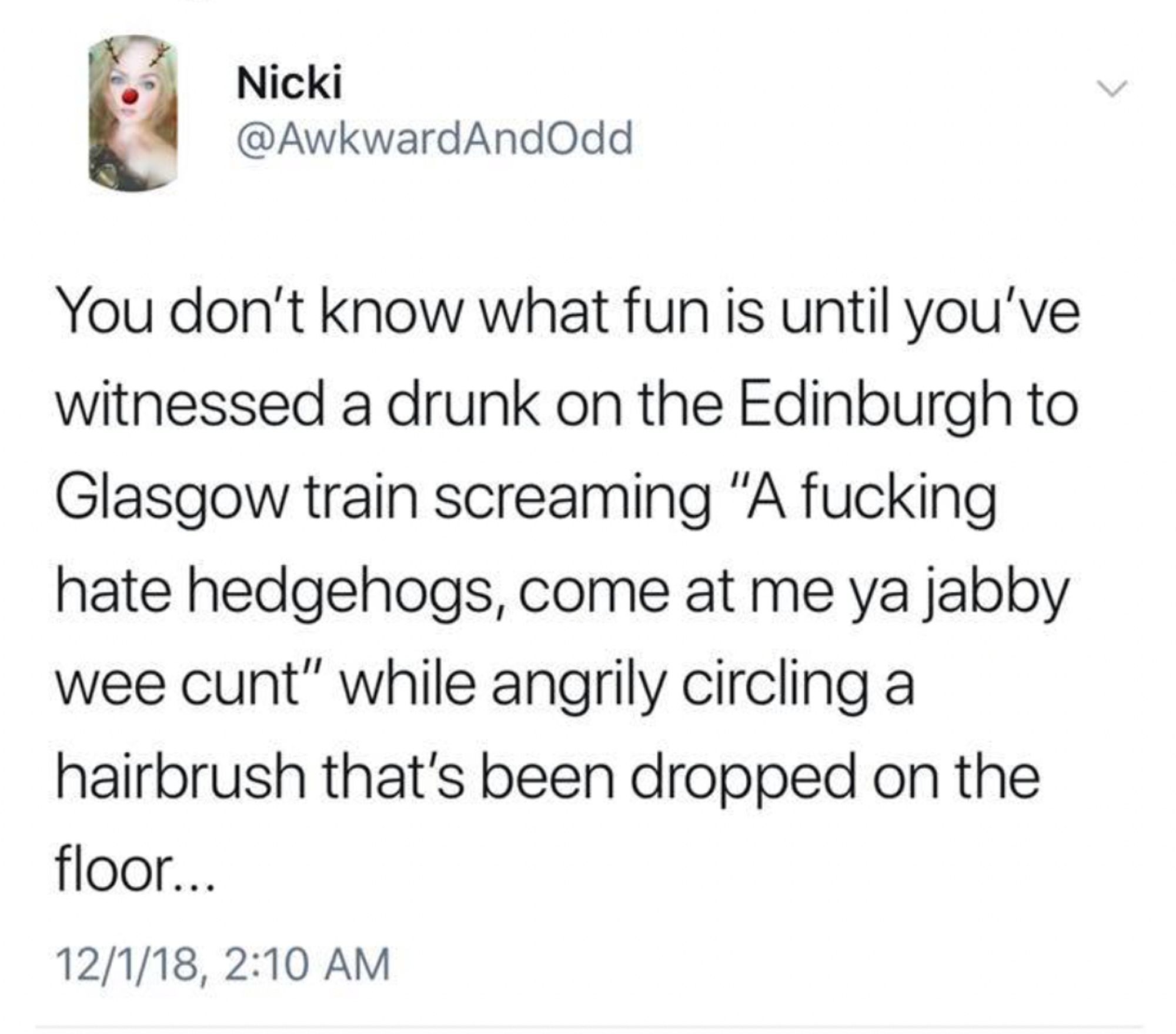
I didn't know what to post, so I panicked.

Image says:

"You don't know what fun is until you've witnessed a drunk on the Edinburgh to Glasgow train screaming "A fucking hate hedgehogs, come at me ya jabby wee cunt" while angrily circling a hairbrush that's been dropped on the floor..."

By: Nicki@AwkwardAndOdd