skilltheamps

joined 2 years ago
[–] skilltheamps@feddit.org 1 points 1 month ago

btrbk ... && curl https://uptime.my.domain/api/push/... is exactly what I do in a systemd service with nightly timer. Uptime Kuma sends a matrix message (via a bot account on matrix.org) if it doesn't get a success notification in 25h. I have two servers in different locations that do mutual backups and mutual uptime kuma monitoring. Should both servers go down at the same time, there's also some basic and free healthcheck from my dynamic-ipv6 provider https://ipv64.net/, so I also get an email if any of the two uptime kumas cannot be reached anymore.

[–] skilltheamps@feddit.org 7 points 1 month ago

You need to ask yourself what properties you want in your storage, then you can judge which solution fits. For me it is:

  • effortless rollback (i.e. in case something with a db updates, does a db migration and fails)
  • effortless backups, that preserve database integrity without slow/cumbersome/downtime-inducing crutches like sql dump
  • a scheme that works the same way for every service I host, no tailored solutions for individual services/containers
  • low maintenance

The amount of data I'm handling fits on larger harddrives (so I don't need pools), but I don't want to waste storage space. And my homeserver is not my learn and break stuff environment anymore, but rather just needs to work.

I went with btrfs raid 1, every service is in its own subvolume. The containers are precisely referenced by their digest-hashes, which gets snapshotted together with all persistent data. So every snapshot holds exactly the amount of data that is required to do a seamless rollback. Snapper maintains a timeline of snapshots for every service. Updating is semi-automated where it does snapshot -> update digest hash from container tags -> pull new images -> restart service. Nightly offsite backups happen with btrbk, which mirrors snapshots in an incremental fashion on another offsite server with btrfs.

[–] skilltheamps@feddit.org 9 points 2 months ago (6 children)

This is about contributing code that was co-created with an llm like copilot. Not about adding "AI" features to fedora.

[–] skilltheamps@feddit.org 2 points 2 months ago (1 children)

Rootless podman cannot bind ports <1024, only root can by default (on pretty much any distro I guess). Have you done something like sysctl net.ipv4.ip_unprivileged_port_start=80 to allow non-root processes to bind to port numbers >=80?

[–] skilltheamps@feddit.org 3 points 2 months ago* (last edited 2 months ago)

That is one issue. The next is that software support on phones is generally poor because there's lots of proprietary drivers and they don't have a common base system like computers do (bios). So building custom roms is difficult, doesn't scale well over the number of different devices and they often don't work great in the areas of camera, accelerated graphics and wireless networking. Also installing custom roms is also too difficult for the majority of people, and requires bootloader unlock which is either not possible at all or at a minimum cancels the warranty.

[–] skilltheamps@feddit.org 2 points 2 months ago

Eh naja, "versucht" ist da harmlos ausgedrückt. Einfach Maintainer aussperren ist weder nett noch förderlich für so ein Projekt. Man hätte auch einen soft fork machen können der upstream trackt und Änderungen nach einer Prüfung übernimmt. Wenn man sich mit upstream gut stellt könnte man auch eine doppel-Lizenz Strategie umsetzen, indem Lizenzen für den CRA-kompatiblen soft-fork an andere kommerzielle Konsumer des Projekts verkauft werden, welche sich dafür das Review plus Risiko sparen können. Daraus wiederum könnte man die Reviews und generelle Projektunterstützung finanzieren.

[–] skilltheamps@feddit.org 6 points 2 months ago* (last edited 2 months ago) (2 children)

Nicht-kommerzielle open-source Projekte sind von CRA ausgenommen. An der Stelle wo zuerst kommerziell verkauft wird fängt CRA an zu greifen. Wenn eine Firma in ein kommerzielles Produkt nicht-kommerzielles open-source einbaut muss sie selbst sicher stellen, dass das Produkt und damit auch seine Komponenten die CRA Anforderungen erfüllen.

Nicht-kommerzielles open-source ist keine Lieferkette. Es wird immer so geredet als gäbe es da einen "Lieferant", das ist nicht der Fall. Das ist einfach nur ein Projekt das herumschwirrt, und wenn ich mich daran bediene um das in ein kommerzielles Produkt verwandeln will um damit Geld zu verdienen, dann muss ich auch selbst dafür sorgen dass es den Regeln des Marktes entspricht.

[–] skilltheamps@feddit.org 2 points 3 months ago

I'm afraid this is impossible. This is most likely part of Gnome Shell itself.

[–] skilltheamps@feddit.org 1 points 3 months ago

This is not how redundancy works on cable cars. These systems are not copies of another, but different systems with different working principles. On systems with a pulling component (like the cable here) and a suspension component (like a suspension rope or rails), a safety brake on the cabin is only held open by the tension of the pulling cable. Should the pulling force bee too low, the brake clamps onto the suspension component.

Most of the time there's sadly no medial coverage of the safety systems. So with the accidents I followed either I don't know why the safety systems didn't work, or they were manipulated. For example in the 2021 case at Monte Mottarone, the brake was propped open with maintenance tools.

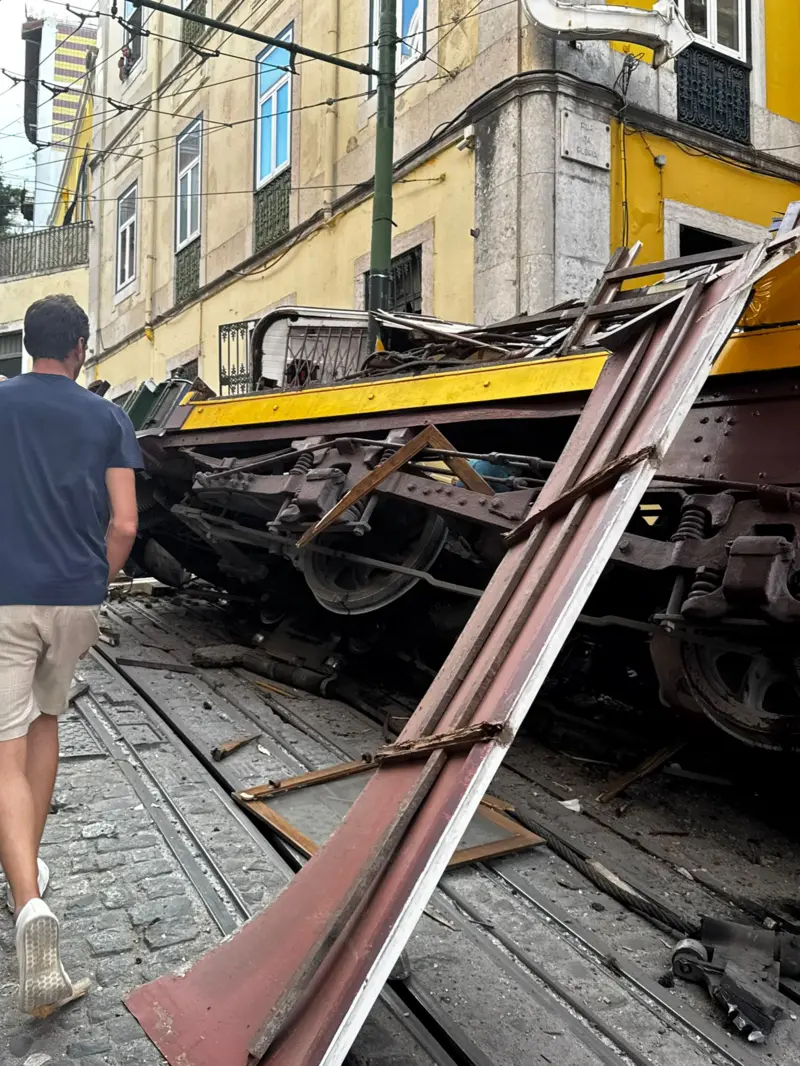
Given the age of the system in Lisbon, I hope it was updated to these safety standards. The most informative I could see was this image showing the underside of the wagon. It is still difficult to tell how it works in detail, but the thing protruding from the cable mount could be such a catching brake working on the inside of the cable guide I think. And to me it looks like the cable pulled out of the holder due to cracks in the holder.

[–] skilltheamps@feddit.org 4 points 6 months ago (3 children)

Von den 202 a-d trifft in diesem konkreten Fall für meine Begriffe wenn dann nur a zu, davon Abs. 1:

Wer unbefugt sich oder einem anderen Zugang zu Daten, die nicht für ihn bestimmt und die gegen unberechtigten Zugang besonders gesichert sind, unter Überwindung der Zugangssicherung verschafft, wird mit Freiheitsstrafe bis zu drei Jahren oder mit Geldstrafe bestraft.

Von "gegen unberechtigten Zugang besonders gesichtert" kann man aber hier ja wohl nicht sprechen...

(Ich bin kein Jurist. Ich will auch keine Lanze für die Hackerparagraphen brechen, die gehören sehr dringend reformiert)

[–] skilltheamps@feddit.org 13 points 10 months ago (1 children)

Ich habe mir letztens gedacht, das ganze Ding mit wählen reicht irgendwie nicht. Der Gedanke in eine Partei einzutreten schien mir aber nicht vielversprechend, und so machte sich ein Gefühl von Hilflosigkeit breit. Dann kam aber der 38C3, und einige Vorträge haben sehr deutlich gemacht, dass kleine Gruppen findiger Menschen viel disruptiver sein können als eine Partei. Insofern ist meine Einstellung gerade eher, dass ich (neben Wählen zu gehen) mich in Richtung von Organisationen und Vereinen bewege, die unabhängig von Wahlen und den ganzen Parteien-Terz meine Interessen vertreten. Bis jetzt sind das der CCC, Correctiv und das Zentrum für politische Schönheit

[–] skilltheamps@feddit.org 9 points 10 months ago (2 children)

Wesentlich in dieser Wahl ist den Anteil der Bundestagssitze für die Afd klein zu halten, und da helfen alle Parteien die unter die 5% Hürde fallen nicht. Insofern würde eine Stimme für die Piraten ohnehin nicht zur Verteidigung der Demokratie beitragen.

view more: next ›