politics

22212 readers
25 users here now

Protests, dual power, and even electoralism.

Labour and union posts go to !labour@www.hexbear.net.

Take the dunks to /c/strugglesession or !the_dunk_tank@www.hexbear.net.

!chapotraphouse@www.hexbear.net is good for shitposting.

Do not post direct links to reactionary sites.

Off topic posts will be removed.

Follow the Hexbear Code of Conduct and remember we're all comrades here.

founded 5 years ago
MODERATORS
1501
1502


You can't really say "I'm only fascist leaning". Either you are or you aren't

1503


My favorite thing that Stalin has ever written

1504


The Atlanta Public Safety Training Center, intended to consume at least 85 acres of forest adjacent to Atlanta’s Black working-class neighborhoods, is more accurately called Cop City. Slated to be one of the largest militarized police training centers in the nation, Cop City is owned by the nonprofit Atlanta Police Foundation, which, by paying $10 a year to lease the land, is funding about two-thirds of this $90 million project, via corporate (Coca-Cola, Bank of America, UPS…) donations. No surprise, then, that people feel Cop City bears watching.

Kamau Franklin has been watching Cop City since its inception. A human rights attorney and full-on community organizer for over 30 years, Kamau helped found Community Movement Builders, a collective of residents and activists in Atlanta’s Black working-class and poor communities. CMB is one of many organizations in the Stop Cop City movement. If it weren’t for months of dedicated fightback by these groups and individual activists, Cop City would probably be ready to open by now.

But massive demonstrations, rallies, tree-sittings, encampments, vigils, petitions, and, more recently, a voters’ referendum have resoundingly delayed the project, despite retaliatory waves of arrests, indictments, and detentions. Most recently, Georgia’s attorney general charged 61 Stop Cop City activists under the Racketeer Influenced and Corrupt Organizations Act (RICO). Originally designed to curb the mafia, RICO is used here to incriminate such mundane acts as handing out flyers, raising donations, or buying glue to make pamphlets – and could add prison sentences of five to 20 years. Having no idea of how all this will end, I asked Kamau how it began…

Kamau Franklin: In 2020 Community Movement Builders was one of the organizations doing a lot of work after the killing of George Floyd, Breonna Taylor, and, here in Atlanta, Rayshard Brooks – which took place less than a mile from our community house. We started organizing around police violence. Things were dying down, then all of a sudden, we started hearing about a plan by the city of Atlanta to build this militarized training center. They’d be renting over 300 acres, with 90 acres scheduled to be deforested. This is land on what we’ve dubbed the Weelaunee Forest, which was Muscogee tribal lands…. It’s geared up to have a Blackhawk helicopter pad, over a dozen firing ranges, urban warfare training, mock cities….

Instantly, we saw this as twofold. One, it was a continuation of over-policing, in particular, of Black communities, which has led to gentrification and to 90% of those arrested in Atlanta being Black. Two, the Atlanta Police Foundation, using money from the city and private corporations not only in Atlanta but nationally, was targeting movements against police terror and violence.

sd: The project was announced in April 2021. What happened then?

Kamau Franklin: In April, May, June 2021, organizing really kicked off. At first, it was straightforward: standard community rallies, demonstrations, town halls. We had the second largest public hearing at City Hall, but even though we peeled off some city council members, Cop City was backed by the council and the mayor’s office. So the city council voted to sign a lease for the Atlanta Police Foundation. After that, they thought the movement would end.

But in June and July, folks slowly began to go into the forest and stay there. Rallies and demonstrations, in and out of the forest, continued to take place. That type of organizing went on for a while. It wasn’t until the end of 2022, when, through an open records request, we found that the Atlanta Police Foundation discussed charging movement organizers with domestic terrorism. Then in December 2022, they made their first raid into the forest against the forest defenders and arrested six people. This was the first wave of arrests of people charged with domestic terrorism.

Earlier on, there were arrests that took place during demos and rallies against Cop City, but those folks weren’t charged with domestic terrorism. Then, in January 2023, the police raided the forest again, arrested another six activists, and killed Tortuguita [Manuel Esteban Paez Terán, they/them, 26-year-old forest defender]. Later in January, another seven or so organizers doing a vigil for Tortuguita in downtown Atlanta were arrested for domestic terrorism. Weeks of action continued and, this March, well over 23 people were arrested at a music festival and charged with domestic terrorism.

In May, they arrested the organizers who helped make public the names of the police who killed Tortuguita. Then they charged people from the Atlanta Solidarity Fund – a bail fund for movement people – with white-collar crimes. Earlier this month, they charged 61 people –most of whom had already been arrested – with RICO charges, using the strangest indictment anyone has ever seen, that called things like “mutual aid” and solidarity work akin to racketeering. A little before that, they arrested four or five organizers who were passing out flyers. So we’ve had this litany of charges, from domestic terrorism to RICO, for the last eight to ten months.

sd: How do things stand? How many people are in jail; how many are still living in the forest?

Kamau Franklin: In January, they cleared the forest out –the Georgia Bureau of Investigation, the Atlanta Police Department, DeKalb County Bureau, County Police Department, the Federal Bureau of Investigation, and Homeland Security – they put a fence around the entire forest. So as of today, there are no more forest defenders. They’ve cleared some land; they have not done any structural build but may be laying pipe and doing other things. Most of the people arrested, if not all, have been released on bail. There’s maybe one person on an immigration hold, still locked up.

During the arrests – particularly on domestic terrorism charges – the police separated people who had in-state licenses from out-of-state people. Those who had Georgia driver’s licenses were, for the most part, let go; people from out-of-state, they charged with domestic terrorism, to further their narrative that these actions come from a bunch of outside agitators. The overwhelming majority of people arrested and charged with domestic terrorism were doing nothing more than sitting in tree huts or tents or attending a music festival or a rally. But charging domestic terrorism is meant to criminalize and frighten people away from the movement.

sd: Mainstream media talk about some Cop City protesters “crossing the line,” from free speech and civil disobedience into “terrorism.” Doesn’t terrorism imply violence? What exactly is considered domestic terrorism here?

Kamau Franklin: They’re talking about property destruction. There have been times when graffiti was written on walls; when corporate offices had their windows broken; a couple of occasions where equipment used to knock down trees was disabled or burnt. Those weren’t the vast majority of tactics used, but they have occasionally taken place.

We in the Stop Cop City movement don’t necessarily consider those acts of violence, right? But if you want to charge somebody with property destruction – if that’s what they were caught doing – then we’d fight the charges, but at least we’d understand why someone got charged. But those individual property acts are the basis for using, not only RICO but also domestic terrorism charges, against a larger movement.

sd: A news account of Tortuguita being killed mentions that, at the same time, a trooper was “seriously wounded.” What happened?

Kamau Franklin: The first news that morning was that a trooper in the woods was shot in his stomach while doing a forest clearing. A few minutes later, news came that a forest defender had been killed. The Georgia Bureau of Investigation immediately put out a press release, claiming that this forest defender shot the state trooper and that police forces – many forces – then shot back at Tortuguita and killed them. Right away, we began to challenge that narrative.

We asked folks in the surrounding neighborhood about hearing gunshots. They did not say, as the Georgia Bureau of Investigation did, that one shot was fired, then police returned fire. Neighborhood people said they heard a sudden burst of gunfire. We should be clear that the Georgia Bureau of Investigation claims there is no videotape of the actual shooting – but in bodycam footage of police in other areas where they were ripping up tents, you clearly hear a burst of gunfire reminiscent of what people in the community said. The officers themselves say, “What’s that? Sounds like suppressed fire,” which is code for cop fire. One of them also comments, “Are they shooting themselves?”

The official autopsy shows that there were 56 entry/exit wounds in Tortuguita’s body and no gun residue on Tortuguita’s palms. So it seems ridiculous that this young forest defender, with no prior criminal record whatsoever, fired a single bullet at police, risking suicide, knowing they would be met with 40 to 50 gunshots in return – particularly since the autopsy showed that they were shot with their palms up, covering their face, sitting in a crisscross position with bullet holes throughout their knees, lower legs, thighs. So we dispute the state’s narrative, that Tortuguita was out to kill a cop, and they had no choice but to fire back. At this late date, they haven’t even released the official report of how Tortuguita was killed.

sd: What about the many law enforcement agencies targeting Cop City protesters? Does this call to mind the olden days of COINTELPRO? Or is this something new?

Kamau Franklin: It definitely calls to mind COINTELPRO – and a newer form, as well. Obviously, throughout COINTELPRO’s history, work between local law enforcement and the Federal Bureau of Investigation was common. Early on, before any arrests took place, via an open records request, we found out that they had developed an actual task force: the Atlanta police, DeKalb County police, Georgia Bureau of Investigation, Homeland Security, and the FBI. What we have here are political actors: the governor, the mayor, the DeKalb County Commissioners Office, the police department, the Atlanta Police Foundation – a private actor – they have their own task force, rooted in destroying the Cop City movement, not only by trying to criminalize it, but by arresting it, and literally by killing members of it. We feel they just didn’t expect this movement to keep on going; they thought they’d stopped us.

sd: What’s the relationship between Atlanta’s communities and the Cop City activists? Where are Atlanta’s elite in all this?

Kamau Franklin: The elite – particularly the Black elite, in terms of preachers, business people, and former elected officials – have all supported this mayor’s building of Cop City. They’ve clearly sided with the corporations, which have donated literally millions of dollars to building Cop City. It’s gonna be the first time in this country’s history that a private, nonprofit organization, the Atlanta Police Foundation, will be responsible for the training of a municipal police department. The elite have been fully on board to make sure that no further uprisings take place; that folks go back into their individual holes in the ground and consume TV, buy products they’re told to buy and leave the governing to them.

On the other side is the everyday community member and organizer, who says, We did not vote for this. The area reserved for Cop City is adjacent to a working-class Black community, which had no votes. The forest had been designated for camping grounds and hiking trails – there were literal plans written up and passed for that community but were scrapped when Atlanta decided on Cop City. One reason this forest is so important is that it helps with flooding, something that happens a lot, with climate change. As they cut down trees, more flooding will take place in those communities.

So, through the biggest mass action tactic we’ve used – the referendum process – we’ve collected over 116,000 signatures from everyday Atlantans, who say they want to have a vote in whether Cop City gets built. We’ve collected more signatures than people who actually voted for the current mayor. That’s unheard of in this city, and maybe across the country. So, with everyday Atlantans – and what’s left of the working-class and poor communities that haven’t been pushed out – there’s a very good relationship of us talking to people, trying to understand their needs and desires.

sd: What’s happening with those signatures?

Kamau Franklin: Our original deadline was August 21, to collect approximately 58,000 signatures that would be verified as signatures of people registered to vote during the last mayoral election. So, as we’re getting closer to August 21, we start to hear that they’ll use “signature-match” and “exact-match,” two well-known voter-repression tools.

The important thing to understand here is that this is the Democratic Party doing all this – the same Party that sued the Georgia Republican Party for using these exact methods to take away votes when Stacey Abrams ran. Meanwhile, a judge had given us extra time –until September 21 – so we continued collecting signatures. Then an appeals court stayed the judge’s order and said that we should stop collecting signatures. So, on Monday, September 11, we gave in the signatures we had. But then the city decided not to start verifying signatures, because of the stay issued by the court. This is a stall tactic; they know that, if we get this on the ballot, we will win at the polls.

sd: The RICO law used to charge those 61 people can include innocuous, nonviolent acts such as handing out a flyer. Could it also be used against people who’ve participated in this voter referendum?

Kamau Franklin: Yeah. The indictment is written in such a broad way that there could be future arrests, indictments, and charges. With RICO, anyone associated with organizing – even people who’ve been doing the referendum part – “Let’s put democracy to the test!” – could be charged with RICO for association with Stop Cop City activities.

sd: Isn’t RICO the same law that Fani Willis used to indict Trump?

Kamau Franklin: These laws are so fungible; they become tools of power, political expediency, in whoever’s hands they’re in. The domestic terrorism law itself was enacted after Dylann Roof shot up a church in South Carolina; it was supposed to protect so-called minorities against violent, extreme acts. That law has never been used before in Georgia – and the first time it’s used is to attack people opposing police violence. RICO has also been used against hip-hop artists, charging them with criminal enterprises.

You also have Attorney General Chris Carr, about to run for governor, trying to score points with his political base by charging these activists with RICO. To be honest, I don’t think he’s concerned about whether he’s able to prosecute and imprison people; he’s trying to throw red meat at a constituency. Particularly when you look at how he laid out the indictment, blaming anarchist ideology, suggesting that the beginning of the conspiracy – which is extremely important –happened the day George Floyd was murdered by police. No one had even heard about Cop City on that day, but he claims May 25, 2020, was the start of a criminal enterprise, because people had the nerve to challenge the supremacy of police in our communities.

sd: I’m wondering if “anarchism” isn’t some wonky prosecutorial way to convince the public that these charges are basically colorblind and not based on a fear of Black people.

Kamau Franklin: Yeah, it brings out this fear of Black folks. Also the fear of Antifa – I thought, when I read the indictment, that “anarchism” is almost like saying “communism.” This is more of a media campaign – because many people arrested weren’t anarchists at all, right? If he gets one or two convictions, he’ll be happy.

In the meantime, there are 61 people whose lives are overturned; who’ve lost jobs; been kicked out of school; and they have to raise the money to get to court dates. People’s lives are in limbo, and some will have to be rebuilt, under the fear of prison time. Because you have a corrupt state, which will use any means at its disposal to stamp out this movement.

sd: Could Cop City be built, even as these RICO cases go to court?

Kamau Franklin: Most definitely. The city has basically seized control of the physical area. There are trucks, trailers, all kinds of equipment there now, clearing forest land. They’ve knocked down over 70 or 80 acres. This struggle has continued for two years, but we are definitely nearing some inflection point, the potential of the movement to stop Cop City. And even if we’re not successful – people don’t like to talk about that part – how do we still hold together? What are our future battles?

sd: Can you compare this to another time in history?

Kamau Franklin: I think Standing Rock is very comparable, in terms of the number of people, the multitude of forces, directly challenging tribal lands being taken away, climate change and fighting white supremacy, and capitalism. I also think there’s a direct correlation to what’s been happening in this country over the last ten years, since Trayvon Martin was killed, Mike Brown in Ferguson, George Floyd and others, where different uprisings and mobilizations have politicized a new generation of people.

I feel like people understand that we’re not only opposing bad policing; we’re opposing the very way in which cities – Atlanta being one example – operate to disenfranchise working-class and poor people; in this case, Black people. We’re not stopping because they tell us to stop; this movement has grown. We have socialists, communists, anarchists, revolutionaries, nationalists, community organizers, environmentalists, voting rights activists, and everyday community people – the expansiveness of this movement scares them. The diversity of tactics scares them, The fact that we haven’t sold each other out because of property destruction. They’ve not been able to divide us, for the most part, into “good” versus “bad” activists.

sd: Are protests still going on?

Kamau Franklin: Oh, yeah. Just a few days ago, there was quite a heroic protest, because it was after people were charged with RICO. These organizers and activists, led by a clergy coalition, decided to go onto the blocked-off grounds, where Cop City’s planned to be built. They issued a stop-work order to the workers in Cop City. Five or six people were arrested. At the time, they were not charged with domestic terrorism or RICO. But their bravery, to understand that these charges may be hanging over their heads, and still protest…

And when we turned in all the referendum ballots, close to 300 people came with us. There are also conversations about actions next week; about a huge action in November. The referendum is just one part of the struggle. There will be actions throughout the struggle, as long as the struggle lasts. And we may still win.

1505
1506


Neat electoral/social analysis of Georgia’s biggest grifter

1507


https://www.foxnews.com/us/troops-plagued-filthy-conditions-squatter-military-barracks

CW: suicideIn one extreme case, officials at one installation told GAO investigators that "service members are responsible for cleaning biological waste that may remain in a barracks room after a suicide."

1508


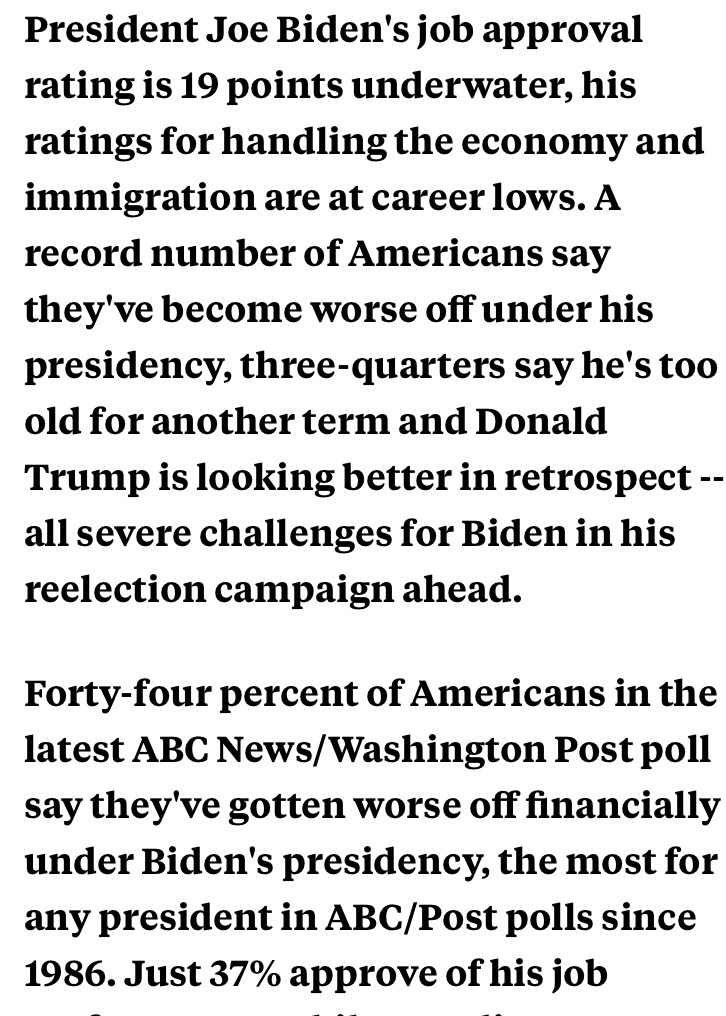
https://abcnews.go.com/Politics/troubles-biden-age-reelection-campaign-poll/story?id=103436611

30% job approval on economics lol, the thing this bozo is running on

1509


I wish I could feel sympathy, but I don't. The Reagan generation did this to themselves, and the rest of us have to suffer with them.

1510
1511
1512
1513


It's a banger lmao he talks so fast. Good slop. Even mentions Borrell's racist "Europe is-a garden" quote.

1514
1515
1516
1517
1518
1519


Vile, evil, disgusting country

1520


By: Noam Chomsky and Vijay Prashad

LET’S begin with a truism: the Russian invasion of Ukraine will be ended either by defeat of one side or by a diplomatic settlement. That much at least should be beyond debate. A defeat is simply not on the cards, since the west will not allow Ukraine to be totally defeated, and Russia – a major nuclear power – cannot be defeated without the prospect of the introduction of nuclear weapons into the conflict. Since, a defeat of one side or the other is simply not possible, the only way forward is through a diplomatic settlement. The alternative, put simply, is collective suicide as both sides move up the escalation ladder until it is too late.

The United States has articulated a policy that it wishes to continue this war to severely ‘weaken Russia’ – as US defence secretary Lloyd Austin and other high officials have been explicitly stating – and, it is claimed, to place Ukraine in a stronger bargaining position for eventual negotiations (or in a weaker position, if the Russian offensive makes an impact, a strong likelihood that is quietly ignored). The policy of trying to ‘weaken Russia’ through the escalation of the war in Ukraine is the position of the United States and the United Kingdom, and with some variation, their European allies (France, as usual, demurs here and there, but when push comes to shove, lines up with Washington).

EXTINCTION AND ANNIHILATION

The rest of the world, overwhelmingly, is calling for a diplomatic settlement to end the horrors before they become even worse. It will be worse first for Ukraine, which has lost tens of thousands of soldiers and suffered major economic damage across the country (as well as lost substantial parts of its territory to Russia). The Ukrainian counter-offensive has failed. The desperation in Kyiv demonstrates that there are few quivers left in Ukraine president Volodymyr Zelensky’s arsenal.

The severe destruction in Ukraine, however, is nothing like the US-UK shock-and-awe style of war, as we saw against Iraq in 2003 and Libya in 2011, which goes straight to the jugular, demolishing energy, transportation, and communication systems, namely anything that allows a modern society to function; neither has Ukraine experienced the use of illegal and near-illegal weapons systems based on depleted uranium and white phosphorus (used by the United States in Iraq). No heads of state from the western countries visited Baghdad while the US and the UK were demolishing it. The argument about double standards is not a talking point for anyone, but a simple fact based on the evidence.

The bitter costs of the war are, of course, not limited to Ukraine and Russia. Millions are facing starvation as grain and fertilizer supplies are curtailed from the rich Black Sea region, and food prices soar along with the profits of a handful of multinational corporations that dominate the global food system. The Black Sea Grain Initiative – made between Ukraine, Russia, Turkey, and the United Nations in July 2022 for 120 days and then subsequently extended – has moved over twenty million tonnes of grain from the region to the rest of the world; this is much below the normal, but nonetheless – as the UN secretary general António Guterres called a ‘beacon of hope’, an illustration that a wider peace agreement is possible. The fate of this initiative is unknown.

Long before the war, humanity faced the pressing problems of extinction (due to the environmental catastrophe) and annihilation (accelerated by the collapse of the nuclear weapons regulation regime, spurred on by the US unilateral withdrawal from the Anti-Ballistic Missile Treaty in 2002, the Intermediate Nuclear Forces Treaty in 2019, and the Open Skies Treaty in 2020). This conflict in Ukraine and the tensions around the South China Sea make it easy to envision steps up the escalation ladder, with one such step being Russia’s suspension of participation in the New START treaty in February 2023. The limited steps to address imminent environmental catastrophe with the watered-down climate change agreements and the weakened environmental protection treaties do not offer confidence that humanity can prevent the death knell for organised human life on earth, and even these inadequate steps have been reversed in the course of the Ukraine war.

GHASTLY GAMBLE

It is far too little discussed, but the US-UK stance entails a ghastly gamble with the fate of Ukraine and far beyond. The gamble is that if the ‘demented madman’ Putin faces defeat, as the US-UK portray the situation, then he will quietly pack his bags and slink away to oblivion or worse, and will not use the conventional weapons that Russia has at the ready, and which it could use to emulate US-UK war in Iraq and, or of Israel against Gaza, and devastate Ukraine, including Kyiv and the western areas so far mostly spared from the worst of the battles.

A moment’s thought should suffice to reveal the ghastliness of this gamble. One can easily see why outside the western propaganda bubble, much of the world sees the conflict as a proxy war between the United States – using the now buoyant North Atlantic Treaty Organisation (NATO) – and Russia, with Ukrainian bodies as the chessboard. If Ukrainians choose to take the gamble, that’s their business, although it should be remembered that Zelenskyy came to office in 2019 on a peace platform that authorised him to cut a deal with Russia and not escalate the situation to war. The appetite for peace was very much in evidence in Ukraine, including in 2014 when Ukraine’s then president Petro Poroshenko promised to ‘end the war in two weeks’. Now, NATO’s chief Jens Stoltenberg says, ‘We must prepare ourselves for a long war in Ukraine’ (to Germany’s Funke media group in mid-September). The cost will not be paid by ‘we’, but by ordinary Ukrainians and Russians who are dying in large numbers.

That the United States is imposing the gamble on Ukraine (to ‘weaken Russia’), sending arms and building up the illusion of a victory while blocking diplomacy, is incontestable. It has influenced the general mood within Ukraine, turning the possibility of peace into the endless horror of war.

For almost everyone, the war is a disaster, increasingly so the longer it persists. Almost everyone. Some are doing just fine. In the corporate offices of fossil fuel companies and military producers, and the financial institutions that sustain them, euphoria is unbounded. They are enjoying record-breaking profits. In October 2022, the Pentagon said that it was giving out 1.2 billion dollars in contracts to arms manufacturers to replenish US military stocks used in Ukraine, an announcement that sent the stocks of Northrop Grumman up by 40 per cent and of Lockheed Martin up by 37 per cent. Due to the blockage of Russian gas into Europe, western energy companies – Chevron, ExxonMobil, Shell, BP, and TotalEnergies – made 134 billion dollars in excess profits in 2022. The arms and energy firms continue to churn out their toxic products, increasing the prospect for destroying organised human life on earth by exploiting new regions for fossil fuel production and for war.

GLOBAL NATO

In the geopolitical dimension, Washington has registered great gains. Before the escalation of the conflict against Russia (with Ukraine as the flashpoint) and against China (with Taiwan as the flashpoint), NATO edged towards obsolescence. In 2006, Ivo Daalder and James Goldgeier wrote a piece in Foreign Affairs calling for a ‘Global NATO’, a project that then seemed entirely quixotic despite the ‘out of area’ operation by NATO in Afghanistan. Five years later, in 2011, NATO conducted an ‘out of area’ operation against Libya, whose actions had not triggered Article 5 that enjoins the alliances only to enter in defence of a member state. But even the adventure in Libya, which virtually destroyed that country, did not drive the momentum towards giving NATO a lease of life after the Cold War and indeed to allow it a global footprint. It was the New Cold War against China and Russia that brought the idea of Global NATO to the fore and allowed the United States to use NATO as an instrument to revitalise the deteriorating Atlantic alliance (threatened as Europe was integrating with Russia for energy and with China for investment). Putin’s invasion of Ukraine cemented the revitalisation of NATO, giving the United States a marvellous gift on a silver platter: Europe.

Since Second World War, there has been deep concern in Washington that Europe might move on an independent course, developing its very natural commercial and other relations with the east – a ‘marriage made in heaven’, as some economists describe it, between German-based advanced industrial Europe and the rich material resources of the east, with the enormous China-based market beckoning beyond. Those opportunities became more real after the collapse of the Soviet Union, when Mikhail Gorbachev proposed a ‘common European home’ from Lisbon to Vladivostok, with no military alliances, no victors and defeated, and common steps towards a social democratic future. That was not to be. US president Bill Clinton launched a new cold war by violating the firm and unambiguous promise by President George H W Bush that NATO would not expand one inch to the east of Germany if Gorbachev agreed to allow Germany to be unified and furthermore, to join NATO, a hostile military alliance – not a small concession in the light of history. Clinton betrayed the handshake agreement made by US secretary of state James Baker and the last Soviet foreign minister Eduard Shevardnadze on February 9, 1990, an agreement about which there is a great deal of deceit by western commentators but which was indeed firm and unambiguous as can be seen from the actual text of the agreement (‘There would, of course, have to be iron-clad guarantees that NATO’s jurisdiction or forces would not move eastward. And this would have to be done in a manner that would satisfy Germany’s neighbours to the east’; at that time, Baker said to Mikhail Gorbachev,‘We understand the need for assurances to the countries in the East. If we maintain a presence in a Germany that is a part of NATO, there would be no extension of NATO’s jurisdiction for forces of NATO one inch to the east’). NATO’s head Jens Stoltenberg recently acknowledged that this war is due to his organisation’s eastward provocation.

NATO began its march eastward by absorbing the Czech Republic, Hungary, and Poland (in 1999), Bulgaria, Estonia, Latvia, Lithuania, Romania, Slovakia, and Slovenia (in 2004), Albania and Croatia (in 2009), Montenegro (in 2017), and finally North Macedonia (in 2020). At the 2008 Bucharest Summit, overruling French and German objections under US pressure, the NATO member states agreed that Georgia and Ukraine ‘will become members of NATO in the future’. This was held in April 2008, and just a few months later, in August, Georgia and Russia fought a war over the breakaway Russian-majority areas of Abkhazia and South Ossetia – a war that was a prelude to the conflict around Ukraine. Russia’s president Vladimir Putin had sounded the alarm at the 2007 Munich Security Conference, when he said that the world does not need a ‘single master’ and where he suggested the necessity for security guarantees for Russia. These points were disregarded, and Putin – who had been a loyal ally of the west – was now denigrated for his audacity to question US leadership (this is when Putin, the great democrat to Bush and Blair before 2007, became the great dictator). The US unilateral withdrawal from nuclear weapons treaties suggested to the Russians that the west might not only expand NATO but place lethal weaponry within striking distance of major Russian cities, which would not be able to protect themselves. This steady march toward confrontation – including the US meddling in the politics of Ukraine a decade ago – leads directly to today’s horror show, with worse to come if this is not brought to an end.

NEW COLD WAR

With Europe now safely in Washington’s pocket, at least for now, the United States has been able to extend the NATO military alliance to the Indo-Pacific region, enlisting NATO in its confrontation with China, which is even more ominous than the terrible events in Europe. The US Indo-Pacific project includes the building up of military alliances around China (such as the Quad – with Australia, India, and Japan) and by the creation of NATO Plus (which includes Australia, Israel, Japan, New Zealand, and South Korea).

The neoconservatives who run US president Joe Biden’s foreign policy have ramped up this confrontation against China. In official terminology, China is now ‘encircled’ by ‘sentinel states’, who are armed with advanced US precision weapons aimed at China, backed by massive naval manoeuvres in the Pacific Ocean. Nuclear-capable B-52s are now based in Darwin (Australia) and in Guam, within easy striking distance of China.

Taiwan is the major flash point. In late February 2023, US House Foreign Affairs Committee chairman Michael McCaul told ABC News that it is ‘Ukraine today. It’s going to be Taiwan tomorrow’. For fifty years, the One China policy has kept peace in Taiwan, not an inconsiderable achievement in international affairs. It is now seriously threatened, primarily by highly provocative US initiatives that are familiar: the visit of US elected officials led by house speaker Nancy Pelosi was followed by other reckless acts of this nature. The Taiwan Policy Act (2021-2022) passed by the Senate Foreign Relations Committee calls for granting Taiwan the diplomatic status of a non-NATO ally, with no diplomatic restrictions, along with enhanced military aid and training and interoperability of military forces – all eerily similar to Ukraine policies of the past decade.

Most serious of all, Biden’s team has now declared economic war on China, as it is rightly termed by the international financial press, designed to prevent China’s technological development. The trade war against China and now the militarisation of that trade war is not about ‘Chinese aggression’ but about the failure of US businesses to compete with Chinese businesses. Rather than allow for competition, the US government has intervened with sanctions against these sectors and against specific companies (such as Huawei). As in the case of unilateral US sanctions against other countries (such as Cuba, Venezuela, and Iran), other states and businesses must observe them whether they like it or not; typically, they don’t like it, but in that case, tough luck. It is dangerous to defy the master. This godfather-like policy towards China is a further blow to Europe, which is already facing a form of deindustrialisation as it follows US demands about cutting energy purchases from Russia and cutting investments from China. The Netherlands, for example, has the world’s most advanced lithographic industry, a prime component in production of the semiconductors that are the core of the advanced economy. Losing the rich China market, under US threats, would be no small blow. The same is true for South Korea’s Samsung and for Japan’s advanced industries. How long they will be willing to endure all of this is one of the many uncertainties in the troubled world scene.

Meanwhile China is proceeding with its global loan and development projects, incorporating Eurasia, extending to Africa, the Middle East, and even to the US backyard in Latin America, much to Washington’s distress. The Belt and Road Initiative – now a decade old – and the concessionary lending by the People’s Bank of China in local currencies comes alongside the fact that China is now the leading trade partner with most countries in the global south. Despite the pandemic and the anti-China policies of the US government, in November 2020 fifteen countries met in Hanoi (Vietnam) to join the Regional Comprehensive Economic Partnership (RCEP) to create the largest trading bloc in history, one that is anchored by the Chinese economy. The United States is not in RCEP, and the US government’s own Trans-Pacific Partnership is now defunct.

There is a famous ditty of Hilaire Belloc’s about the British empire in its heyday: ‘Whatever happens we have got, the maxim gun and they have not’. Guns are not enough to stop China’s development and expansion of its influence, and efforts at economic strangulation are not very likely to succeed either. Most of the world is having nothing to do with it and is moving towards a world order that has ‘no single master’, an order where regionalism has come to be an effective institutional force and where regionalism plus (such as through alliances like BRICS with Brazil, Russia, India, China, and South Africa – now expanded by six major countries, including leading producers of energy) playing an increasingly important role in world affairs (initially in trade relations, but increasingly in the world of politics).

A final word. Everything we have discussed is clinically insane, the behaviour of societies gone completely mad as they stampede to suicide. There’s a reason why the hands of the Doomsday Clock were advanced to 90 seconds to midnight. We are racing towards destruction of the environment that sustains life. Terminal nuclear war is an increasing threat in Europe and Asia. New pandemics are likely, which may make this one look like a picnic in the park. None of these lethal dangers have boundaries. The great powers will either find ways to accommodate and to cooperate for the common good, or they will all collapse together. At the start of the pandemic, the head of the World Health Organisation Dr Tedros Adhanom Ghebreyesus urged the countries of the world to be more collaborative and less confrontational. Common problems needed common solutions, he said. These are wise words, and they need to be heeded.

1521
1522


The focal shift from Russia in Europe to China in Asia is less a mechanism for coping with defeat than the pathological reaction of a country that, feeling a gnawing sense of diminishing prowess, can manage to do nothing more than try one final fling at proving to itself that it still has the right stuff — since living without that exalted sense of self is intolerable.

1523


I really wanted to find this gif but I couldn'tobama-sad

1524


Heart wrenching read about downward mobility of a family in Michigan. The grandfather was a carpenter that retired at 60. The daughter works doubles at a grocery store and A&W for literally no money, as whatever she earns immediately gets burned by transportation costs to and from her job.

There’s so much fucked up shit in this story and it doesn’t even touch on systemic racism.

Article is from March of 2022. I didn’t realize 44% of Americans work low wage jobs. Staggering. I’m sure that number has only gotten bigger.

1525


I might write a summary later

view more: ‹ prev next ›