this post was submitted on 12 Dec 2024
470 points (80.4% liked)
Comic Strips
20690 readers
2612 users here now
Comic Strips is a community for those who love comic stories.
The rules are simple:
- The post can be a single image, an image gallery, or a link to a specific comic hosted on another site (the author's website, for instance).
- The comic must be a complete story.
- If it is an external link, it must be to a specific story, not to the root of the site.
- You may post comics from others or your own.
- If you are posting a comic of your own, a maximum of one per week is allowed (I know, your comics are great, but this rule helps avoid spam).
- The comic can be in any language, but if it's not in English, OP must include an English translation in the post's 'body' field (note: you don't need to select a specific language when posting a comic).
- Politeness.
- AI-generated comics aren't allowed.
- Adult content is not allowed. This community aims to be fun for people of all ages.
Web of links
- !linuxmemes@lemmy.world: "I use Arch btw"
- !memes@lemmy.world: memes (you don't say!)
founded 2 years ago
MODERATORS
you are viewing a single comment's thread
view the rest of the comments
view the rest of the comments
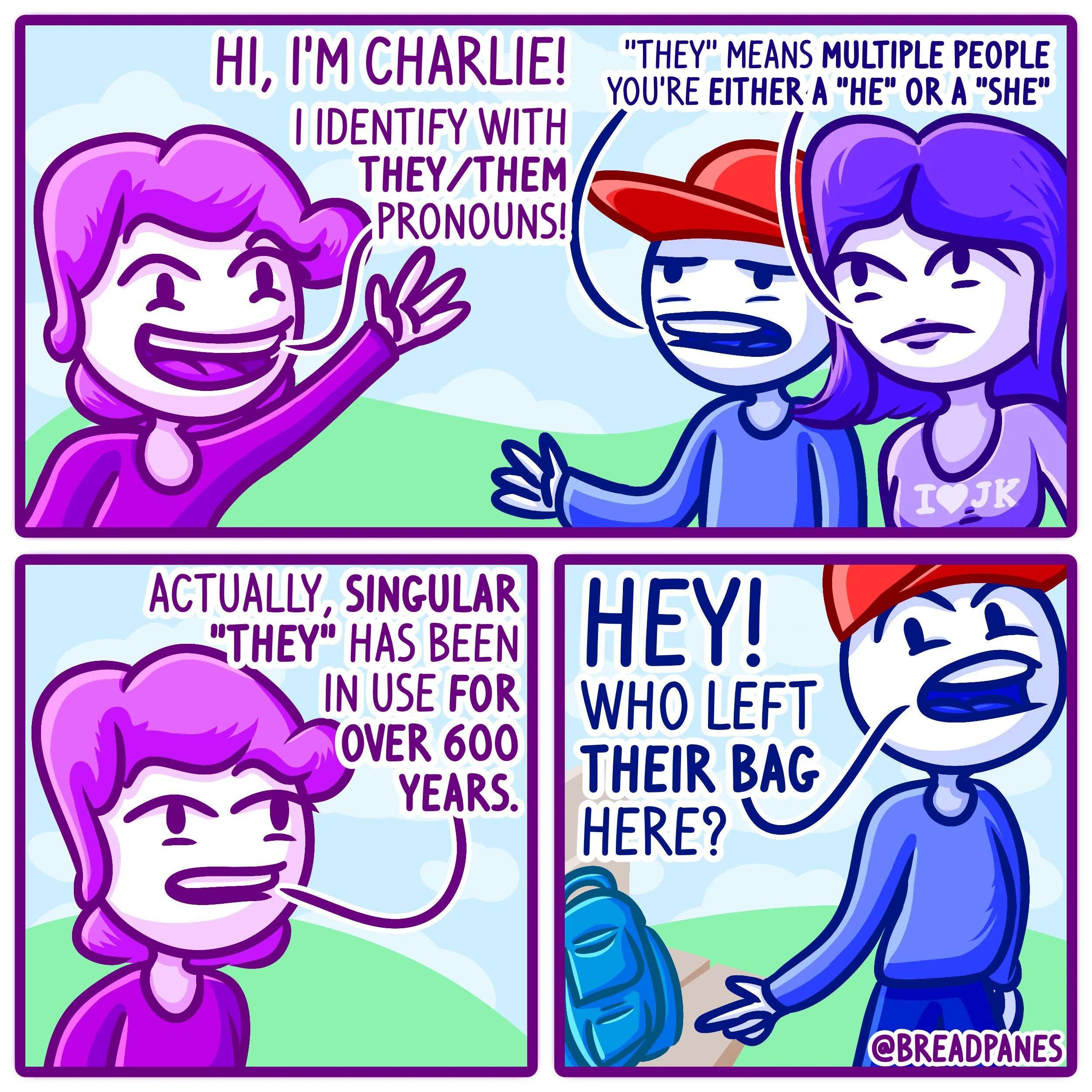
One thing that might help it feel less strange is realising that you already use a grammatically plural pronoun to refer to individuals all the time: the word "you". It's always "you are tall", not "you is tall", same as "we" or "they" instead of "he" or "she". This is because it was historically plural, and "thou" was the singular. Over time we started using the plural to be more polite, and then eventually always using it.
"Thou is tall" sounds weird though.
This made my brain short circuit lol. Can't believe I never noticed.
Yeah but that's because you see it in archaic contexts. How do you feel about 'thou art tall'?
But art sounds like are. Is art singular?
From the dictionary: (archaic) second-person singular simple present indicative of be
So, yes?
Why the question mark?
To convey uncertainty, because the dictionary classification of the word was a bit of a mouthful, and I was only 90% certain that I was interpreting it correctly.
It's "thee is tall."
He, she, thee.
Ahhh, that makes so much more sense.
No, that's incorrect.
It's "Thou are tall" or "Thou art tall"
* Used as an object (It is thine) or historically, when the following word started in the vowel (Thine eyes sparkle like diamonds, Mine ears ache)
** Used as an object (it is hers)
Yes I too, read the Wikipedia entry for thou/thee.
Are the Outlander writers just dumb or something then? Or is what you're referring to ("thou art") just a different context.
Because in Outlander, the quakers clearly use "thee is" and not "thou art/are".
Because they use it as the second person singular.
Minor spoilers for latest season of Outlander
Thee is a wolf
I’m joining in the “this blew my mind” sentiment and just want to say thanks for sharing this tidbit of info.
Thee has had thee mind blown?
It only feels strange because of how it's been used previously in my lifetime, not from historical usage. But as you've shown, language changes over time, and not having a singular neutral pronoun has proven to be a big omission in English (since "they" has only traditionally been used that way in certain limited cases). If it was good enough for "you," it's good enough for "they!"