this post was submitted on 03 Dec 2025
860 points (97.9% liked)
Memes
15543 readers
855 users here now
Post memes here.
A meme is an idea, behavior, or style that spreads by means of imitation from person to person within a culture and often carries symbolic meaning representing a particular phenomenon or theme.
An Internet meme or meme, is a cultural item that is spread via the Internet, often through social media platforms. The name is by the concept of memes proposed by Richard Dawkins in 1972. Internet memes can take various forms, such as images, videos, GIFs, and various other viral sensations.
- Wait at least 2 months before reposting
- No explicitly political content (about political figures, political events, elections and so on), !politicalmemes@lemmy.ca can be better place for that
- Use NSFW marking accordingly
Laittakaa meemejä tänne.
- Odota ainakin 2 kuukautta ennen meemin postaamista uudelleen
- Ei selkeän poliittista sisältöä (poliitikoista, poliittisista tapahtumista, vaaleista jne) parempi paikka esim. !politicalmemes@lemmy.ca
- Merkitse K18-sisältö tarpeen mukaan
founded 3 years ago
MODERATORS
you are viewing a single comment's thread
view the rest of the comments
view the rest of the comments
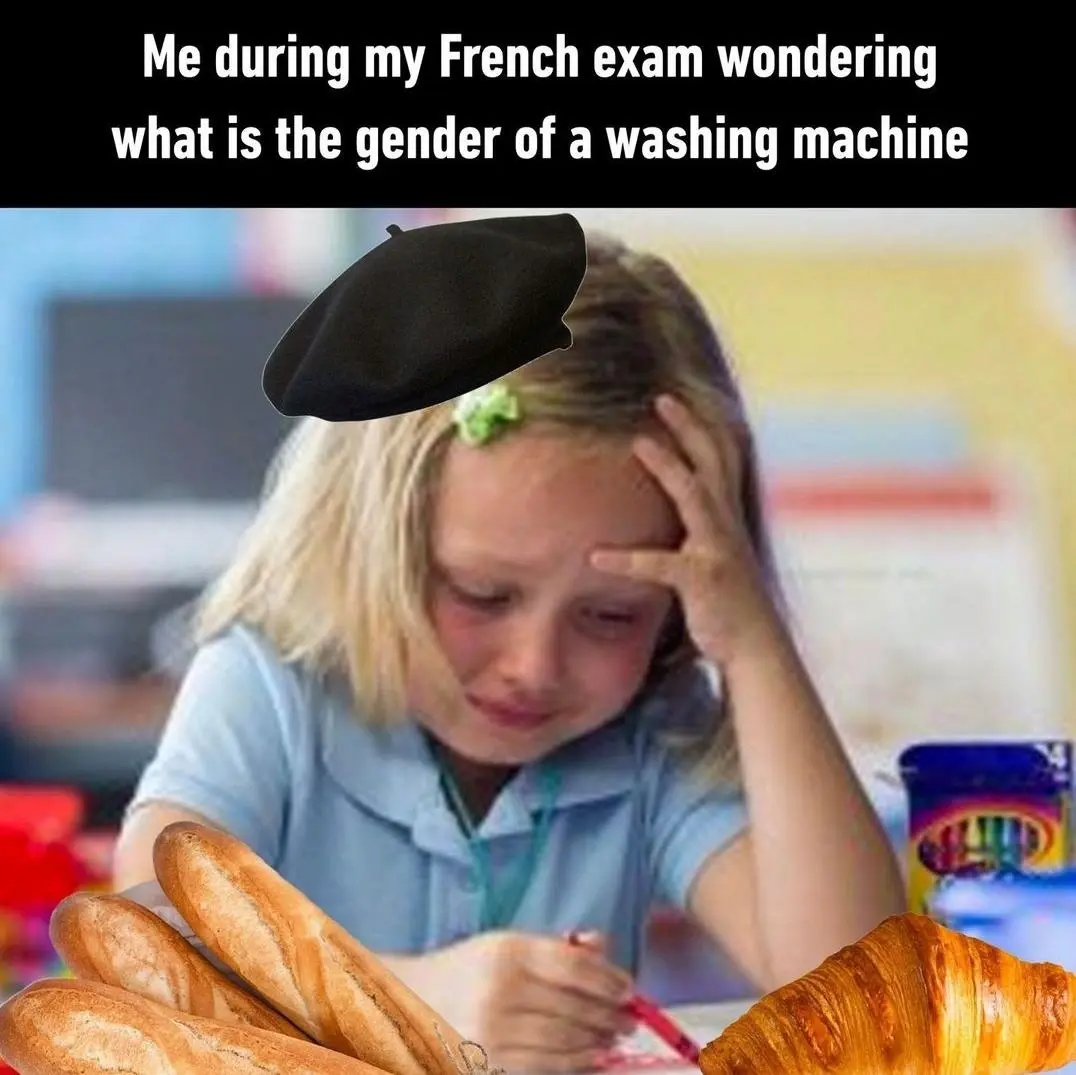
In French, it's 'le pénis,' but nobody says that. 'Dick,' is feminine (la bite.)
Also, 'vagina' is masculine, but 'pussy' is feminine, because if you were to say 'le chat' it would mean a cat, but by feminising the word, it becomes 'la chatte,' meaning pussy.
As someone who grew up Anglophone, I actually find gendered languages much more precise. On the other hand, in order to make yourself understood one must have a rich vocabulary, because the definitions of words are often more narrow than in English.
And don't even get me started on phrasal verbs... English is messy.
Just never ask a group of Germans what the singular article of Nutella is.
Put some yogurt on that!
You'd better back down before this blows up or i break down
Pure poetry.
back up - actual phrase
break up - actual phrase
Why no blow down?
I don't get the weirdness of phrasal verbs? It's a basic staple of every Indoeuropean language to generate verbs by tacking on prepositions. Ok, it's a bit weird to use prepositions after the word, but that's just standard Germanic separable verbs that are a bit regulized. So what?
They're just so ubiquitous in English. In my experience, people coming from the Romance languages have a very hard time with them, because most of the actions they describe are a single verb in their mother tongues. Imagine having to remember what two words mean, but then also having to remember that when you use the two words together, they form a distinct, sometimes even unrelated, meaning.
And there's thousands.
Well, Romance languages have thousands, too, like e.g. French poser and sup-poser, dé-poser, re-poser, trans-poser, pro-poser, im-poser, ex-poser, pré-poser, anté-poser, op-poser, super-poser, com-poser, juxta-poser, ap-poser, dis-poser, postposer,
If I call up a random French or Spanish article on wikipedia, a decent amount, if not the majority of verbs (not counting auxilliary verbs) are compounds. Somehow Romance speakers seem to have lost the ability to spot them, a Mexican coworker of mine was absolutely convinced Spanish does not have compound verbs as well.
Oh – I see. The Romance prepositions have changed. Knowing Latin I cannot not recognise the loads of compound verbs, but with sur, de, derriere, travers, par, en, hors, avant and so on the compounds are not recognisable any longer and our poor Romance friends have to learn all the words by themselves instead of nice semilogical groups.
I would love to see that discuss
Sorry, I don’t understand what I am seeing here. Is that someone xeeting a screenshot of someone reporting to Duolingo that penis should be feminine, not masculine in Spanish?