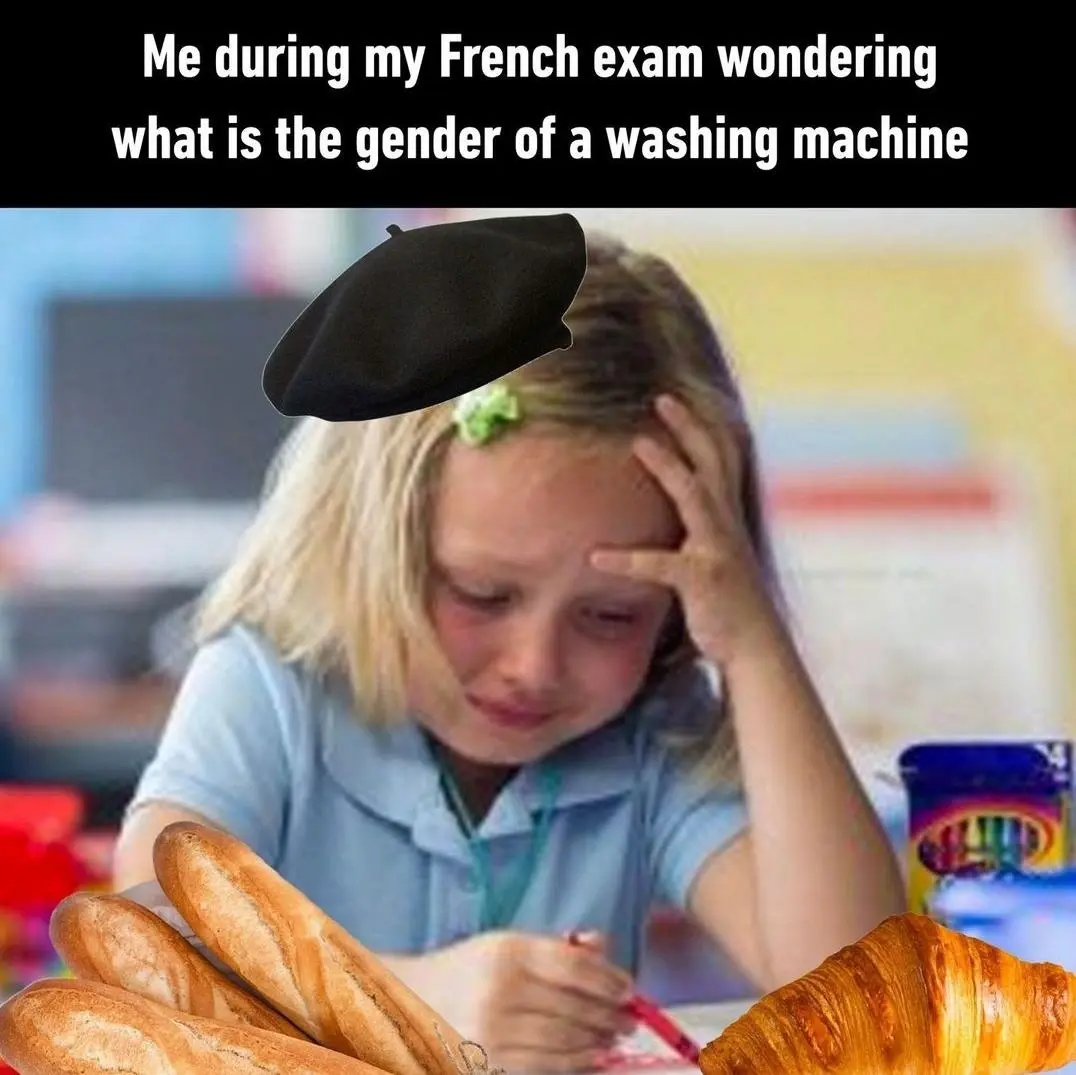
I've found that most of the time, just pick the most sexist answer you can think of, and you'll typically be right!
I really don't like gendered languages.
Post memes here.
A meme is an idea, behavior, or style that spreads by means of imitation from person to person within a culture and often carries symbolic meaning representing a particular phenomenon or theme.
An Internet meme or meme, is a cultural item that is spread via the Internet, often through social media platforms. The name is by the concept of memes proposed by Richard Dawkins in 1972. Internet memes can take various forms, such as images, videos, GIFs, and various other viral sensations.
Laittakaa meemejä tänne.
I've found that most of the time, just pick the most sexist answer you can think of, and you'll typically be right!
I really don't like gendered languages.
You'd love German – there is absolutely zero system or logic behind what word has which of the three genders.
three?!
German is woke
It totally isn't unfortunately, the gender neutral pronoun (if that's what it's called?) doesn't work for humans.
Yep. Masculine, feminine, and neuter. It’s annoyingly hard to learn. Plus all the other adjectives and such change to match. It’s wild.
There are some general guidelines, which hold true more often than not: https://germanwithlaura.com/noun-gender/
For example, planets that don't end with an e and which aren't Venus tend to be male
Yeah, no, it doesn't make sense:
Der Mann (the man - male article)
Die Frau (the woman - female article)
Der Junge (the boy - male article)
Das Mädchen (the girl - neutral article)
Like, come on gendered articles, you had one job.
Anything with -chen/-klein (a diminutive) is neuter.
E.g. in addition to Mädchen there is Jungchen (~"youngster") that is also neuter rather than masculine.
I only studied french for a short time, but I feel like that really doesn't work for french:
Those were the two onces I could remember like this half a year after ending my french studies, but could be that those are only two uncommon counterexamples.
Also, both of these are what you would "expect" in German (die Bluse, der Gürtel)
You'll be right 50% of the times. Or 33% in german. And it doesn't match between languages. Like, "cat" is a she in german and a he in french. Often synonyms have different genders : une lettre/un courrier (both mean a mail).
I think the issue is that you are searching your mind for correlations between gender and sexism-related, which is often easier than searching for non-correlation. If I ask you "quick, think of a singer that wears leather", you'll find one instantly. But if I ask "quick, find a singer that doesn't wear leather" it takes a while, even though there more of them.
If you want a better impression of the phenomenon, open a dictionary, go over words one by one and count the points.
And also "organ" (the instrument) in french is male when singular and female when plural. "C'est un bel orgue" and "Ce sont de belles orgues".
That's what I love about my native Hungarian, even pronouns are ungendered.
Everything else is stupid complicated though. We have tonal harmony to worry about instead.
Mark Twain also struggled with language
To continue with the German genders: a tree is male, its buds are female, its leaves are neuter; horses are sexless, dogs are male, cats are female—tomcats included, of course; a person's mouth, neck, bosom, elbows, fingers, nails, feet, and body are of the male sex, and his head is male or neuter according to the word selected to signify it, and NOT according to the sex of the individual who wears it—for in Germany all the women wear either male heads or sexless ones; a person's nose, lips, shoulders, breast, hands, and toes are of the female sex; and his hair, ears, eyes, chin, legs, knees, heart, and conscience haven't any sex at all. The inventor of the language probably got what he knew about a conscience from hearsay.
Dogs are male? In my language dogs are female. So I guess there is no standard for gendered language.
It is said that when English went from old English (which was gendered) to modern English, part of the problem was that the genders of the Germanic roots didn’t match the genders of the French influences so the people chose to just skip it all together.
Basically the last good decision in the creation of English
Dunno about German but in french dogs are male or female depending on their actual gender (obviously the female word has been adopted as a slur towards women, to be fair sometimes the masculine also is used that way for men).
I asked my Francophone buddy that grew up in backwoods Quebec how the hell he kept it all in his head. He said that he never bothered.
If it had an "e" on the end, he just assumed it was feminine.
If he was drunk, he didn't give a single flying tabernak.
It's likely the same as English spelling. Just years and years of repeated exposure, and you eventually pick up most of it through osmosis
I like when the gender changes what the noun is. Here are a couple Spanish examples: la cometa = the kite (feminine) or el cometa = the comet (masculine) la papa = the potato (feminine) or el papa = the Pope (masculine).
Swahili has 18 genders, though only 16 are in active use.
Oh hey, someone that used gender in regards to Spanish correctly.
I say that in regards to one of my Spanish teachers from high school who would always grade us wrong when we say male/female instead of masculine/feminine. One day he explained that by saying "Objects have gender! People have sex!"

In French, it's 'le pénis,' but nobody says that. 'Dick,' is feminine (la bite.)
Also, 'vagina' is masculine, but 'pussy' is feminine, because if you were to say 'le chat' it would mean a cat, but by feminising the word, it becomes 'la chatte,' meaning pussy.
As someone who grew up Anglophone, I actually find gendered languages much more precise. On the other hand, in order to make yourself understood one must have a rich vocabulary, because the definitions of words are often more narrow than in English.
And don't even get me started on phrasal verbs... English is messy.
For all of the shit people talk about the English language, this is a big thing I appreciate about it. What the hell was the point of even gendering random things from the start? In German, the main gendering are die, der, and das with das being gender neutral. I would like to see a world where in scenarios like that they just move everything to das.
Here's a simple trick:
Apply misogyny and sexism /s
Buuuut cars are a men thing aren't they? And yet it's la voiture...... Curious.......
See... You have to get into the mind of a straight man from the 1950s and ask yourself one of 2 questions: Is this a woman's thing? Or would I fuck this thing? Cars are considered "beautiful" and "sexy" and therefore fuckable by a man. I hope this has been a good lesson in outrageous sexism.
And yet 'ship' is masculine in French, despite even in genderless English being referred to by sailors throughout history as a 'she'
Is it possible to bash your way though this, as a foreigner, by getting the gender wrong half the time? Are mis-genedered nouns sometimes homophones for completely different things, or can you be understood with bad grammar, regardless?
I say this since sometimes "bad/wrong" is less about understanding and more about "that sounds funny" or "nobody talks like that."
You will be understood, it will just give people a small pause.
Sometimes it may cause confusion, like "the phone (he) went through the washing machine (she) and now <she/he> is broken" changes meaning if you get the pronoun wrong. But then if you are used to disambiguate thIs kind of situation - and you have to in english - it shouldn't happen too often
One of my languages has three genders for living creatures, and two genders for items. Those genders are all different from each other: humans and other living beings are male/female/living neutral, things are item neutral/item neutral. An item neutral plural is also used for groups of living beings, but not for all groups of items.
One item neutral singular can in some instances be used for a living being regardless of their gender. The other item neutral would be insulting if used about living beings, and especially dehumanising to humans (wish someone had told me this sooner).
I have no idea when to use which item neutral. Locals keep correcting me or almost imperceptibly wincing when I get it wrong, so when I want to sound more fluent I just use the item plural for singulars as well - it seems less annoying for some reason.
Oh, and for one of the item neutrals, if you accidentally use the other item neutral it means the plural of the first one. Kill me now, lol.
Pierre-Frédérique-Antoine and Mike having llunch after french class. Mike : Oh wregaarde un mouche! PFA : non, on dit UNE mouche. Mike: wow t'as de bons zyeux!
My two main fluent languages are not gendered. It was such a weird concept when I started to learn French.
English is such a poor language that they only have the article The and nouns without genders.
Seethe and cope.