this post was submitted on 03 Dec 2025
860 points (97.9% liked)
Memes
15556 readers
540 users here now
Post memes here.
A meme is an idea, behavior, or style that spreads by means of imitation from person to person within a culture and often carries symbolic meaning representing a particular phenomenon or theme.
An Internet meme or meme, is a cultural item that is spread via the Internet, often through social media platforms. The name is by the concept of memes proposed by Richard Dawkins in 1972. Internet memes can take various forms, such as images, videos, GIFs, and various other viral sensations.
- Wait at least 2 months before reposting
- No explicitly political content (about political figures, political events, elections and so on), !politicalmemes@lemmy.ca can be better place for that
- Use NSFW marking accordingly
Laittakaa meemejä tänne.
- Odota ainakin 2 kuukautta ennen meemin postaamista uudelleen
- Ei selkeän poliittista sisältöä (poliitikoista, poliittisista tapahtumista, vaaleista jne) parempi paikka esim. !politicalmemes@lemmy.ca
- Merkitse K18-sisältö tarpeen mukaan
founded 3 years ago
MODERATORS
you are viewing a single comment's thread
view the rest of the comments
view the rest of the comments
You'd love German – there is absolutely zero system or logic behind what word has which of the three genders.
three?!
German is woke
It totally isn't unfortunately, the gender neutral pronoun (if that's what it's called?) doesn't work for humans.
oh, it does work...
...if you're bigoted enough.
Or if you're so progressive that you know how to Entgendern nach Phettberg.
The neuter pronoun ("it") doesn't work for humans in English either.
Yeah, but in English you don't go around and label EVERYTHING with the other two genders (only if you're a bit weird and pretend your car is a she or something) and our they is the same as the female pronoun (sie), which makes that unusable as well.
Why not though? Just because it sounds rude or something?
Yes.
Polish also has three. She, he, it/this.
I think most slavic languages in general, not just polish.
Yep. Masculine, feminine, and neuter. It’s annoyingly hard to learn. Plus all the other adjectives and such change to match. It’s wild.
When I studied German a bit for fun I gave up on trying to memorize the genders and just used "das" for everything. Yeah it's wildly incorrect but still mostly understandable which is fine for me.
Just say d'. It's not wrong, it's an abbreviation for whatever it's supposed to be!
Yeah, a lot of european languages have a three gender system: masculine, feminine and neuter
Proto-Indo-European, the language which most European (and some South Asian languages) originate from, had a three gender system
Even English used to have a three gender system before it disappeared in the Middle English period
Despite the name, the neuter gender tends to not be used for people, although in some languages (such as Polish) the use of the neuter gender to refer to non-binary people is gaining traction
There are some general guidelines, which hold true more often than not: https://germanwithlaura.com/noun-gender/
For example, planets that don't end with an e and which aren't Venus tend to be male
Yeah, no, it doesn't make sense:
Der Mann (the man - male article)
Die Frau (the woman - female article)
Der Junge (the boy - male article)
Das Mädchen (the girl - neutral article)
Like, come on gendered articles, you had one job.
Anything with -chen/-klein (a diminutive) is neuter.
E.g. in addition to Mädchen there is Jungchen (~"youngster") that is also neuter rather than masculine.
But there's no Mäd.
Maid. Man kann sich auch lernresistenter geben als man ist.
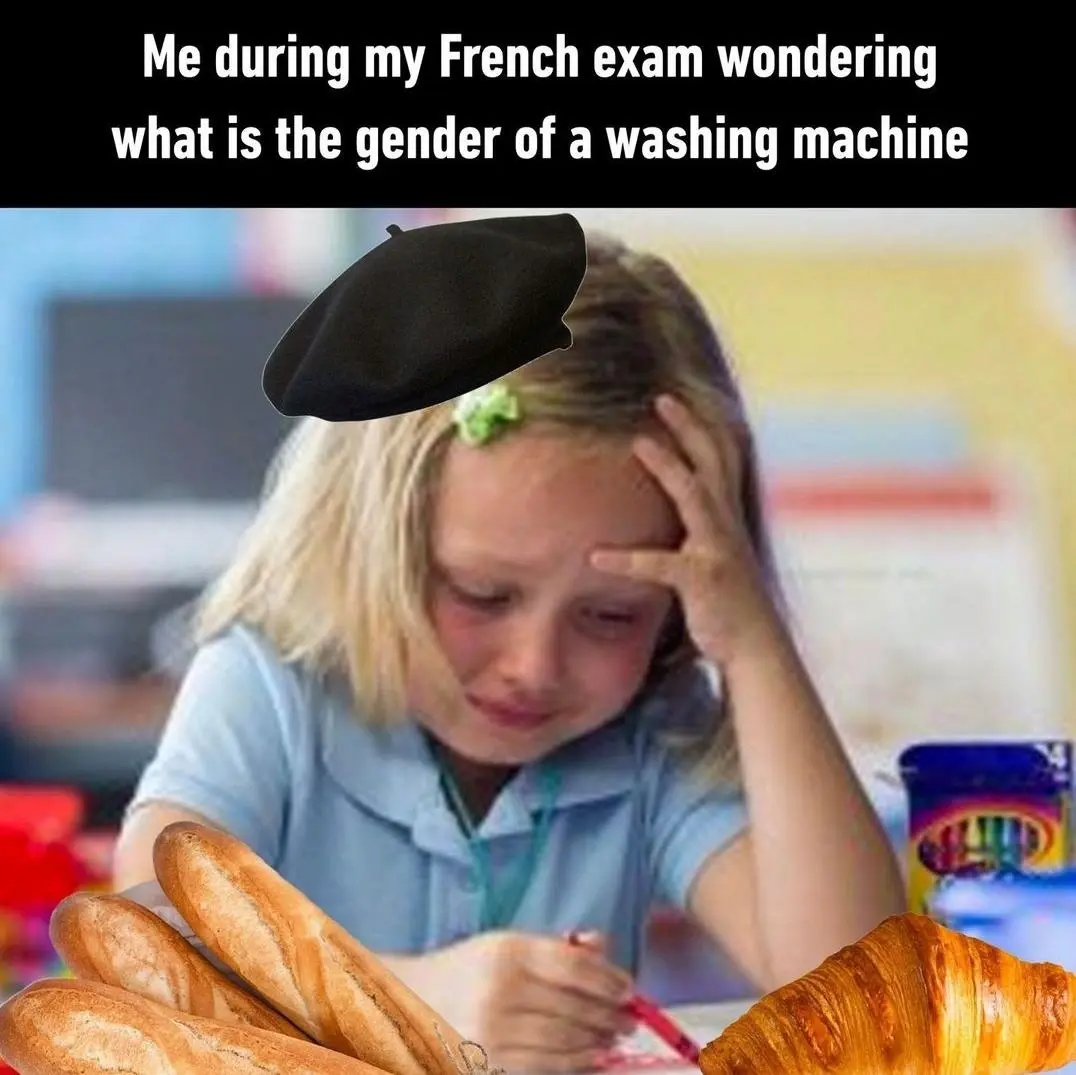
Alles voll logisch, stimmt. Ich geh' dann mal das Waschmaschine befüllen 👌
Are there words in German ending in -e that are not female?
Der Riese
Der Junge
Der Bote
Das Gebirge
Das Gelände
Das Ende
Thanks.
The girl one was always funny to me. "The girl ran to its mother."
doesn't work at all, completely breaks down for the planetoids and moons...
which makes sense, since those names are not german, which is why german grammar doesn't apply to them.
latin loanwords work the same way in german as they do in latin: completely at random and just have to be memorized...but at least they do follow the gender of the deity, so if you know your greco-roman pantheon it's pretty easy!
edit: also a very weird example, with a weird rule about ending in "e"; venus and earth (erde) are the only female planets...
Still mostly only good as a guessing guideline because there's no real system, just etymological patterns, but yea you can guess more than 33% for sure.
It's not perfect, no, but I feel like you can identify feminine words based on their endings alone in 90% of cases, and if you can use a few general rules to make masculine/neuter better than a 50-50 guess, you're already right more often than you're wrong. Maybe even 75% with no rote menorization whatsoever
Edit: I actually just read masculine is about 2x as common as other genders, so always guessing masculine should take you to 50% alone
There are some rules. Some of them are easy. One word ending is always feminine. I don't remember which tho. which is a shame :/
-ung is always feminin (among others like -keit) and mostly -e but the exceptions are enough that you can’t relax.