DigitalAudio

joined 2 years ago
MODERATOR OF
[–] DigitalAudio@sopuli.xyz 1 points 3 months ago* (last edited 3 months ago)

Exactly. Where I live the button just reads "PUSH TO WALK"

[–] DigitalAudio@sopuli.xyz 3 points 3 months ago* (last edited 3 months ago) (1 children)

Cyborganismさん。

JapaneseLanguageへようこそ!よろしくおねがいします。

日本語は たのしいですよ。私は 10年間 べんきょうしています。でもまだ たのしいです!がんばってください。

日本に ひっこし(move)ますか?りょこう(travel)しますか?どうぞ 日本を たのしんでください!

あと 一つの こと:

「たすけが ひつようです」は OKですが、「みなさんの きょうりょく(assistance)を おねがいします」はパーフェクトです!

[–] DigitalAudio@sopuli.xyz 0 points 3 months ago

I mean, fair enough, but also, we really shouldn't be making it even entertaining new definitions for words based on online ragebait.

[–] DigitalAudio@sopuli.xyz 0 points 3 months ago (3 children)

Not at all. Incels are almost overwhelmingly misogynistic and into a lot of weird pseudo scientific shit. Incels are those claiming they deserve women but at the same time don't deserve them because they're too beta and all the rich alphas are getting 10 chicks a second, so they excuse their lack of success with dating in a lot of made up bullshit to delude themselves into never improving as people.

Incels are not just virgins, they're basically a cult, and thinking people use it just as 'virgin' is either deliberately obtuse or ignorant

[–] DigitalAudio@sopuli.xyz 14 points 4 months ago

Not to mention there are nice beaches on every continent, so they're much less of an incentive for any non-European tourists. Of course, I doubt non-Europeans are the majority, but still very significant.

In the Americas you have the Caribbean, in Asia you have Bali and Thailand, and even within Europe you have Mallorca, Ibiza and other options.

Meanwhile, only in Italy do you have the Colosseum and all of that famous stuff

[–] DigitalAudio@sopuli.xyz 3 points 4 months ago (2 children)

Interestingly enough, I love fictional movies, TV shows and comics/graphic novels/manga. It's just with books where I get bored extremely easily if I don't feel like there's a tangible connection with the real world.

I guess I approach books with a "time to learn" mindset, and not necessarily as sources of entertainment. Even though I very much enjoy learning about history, and find it entertaining.

I read a lot, too, just not much fiction. If you look at my Kindle library, I have bought like 50 books since I got it, around 10 are fiction, and all are about 30-40% through, none are finished. The remaining 40 are either history books or textbooks for my other hobbies. I have only dropped 2 of them.

I have a handful of fictional books that I have finished and thoroughly enjoyed: Hundred Years of Solitude by Garcia Marquez, Musashi by Eiji Yoshikawa, the Harry Potter Series (when I was younger), the Feast of the Goat by Vargas Llosa and the Woman in the Dunes by Kobo Abe.

[–] DigitalAudio@sopuli.xyz 11 points 4 months ago (4 children)

That has been me in the past. Not to my wife, but as a younger person, I only read history books and stuff (still do) and felt superior because I did that (I don't do that anymore of course), so I would sneer at my friends' fiction and stuff because it was "worthless" compared to "real history" where you "actually learned stuff".

It's a dumb mindset, and I definitely don't feel like that anymore. I still don't read fiction or enjoy it, but it's just a hobby like any other, or like my thing with history.

[–] DigitalAudio@sopuli.xyz 7 points 4 months ago* (last edited 4 months ago)

That is me. I have a poor sense of color and have needed to be restrained in the past.

Jokes on my wife though because her sense of pitch is shaky, while I sure can sing.

Then again, she's an artist and I'm a musician. She has taught me how to avoid the really bad combinations and some theory of color while I have taught her to stay on pitch when there's a background voice doing something else.

[–] DigitalAudio@sopuli.xyz 12 points 4 months ago

The funniest part is that based on what people are saying or GPT5, the ending where AIs get super bored of humans' stupidity and dump them seems so likely

[–] DigitalAudio@sopuli.xyz 2 points 4 months ago

I think they're in a tight spot. With South Park plots, usually there's a neat bow to tie it all up. And when they do social commentary or political criticism (except for that one bad season), they can just mock whoever it is and go back to normal life at the end. But since the current state of the US is pretty exceptional, and it seems to be in free fall, there is no real way to end political episodes. The people they're mocking can't be portrayed to change, grow, die or become irrelevant, so there's only so much they can do.

[–] DigitalAudio@sopuli.xyz 8 points 4 months ago

Damn, imagine the levels of segregation, speciesm and genocide we would see if other human species had thrived and grown like us.


This is one of my all time favourite tracks. It's just brilliant.


I've found that any time I'm interested in a game, looking up let's plays in Japanese has helped me make a lot of connections between the game's contents and Japanese vocabulary.

I'm linking a good example of that with Metroid Dread, which is a game I played last year and I spend a few weeks watching let's plays and reading online content about it in Japanese, mostly because I loved the game, but I also thought that doing so might be a good exercise for intermediate learners as well.

The key to searching for a let's play is to just enter the Japanese name of the game (for example: バイオハザード4 or ダークソウル3)and then adding 実況 which is the keyword here. Any popular game followed by 実況 is likely to yield tons of results, so give it a try if you're into games, and you may learn a lot of vocabulary from it!


Hello everyone, and welcome to our (kind of) daily JLPT thread! I'm sorry I couldn't post one of these for the past week. I was busy with work and couldn't get the time to prepare an entire review of a new structure. I'm back and hopefully will be posting these more regularly again. With that said, let's get started!

本日の文法:JLPTN3の「~(という)わけではない」

~わけではない Is a pretty common expression that you're going to find in a lot of media such as anime, manga, manzai and dramas. It's also used in everyday conversation, though, so you will get a lot of mileage out of this one.

For the most part, its meaning is close to "it's not like..." or "...doesn't mean that...", so basically, it's an expression for a partial negation of a statement. You'd use it when you don't want to fully deny something, but still want to point out that something isn't quite correct.

So a few example sentences would be

お金があるから、必ず幸せにるというわけではない。"Having money doesn't necessarily mean you will be happy."

成績が良かったから、他の生徒に教えるのが得意なわけではない。"Having good grades doesn't mean you will be good at teaching other students"

So right now there are a few additional things you may be wondering:

First of all, what is という in this instance, and why is it optional? Is it really always optional or does it have a more nuanced use most of the time?

Generally speaking, where you can use a simple わけではない, you can also use a というわけではない. They're grammatically equivalent in that sense. However, they do have a very slightly different meaning, where という gives the impression that you're taking a less opinionated and more objective approach to the conversation. You would use というわけではない when you perhaps want to make a general statement. Looking at our first example sentence, you will notice that we're talking about a general perspective "money doesn't mean happiness in general", and as such, it doesn't feel like you're talking about anyone in particular, and you're just making a statement. But for our second sentence, you may notice the situation is most likely referring to a successful student that has decided to teach the rest of his class, and is probably not great at it. In this case, leaving out という makes the comment slightly harsher, almost like a criticism to a specific person in question.

So do keep those differences in mind.

Also, it's important to point out that わけではない is a rather stiff way to use this expression, and you may want to use わけではありません in formal contexts, or わけじゃない in more casual contexts. わけではない sounds a bit academic, kind of like the one speaking is a figure of authority. The type of speech you would find in textbooks, newspapers, academic research and similar scenarios.

Some examples for different settings would be

この道まっすぐ行ったら、すぐに図書館に到着するというわけではありません。その前、公園も渡らなければなりません。"You will not reach the library immediately if you walk straight down this road. You have to cross the park first as well."

いや、別に俺の妹が天才なわけじゃないけど、結構頭がいいし、頑張れる人間だから。"Nah, it's not like my sister is a genius or anything, but she's pretty smart, and she works hard."

The first example could be someone giving directions to another person, presumably a complete stranger. In this scenario, using full-on 敬語 would probably be overkill, but using a more informal form would come off as rude. This is why a polite form like this one might work.

The second example is far more informal, but you will also encounter a lot of this in every day life. I've personally found myself speaking to many of my co-workers like this in the office. Definitely not to my boss or other superiors, though, so watch out for that.

I think that will be all for today! Hope everyone is having a nice day, getting ready for JLPT in only 12 days!


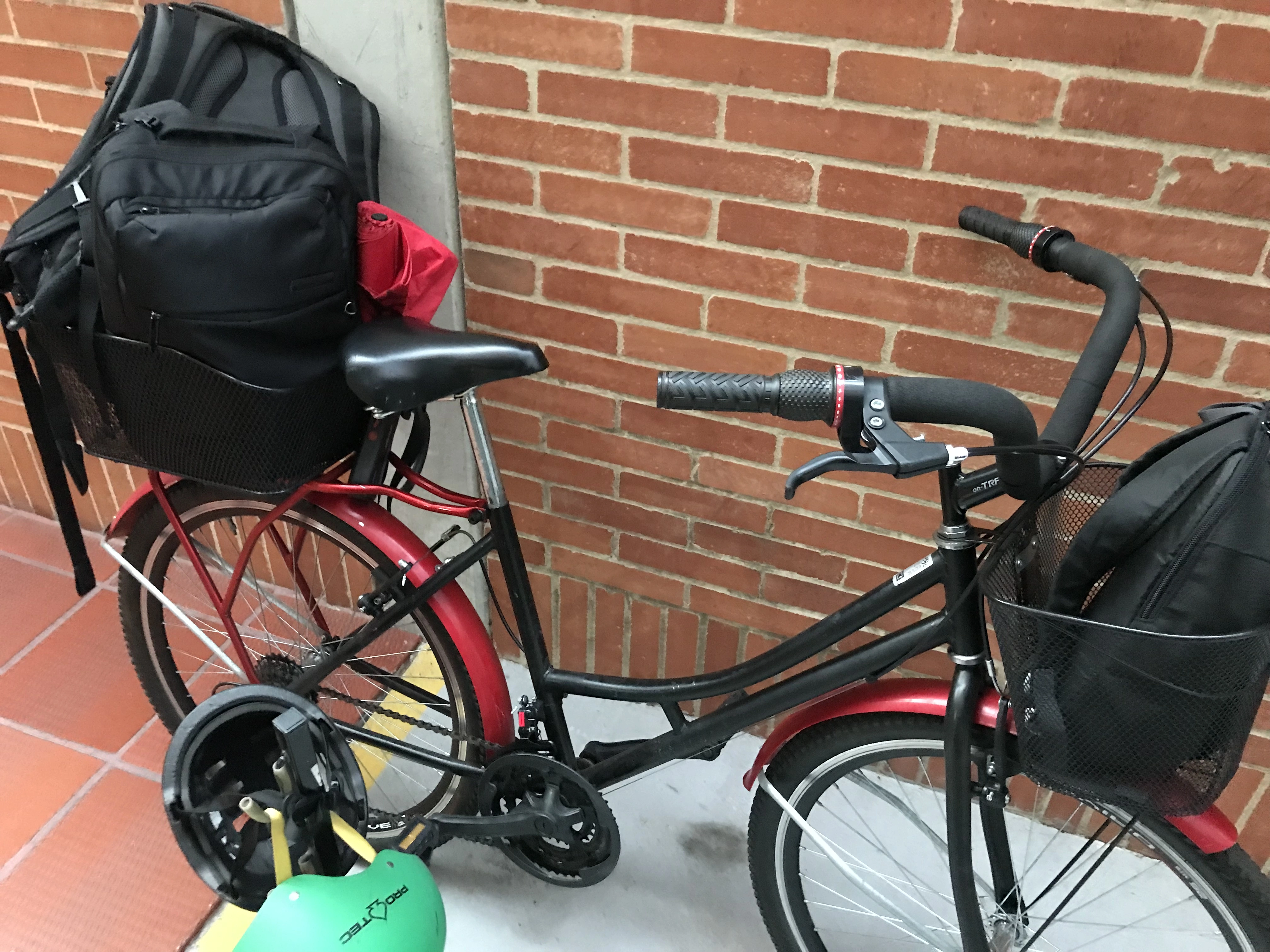
I sort of created a system where the tiny bag in the front will contain my personal stuff like phone charger, water bottle, wallet, earphones, etc.

The first bag in the back contains the tech stuff like laptop, audio interface, and microphones (if any), and the larger bag contains the heavy lifting stuff like the cables, smaller table mic stands I can fit inside it, duct tape, scissors, AC/DC adapters and so on.

Last time I did 20km each way on it, and although I got home pretty tired, it also felt super rewarding as well.
 

Hello everyone, I realised we don’t really have an introductory or meta thread for this community, and I thought it might be wise to create one.

So first of all, you might be wondering what japaneselanguage’s particular scope is and how it might be different from other Japanese communities in other instances.

Generally, I don’t like to think that we will be competing with other instances, but rather that we will be filling a niche for people that might be interested in discussing the language itself rather than it’s study methods. This community isn’t going to be a place to discuss the speedrunning or the efficiency of learning Japanese as there are other communities dedicated to those subjects.

Instead, this will be a place where we can discuss how the Japanese language works, it’s phonetics, it’s writing system, calligraphy and other related topics, our handwriting, as well as all other sorts of topics.

Learning materials, media, and literary discussion are very much welcome and encouraged! The only subject that will be discouraged (though not downright banned) is discussion of study methods exclusively without also including discussion about the language itself. So threads in the style of “how I learned 1,000 Japanese sentences over a three-week period” and similar threads focusing more on the methods than the language will probably belong in more specific communities.

Thank you very much for browsing this community and I hope we will be able to build a fun space for all of us who love Japanese.


Hello everyone, and welcome to our daily JLPT thread! The July tests are coming up quickly, so I thought we could have a daily thread where we discuss questions, or talk about what we've been practicing. In this thread I will also be sharing one graded grammatical structure every day, so feel free to use it for your own reference.

本日の文法:JLPTN1の「~極(きわ)まりない」

~きわまりない Is a very interesting structure that could translate to "extremely" or "as can be".

A few example sentences for this could be

図書館で大声を出して騒ぐなんて、迷惑きわまりない。 "Speaking loudly and making a ruckus at a library is as annoying as it gets"

昨日、彼の態度は失礼きわまりない "His attitude yesterday was extremely rude"

This structure could be considered relatively similar in meaning to 「非常に」 though naturally the way it's built is different. In this case you mostly just attach it to a noun. That makes it relatively easy to use! Remember that this is a relatively literary or formal structure, so you probably won't be hearing it too much when speaking casually or colloquially.

Hope everybody has a very nice day studying for your upcoming test!

view more: ‹ prev next ›