It's cool, but upside down.
Water flows downhill to the ocean. ;)
1. Defining a Guide Guides are comprehensive reference materials, how-tos, or comparison tables. A guide must be well-organized both in content and layout. Information should be easily accessible without unnecessary navigation. Guides can include flowcharts, step-by-step instructions, or visual references that compare different elements side by side.
2. Infographic Guidelines Infographics are permitted if they are educational and informative. They should aim to convey complex information visually and clearly. However, infographics that primarily serve as visual essays without structured guidance will be subject to removal.
3. Grey Area Moderators may use discretion when deciding to remove posts. If in doubt, message us or use downvotes for content you find inappropriate.
4. Source Attribution If you know the original source of a guide, share it in the comments to credit the creators.
5. Diverse Content To keep our community engaging, avoid saturating the feed with similar topics. Excessive posts on a single topic may be moderated to maintain diversity.
6. Verify in Comments Always check the comments for additional insights or corrections. Moderators rely on community expertise for accuracy.
Direct Image Links Only Only direct links to .png, .jpg, and .jpeg image formats are permitted.
Educational Infographics Only Infographics must aim to educate and inform with structured content. Purely narrative or non-informative infographics may be removed.
Serious Guides Only Nonserious or comedy-based guides will be removed.
No Harmful Content Guides promoting dangerous or harmful activities/materials will be removed. This includes content intended to cause harm to others.
By following these rules, we can maintain a diverse and informative community. If you have any questions or concerns, feel free to reach out to the moderators. Thank you for contributing responsibly!
It's cool, but upside down.
Water flows downhill to the ocean. ;)
What's the difference between groundwater, and water in soil?
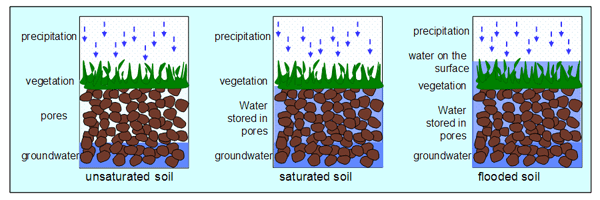
Water in soil = water in the pores of the soil
Groundwater = water below the water table
I am guessing that water in soil is the water contained in the upper layers of soil and dirt while groundwater is used for water reserves far under the ground much below the soil layers and even below the rock layers
What an oddly difficult guide to read
I like it. Feels intuitive to me.
It's terrible. It's missing an explanation for what the outflow part from "groundwater" is.
It isn't showing an outflow from the groundwater slice, each circle is an expanded view of the small slice in the circle above. The only thing missing is the percentage of the small slice in the circle where it begins. The soil, atmosphere, and organism water are not falling under groundwater, they are just much smaller slices of the freshwater circle.
If you want to make it much easier to read, separate saltwater and freshwater, and change the bottom charts percentages from 52% and 38% to 0.52% and 0.38%.
"Surface water," presumably.
That doesn't make sense. Water in living organisms, water vapour in the air and in the soil are not surface water.
This chart is truly terrible throughout.
I don't find it difficult to read. Most of the freshwater consists of groundwater and ice; the rest is made up of what's shown in the circle at the bottom.
It wouldn't have been hard to just include those last three percentages.
I'll give you that. No more wheels, but value labels for those would have been good.
So organisms have just as much water as rivers? That seems surprising, but I guess it could be that way.
Thinking the same thing. But now that I think about it, there is a lot of vegetation that would take up the majority of that share. Think about all the streama and rivers, then think about all the vegetation that surrounds and how easy it would be to fill those rivers with it. But still that's a lot of water.
50% of a tree is apparently water, which seems like a lot.
It's the other 60% you have to worry about
Could just be that whatever was used to create the diagram has a minimum slice size and anything below that just gets rounded up. Without labels for the size of each slice it's impossible to tell.
Would be nice if they included a source for this data. Then it would not be impossible to tell.
Just eyeballing it the organisms looks maybe 2/3rds the size of rivers?
Further splitting the water in lakes:
Lake Baikal is the world's largest freshwater lake by volume, containing 23,615.39 km3 (5,670 cu mi) of water or 22–23% of the world's fresh surface water
I wonder how the amount of ground water has changed over the last ~100 years. Has pumped ground water raised the oceans a measurable amount?
Alternate title: Nestle water monetization percentages
Climate change looks more frightening now.
Yep, melting ice will cause sea level rise, and millions live in the coastal cities that will be affected.
Thanks to this graphic, I have a hard time understanding how ~2% more water from glaciers will flood the planet
Living next to the great lakes, it never really hit me how unbelievably privileged I am to be able to swim in large bodies of freshwater until a few years ago. This chart definitely reinforces that.
And what share controls Nestle?
any plans to save freshwater that is getting lost by melting glaciers?
Nestle can probably monetize in the future, so I'm sure they're working on it.
oh man, I don‘t want to give anyone ideas