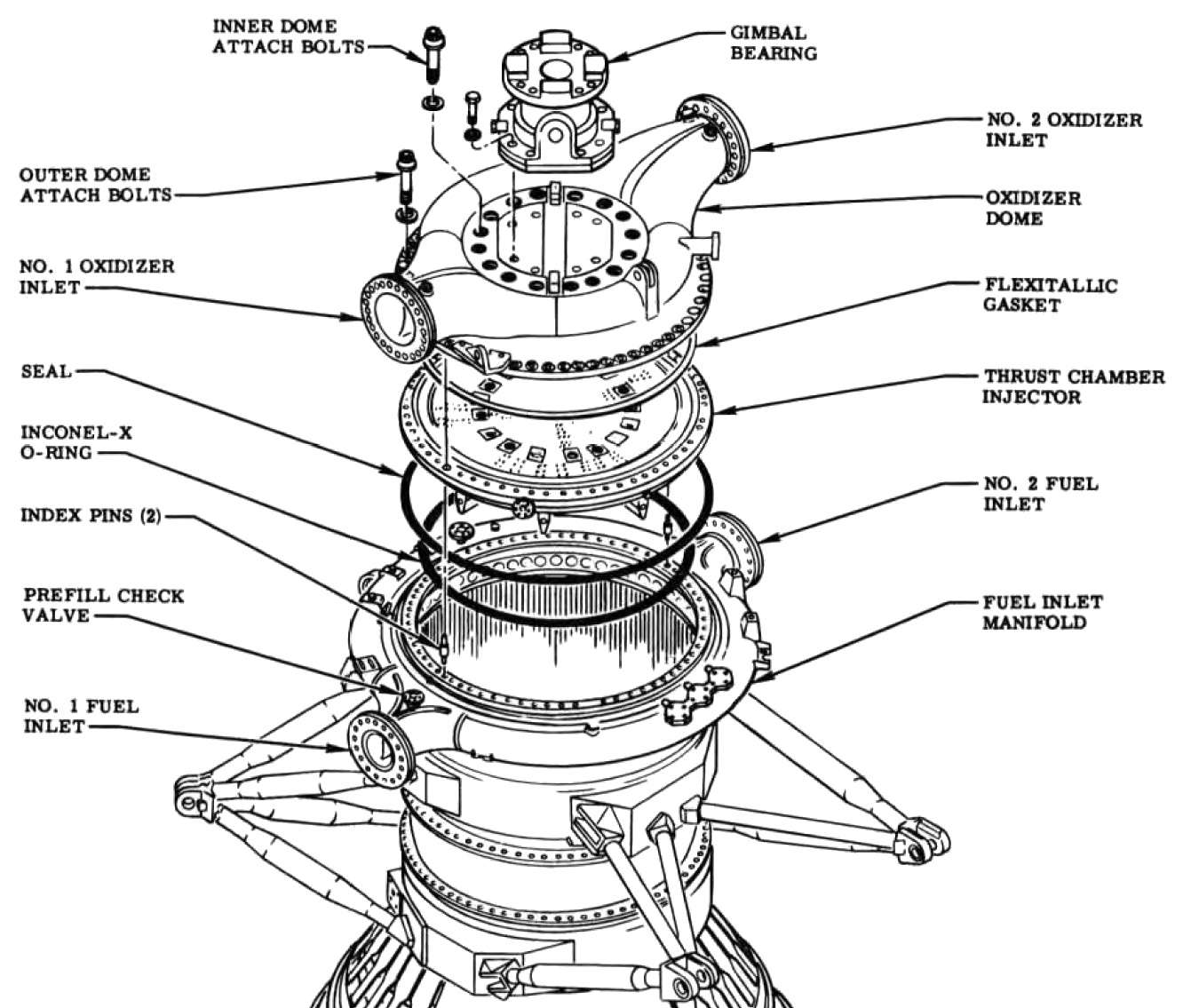
If this thing was in the ON position, you would be very warm right now.
Also, if I remember correctly, the smaller holes are fuel and bigger holes are oxidizer.
And for those wondering what any of this means. The more surface area of your fuel, the better the combustion. So the fuel is sprayed out of these holes with the oxidizer and that's what burns. But these holes aren't like a shower head, the flow doesn't come straight out because then you would have streams of fuel and oxidizer in parallel flows dropping into the giant fireball below and it would be highly reliant on that fireball's turbulence to do the actual mixing.
Instead the pair of holes are kind of angled at each other. So that their streams that they spray form a V. This causes the fuel or oxidizer to start spraying, which increases surface area, which increases combustion. They played with all kinds of designs with these, because maximizing the combustion is critical to getting as much energy out of the burn as possible.
So that's why you see a pair of holes all the way around. They shoot fuel or oxidizer at the other fuel or oxidizer coming out of the other hole of the pair. And the arrangement, size of hole, angle of the hole, etc, were all characteristics that were basically the secret sauce of rockets back then. This arrangement is a like pair impingement injector. That is, there is a pair, they shoot the same thing out each hole (like), and the holes are angled to form that V I talked about (impingement). Unlike pair, and unlike triplets were also other types of designs. Unlike pairs are a bit more complex because the oxidizer (dinitrogen tetroxide) has a bit more mass than the fuel (Aerozine-50), so the spray from the two jets hitting each other would cause the atomized molecules head off in an angle biased AWAY from the thing with more mass' hole. So you compensate by changing the angle of one of the jets by an amount that would put the spray to atomize evenly.
More complex designs also had to start adding baffle plates to reduce fuel sloshing. The baffles break up the waves of force pushing the fuel out of the intended direction. There's also pogo oscillation where the wave of force pushing the fuel begins to hit a frequency that matches the fuel's natural slosh frequency. This would lead to a feed back loop that if unchecked would begin producing pressure waves into the rocket's structure that can start to match the resonant frequency of the material used to build the rocket.
The rocket is flying up, fuel and oxidizer is flowing down. So the fireball moves down as the speed of the rocket moves up, the rocket is starting to leave where the fireball was at. But that allows more mixing (since the fireball and the fuel source are further away) causing stronger combustion, causing the fireball to slowly move back up into the rocket because now the fireball has more power. This pushes the rocket faster causing it to get away from the fireball, rinse and repeat. That up and down motion (longitudinal) is where these waves of force are coming from.
And all of this is why solid rockets became way more popular. There's way less of these things to consider in a solid rocket design.
 . The injector is roughly where the skirt meets the metal tub looking thing.